

Your Google Maps ranking is not just about where your business is located. Many Central Texas business owners assume that being close to a customer or having a handful of good reviews is enough to land in the top results. The reality is more layered than that. Google Maps ranking depends on business information accuracy, relevance, and prominence working together. Get any one of those wrong and you can lose ground to a competitor across town. This guide breaks down exactly what ranking means, what drives it, and the specific steps you can take to climb higher on Google Maps.
Table of Contents
- What does Google Maps ranking mean?
- The factors that influence Google Maps ranking
- Common misconceptions about Google Maps ranking
- Actionable steps to improve your Google Maps ranking
- A smarter approach to Google Maps ranking: What most guides miss
- How YourLocalSEO can help improve your Google Maps ranking
- Frequently asked questions
Key Takeaways
| Point | Details |
|---|---|
| Ranking factors explained | Google Maps ranking depends on relevance, distance, and prominence—not just reviews or location. |
| Optimize to improve | You can influence your business’s rank by updating info, managing reviews, and staying active. |
| Action brings results | Regular updates and engagement can boost local visibility and customer actions within weeks. |
| Myth-busting matters | Understanding common misconceptions helps you avoid wasted effort and focus on what works. |
What does Google Maps ranking mean?
When someone in Austin or Pflugerville searches for "nail salon near me" or "best tacos in Round Rock," Google returns a set of local results. The top three businesses that appear in that boxed section are called the local map pack or the 3-pack. Getting into that 3-pack is one of the most valuable positions your business can hold online.
Your Google Maps ranking is simply your position in those local results. Rank first and you get seen first. Rank tenth and most searchers never find you at all. It is that direct.
Here is why it matters so much for Central Texas businesses:
- More visibility means more phone calls, website clicks, and walk-in customers
- Businesses in the top 3 positions capture nearly 70% of all local search traffic
- A higher rank builds credibility, because searchers trust Google's top results
- Competitors ranking above you are actively taking customers you could be serving
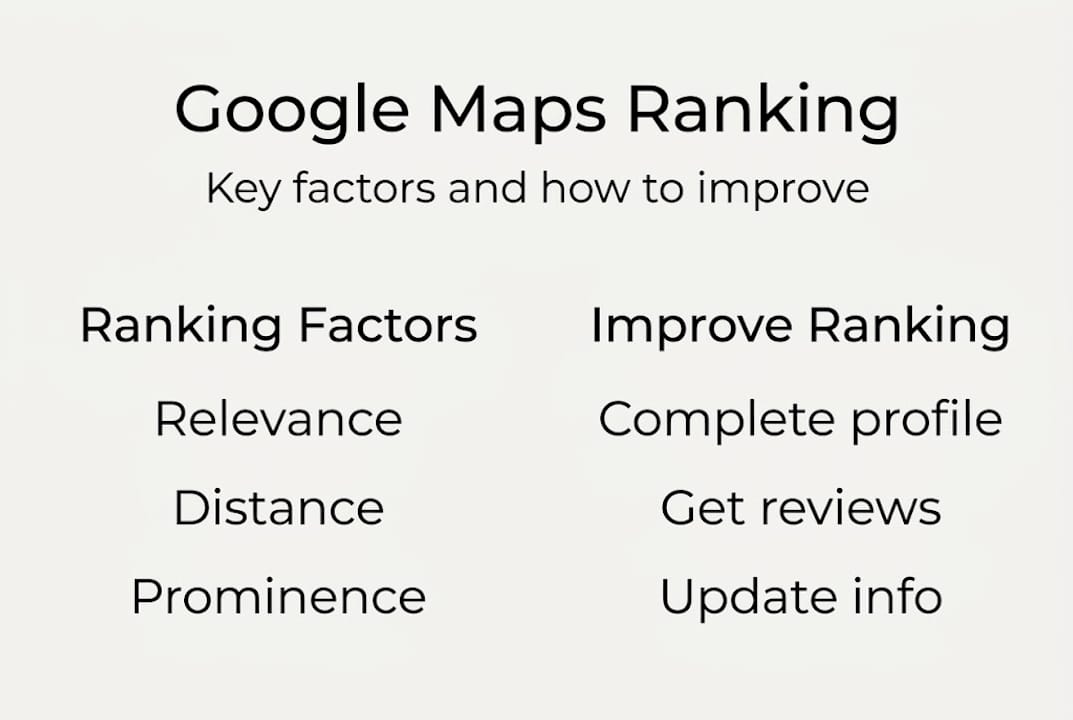
Google uses three core signals to determine where your business lands:
"Relevance, distance, and prominence help determine Maps rankings." — Google
Relevance measures how well your business profile matches what someone searched for. Distance considers how far your business is from the searcher or the location they specified. Prominence reflects how well known and reputable your business is, based on reviews, links, and mentions across the web.
None of these three signals works in isolation. A business with great reviews but an incomplete profile can still rank lower than a competitor with fewer reviews but perfectly optimized information. Our local SEO guide goes deeper into how these signals interact and what you can do about each one.
Understanding this three-factor model is the foundation. Once you see ranking as a system rather than a lottery, you realize there are real levers you can pull.
The factors that influence Google Maps ranking
Understanding these core concepts sets the stage for examining what actually impacts your specific ranking. Let's break each factor down and look at what you can do to strengthen it.
| Factor | What it means | How to improve it |
|---|---|---|
| Relevance | How closely your profile matches the search | Complete every profile field, add accurate categories, list all services |
| Distance | Proximity of your business to the searcher | Cannot change your address, but strong other signals offset distance |
| Prominence | Your reputation and authority online | Earn reviews, build citations, get local backlinks |
Business info accuracy, reviews, and local backlinks are significant ranking signals that Google weighs when deciding who shows up first. Ignoring any of these is leaving ranking potential on the table.
Here are three simple actions any owner can start today:
- Audit your Google Business Profile for missing or outdated information, including hours, phone number, and website URL
- Add or update your business categories to match the services you actually provide, not just a broad label
- Ask your last five satisfied customers to leave a Google review this week
Prominence is often the most misunderstood factor. It is not just about how many reviews you have. It includes how often your business name, address, and phone number appear consistently across directories and local websites. These consistent mentions are called citations, and they signal to Google that your business is legitimate and established.
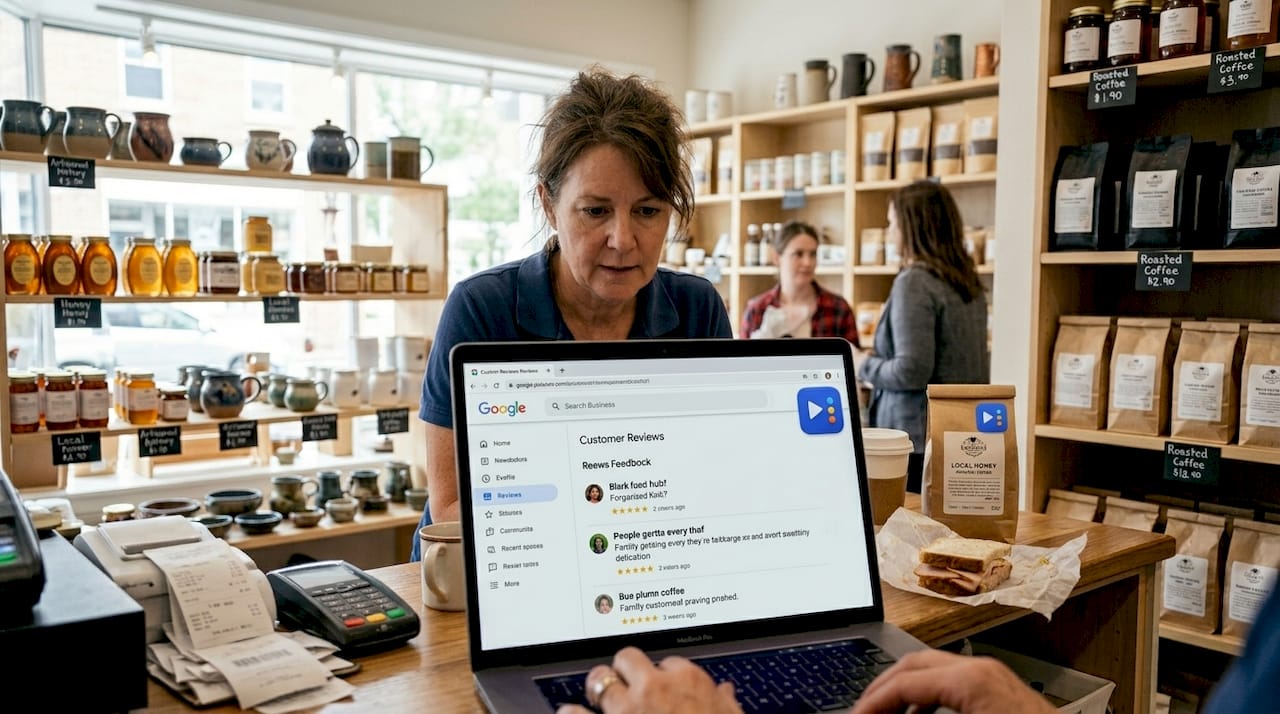
Pro Tip: Consistently respond to reviews, including negative ones. Google sees active engagement on your profile as a signal of a real, attentive business. A thoughtful reply to a 2-star review can actually help your prominence more than ignoring five 5-star reviews. You can find more quick wins in our local SEO tricks resource.
Your website also plays a role. A well-structured site with location-specific pages sends relevance signals back to your Maps listing. Our website design tips outline how your site and your Google Business Profile work together to reinforce your local authority.
Common misconceptions about Google Maps ranking
With the facts and myths clarified, it is time to focus on what you can do right now. But first, let's clear out the misinformation that holds so many local business owners back.
Here are the top three myths we hear most often, along with the truth:
- Myth: Your physical location is the only thing that matters. Many believe proximity is the only factor, but info and reviews matter just as much. A business in Cedar Park can outrank one in downtown Austin if its profile is more complete and its prominence is stronger.
- Myth: More reviews automatically mean a higher rank. Review quantity helps, but review quality, recency, and your response rate all factor in. Ten recent, detailed reviews often outperform fifty old, generic ones.
- Myth: You can set up your Google Business Profile once and leave it alone. Google rewards active profiles. Businesses that regularly post updates, add photos, and keep their hours current tend to rank above those that have not touched their profile in months.
Pro Tip: Update your profile photos at least once a month and confirm your hours before every major holiday. These small actions signal to Google that your business is active, which directly supports your ranking.
We see these myths play out constantly with businesses across Pflugerville and Austin. A restaurant owner assumes their great food and loyal customers will carry their ranking. A nail salon assumes their 80 reviews are enough. Neither is true without ongoing attention to the full picture.
The good news is that once you stop believing these myths, you free up your energy to focus on what actually works.
Actionable steps to improve your Google Maps ranking
Fighting misinformation is one part. Now, let's lay out a hands-on roadmap to real ranking improvement. These steps are ordered by impact, so start at the top.
- Claim and verify your Google Business Profile if you have not already. An unverified profile cannot rank competitively.
- Complete every section of your profile. This means services, business description, hours, website, phone number, and at least 10 photos.
- Choose the right primary and secondary categories. This is one of the most powerful relevance signals you control.
- Build consistent citations across directories like Yelp, Apple Maps, and local Chamber of Commerce listings.
- Ask for reviews actively. Send a follow-up text or email after every completed job or visit.
- Post weekly Google Business Profile updates with offers, events, or helpful tips.
- Respond to every review within 48 hours to show engagement.
Accurate info, fresh content, and regular reviews are the core of what Google looks for when ranking local businesses.
| Profile element | Before optimization | After optimization |
|---|---|---|
| Profile completeness | 40% filled out | 100% filled out |
| Photo count | 2 photos | 15+ photos |
| Review response rate | 0% | 90%+ |
| Weekly posts | None | 1 per week |
| Estimated visibility increase | Baseline | Up to 3x more profile views |
For a deeper look at how these steps compound over time, our in-depth local SEO strategies page walks through advanced tactics. You can also see real-world results from businesses we have worked with across Central Texas. If you are in the Hutto area, our Hutto SEO services page covers location-specific strategies.
A smarter approach to Google Maps ranking: What most guides miss
We work in local SEO every day across Pflugerville, Austin, Round Rock, and the surrounding communities. And the pattern we see most often is this: business owners focus intensely on reviews or worry about their address, while completely ignoring the relevance signals that Google actually weighs heavily.
Your business category selection is one of the most underused ranking levers available. Most owners pick one broad category and move on. The reality is that selecting precise primary and secondary categories, aligned with the exact searches your customers use, can move your ranking faster than getting 20 new reviews.
Posting regular updates to your Google Business Profile is another overlooked signal. Think of it like this: Google wants to send searchers to businesses that are open, active, and engaged. A profile with fresh posts tells Google your business is alive and worth recommending.
The businesses we see climb fastest are not the ones with the most reviews. They are the ones treating their Google Business Profile like a living part of their marketing, not a one-time setup task.
Earning even one or two credible local links, from a Pflugerville business association, a local news feature, or a community event page, can push your prominence score in ways that dozens of directory citations cannot match. Our Google Maps tips cover exactly how to pursue these opportunities without needing a big budget.
How YourLocalSEO can help improve your Google Maps ranking
If you would like expert help fine-tuning your profile and boosting your rank, here is how ourLocalSEO can support you.

We are a Pflugerville-based local SEO agency that works hands-on with small businesses across Central Texas every day. From full Google Business Profile optimization to citation building and review generation, we handle the details so you can focus on running your business. Our Pflugerville SEO experts team has helped nail salons, restaurants, med spas, and service businesses climb the Maps rankings and drive real foot traffic. Start with our comprehensive local SEO guide or check out our SEO ranking tricks for quick wins you can apply today. Ready to get started? Reach out and let's build a strategy around your location.
Frequently asked questions
What is Google Maps ranking?
It is the position where your business appears in local search results on Google Maps, determined by relevance, distance, and prominence working together as a combined signal.
How long does it take to improve my Google Maps ranking?
Most businesses see noticeable changes within a few weeks of proper optimization, though consistent long-term effort is what locks in lasting results.
Are reviews the most important factor in Google Maps ranking?
Reviews matter, but ranking also depends on complete business info, accurate categories, and local links, so no single factor dominates on its own.
Can I pay Google to rank higher on Maps?
No. Google does not accept payment for higher organic Maps rankings. Only Google Ads placements can be purchased, and those appear separately from organic results.