
Your homepage is working for you around the clock, whether you've optimized it or not. For nail salons and med spas in Central Texas, that page is often the difference between a potential client booking an appointment and scrolling past to a competitor. Most small business owners assume homepage SEO is something only big brands worry about. That assumption costs real money. When someone in Round Rock searches "nail salon near me" or a resident in Georgetown looks for a med spa, Google evaluates your homepage in seconds. The signals it finds, or doesn't find, determine whether you show up. Here's how to make sure you show up.
Table of Contents
- Why homepage SEO matters for local business success
- Essential homepage SEO elements for Central Texas businesses
- Avoiding SEO pitfalls: User intent, dwell time, and AI snippets
- Applying homepage SEO for ongoing business growth
- Why most local businesses underestimate homepage SEO
- Take your homepage SEO to the next level
- Frequently asked questions
Key Takeaways
| Point | Details |
|---|---|
| Homepage SEO impacts visibility | Your homepage is the foundation for appearing in local searches, especially for service-based businesses. |
| Local keywords and NAP matter | Consistent use of local keywords and clear business information help search engines connect you to local customers. |
| Avoid keyword stuffing | Focusing on user intent and valuable content leads to better engagement and search rankings. |
| Maintain and update | Regularly refresh homepage elements and monitor metrics to sustain SEO results and business growth. |
Why homepage SEO matters for local business success
Building on the introduction, let's define exactly why homepage SEO is more critical than most small business owners realize.
Your homepage is not just a welcome mat. It is the single most authoritative page on your entire website. Search engines treat it as your primary on-page SEO asset, and as HubSpot's step-by-step guide on on-page optimization confirms, the homepage serves as a primary SEO asset for local businesses. That means the signals Google reads on your homepage carry more weight than any other page on your site.
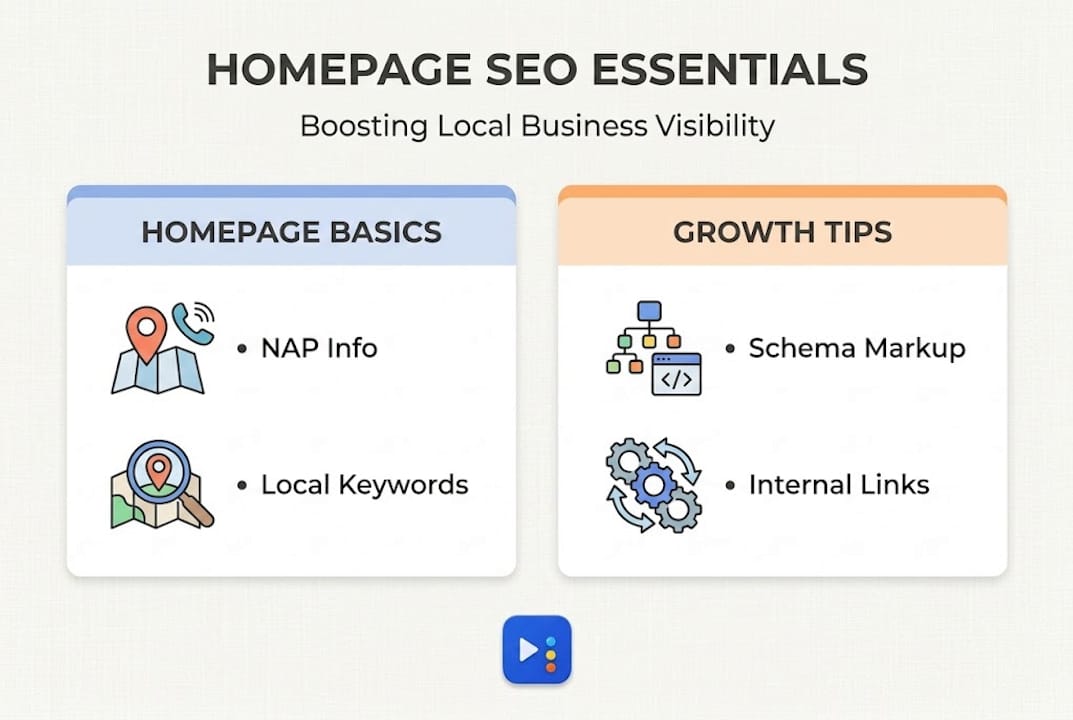
For a nail salon in Pflugerville or a med spa in Cedar Park, this matters enormously. When a potential customer searches for services in your area, Google is already scanning your homepage for specific trust signals before it considers showing your business. Those signals include your NAP (Name, Address, and Phone number), your local keywords, and structured data called LocalBusiness schema markup, which is code that tells search engines exactly what your business is and where it operates.
"Your homepage is not just a branding tool. It is your strongest SEO signal to Google, and for local businesses, it can be the deciding factor between ranking and disappearing."
Here's a comparison that clarifies why your homepage deserves more attention than your other pages:
| Feature | Homepage SEO | Service page SEO |
|---|---|---|
| Domain authority impact | High | Moderate |
| Local keyword targeting | Broad (city + service) | Specific (single service) |
| NAP visibility | Essential | Optional |
| Schema markup priority | LocalBusiness schema | Service schema |
| First impression for visitors | Yes | Rarely |
| Internal link hub | Yes | No |
| Google crawl priority | Highest | Lower |
The table above makes one thing clear. Your homepage carries more responsibility and more opportunity than any other page. Service pages are valuable, but they lean on the authority your homepage builds first.
A common misconception is that if you have a Google Business Profile set up, your homepage SEO handles itself. It doesn't. Your GBP and your homepage work together, but they are separate signals. A well-optimized GBP without a strong homepage leaves ranking potential on the table. Another misconception is that simply mentioning your city name a few times is enough to rank locally. Local SEO goes deeper than that. It includes keyword placement in headings, schema markup, NAP consistency across the web, and internal linking structure. Our Central Texas SEO guide breaks down how these elements connect for businesses in this market.
The key homepage elements that influence local search are:
- NAP: Must be consistent, accurate, and visible on the homepage
- LocalBusiness schema: Structured data that confirms your business type and location
- Local keywords: Terms like "med spa in Austin TX" or "nail salon Georgetown" woven naturally into headings and copy
- Internal links: Connecting visitors and crawlers to your core service pages
- Social proof: Reviews and testimonials that signal credibility to both users and search engines
Essential homepage SEO elements for Central Texas businesses
Now that you know why homepage SEO is vital, here's how to put the evidence-backed building blocks in place.
Incorporating NAP, LocalBusiness schema, service overviews with local keywords, and internal links signals relevance to search engines in a way that generic content simply cannot match. Each element plays a specific role. Together, they create a homepage that ranks and converts.

Here is a data-driven look at how these elements perform:
| Homepage element | Impact on local ranking | Implementation difficulty |
|---|---|---|
| NAP consistency | Very high | Low |
| LocalBusiness schema | High | Medium |
| Local keyword in H1 | High | Low |
| Internal links to service pages | Medium to high | Low |
| Before/after gallery | Medium | Medium |
| FAQ section | Medium to high | Low |
| Customer reviews/testimonials | Medium | Low |
Follow this numbered framework to build your homepage SEO from the ground up:
-
Display your NAP in a consistent format. Place your business name, full address, and phone number in your footer and ideally in the header or contact section. Use the exact same format across every online directory, your GBP, and your website. Even small differences like "St." vs. "Street" can create confusion for search engines.
-
Add LocalBusiness schema markup. This is a block of structured data you add to your site's code. It tells Google your business name, address, phone number, hours, and service area. If you use WordPress, plugins like Yoast or Rank Math can generate this automatically. If not, a developer or SEO partner can implement it directly.
-
Write a service overview with local keywords. Your homepage should summarize what you offer and where you offer it. A med spa in Austin should include a sentence like "We provide medical-grade facials, Botox, and laser treatments to clients across Austin, Round Rock, and Cedar Park." This tells Google and your visitors exactly what you do and who you serve.
-
Build internal links to your core service pages. Every service you mention on your homepage should link to a dedicated service page. This distributes authority across your site and helps search engines understand your full offering. Our website design best practices include this internal linking structure as a standard feature.
-
Add a before/after gallery. For nail salons and med spas, visual proof of results is a powerful trust signal. Galleries also increase the time visitors spend on your page, which is a positive engagement signal to Google.
-
Include an FAQ section. FAQs allow you to answer common questions using natural, question-based language that matches how people search. They also improve your chances of appearing in AI-generated answer snippets.
Pro Tip: If you serve multiple cities in Central Texas, consider a brief "Areas we serve" section on your homepage that lists locations like Pflugerville, Georgetown, Manor, and Cedar Park. This simple addition can significantly strengthen your local relevance signals. Our team applies this approach in our Georgetown SEO strategies work with clients in that area.
Avoiding SEO pitfalls: User intent, dwell time, and AI snippets
With the right elements in place, the next step is steering clear of common mistakes that can undermine your homepage SEO.
One of the most damaging mistakes a small business owner can make is keyword stuffing. This is the practice of repeating target keywords excessively throughout your homepage in hopes of ranking higher. Google's algorithm is far too sophisticated for this to work, and it actually penalizes pages that feel unnatural or spammy. Avoid keyword stuffing; focus instead on user intent with FAQs and before/afters on your homepage to boost dwell time and AI snippet eligibility.
Dwell time refers to how long a visitor stays on your page before returning to Google. A high dwell time signals to Google that your page was useful and relevant. A low dwell time tells Google the opposite. Here's what drives dwell time up or down:
Factors that boost dwell time:
- Engaging before/after galleries that visitors scroll through
- FAQ sections that answer real questions visitors have
- Video content such as a tour of your salon or a treatment walkthrough
- Clear service descriptions with benefit-focused language
- Testimonials and reviews that build trust and encourage continued reading
Factors that reduce dwell time:
- Slow page load speed (especially on mobile)
- Cluttered or confusing layouts
- Walls of text with no visual breaks
- Content that doesn't match what the visitor searched for
"Google's goal is to connect searchers with the most relevant and helpful result. Your homepage needs to convince Google, and your visitors, that you are that result."
The rise of AI-driven search features like Google's AI Overviews changes how some queries are answered. Google's AI pulls answers directly from web pages it considers authoritative and well-structured. Your FAQ section is your best opportunity to be that source. Write questions the way your clients actually ask them. "How long does a gel manicure last?" or "What is the recovery time for a chemical peel?" are examples of real questions your homepage FAQ can answer and potentially surface in AI snippets.
For Pflugerville SEO insights and broader Austin SEO strategies, we consistently see that the businesses earning AI snippet placements are the ones with clean, well-organized FAQ content on their homepages. This is not a coincidence.
Pro Tip: Keep your FAQ answers concise, between 40 and 80 words each. Google tends to favor brief, direct answers for featured snippets and AI Overviews. Long, rambling answers rarely get pulled.
Applying homepage SEO for ongoing business growth
Avoiding pitfalls sets the stage for ongoing updates and practical strategies for homepage SEO maintenance.
Homepage SEO is not a one-time project. It requires consistent attention to keep your rankings strong and your content accurate. The good news is that the ongoing work is manageable when you follow a structured routine.
A key principle to reinforce here: internal links to service pages signal relevance to search engines and help distribute the authority your homepage builds. Every time you add a new service, that service needs a dedicated page, and your homepage needs a link to it. This keeps your site architecture clean and your SEO strong.
Follow this numbered maintenance routine to stay ahead:
-
Monitor your homepage metrics monthly. Track organic traffic, average time on page (dwell time), and keyword rankings using Google Search Console and Google Analytics. Both tools are free. Look for drops in traffic or rankings as early warning signs that something needs attention.
-
Update your NAP and service overviews quarterly. If you've changed your phone number, moved to a new location, added a new service, or adjusted your hours, your homepage must reflect those changes immediately. Outdated information creates a mismatch between your site and your GBP, which can hurt local rankings.
-
Add and feature fresh testimonials regularly. Reviews and testimonials on your homepage serve double duty. They build trust with visitors and provide fresh content for search engines to crawl. Ask satisfied clients to leave Google reviews, then feature select quotes on your homepage with their permission.
-
Align your homepage with your Google Business Profile. Your GBP and homepage should tell the same story. Consistent business name, address, phone number, services, and hours across both platforms reinforce your credibility with Google. If your GBP gets updated, check your homepage too.
-
Review your internal link structure every six months. As you add new service pages, make sure your homepage links to the most important ones. Remove links to any pages you've deleted or combined. A clean internal link structure makes your site easier for Google to crawl and easier for visitors to navigate.
Statistic to note: Businesses that actively maintain their local SEO, including homepage updates, consistent NAP, and regular GBP management, see measurably better rankings over time compared to those that set it up once and forget it. Ongoing effort compounds. Our Round Rock SEO tips page covers specific tactics we use with clients in that area.
Why most local businesses underestimate homepage SEO
We've worked with nail salons and med spas across Central Texas, and one pattern shows up consistently. Business owners invest time in creating polished service pages and ignore the homepage. They assume the homepage just needs a nice design and a logo. That's a costly oversight.
The homepage is a key SEO asset, especially when it carries proper NAP and schema markup. It is not just for big brands with large marketing budgets. In fact, for a small local business competing in a specific city or neighborhood, the homepage is often the single fastest path to better rankings.
What we've learned from running real local SEO campaigns is this: small changes on the homepage, like adding a clear service overview with the city name in the heading or embedding a FAQ section, can move rankings faster than months of new blog content. The homepage is the leverage point most business owners aren't using. Our local SEO guide captures many of the frameworks we've refined through this hands-on experience.
Don't overthink it. Start with the basics. Nail those. Then build from there.
Take your homepage SEO to the next level
Understanding homepage SEO is one thing. Actually implementing it while running a busy nail salon or med spa is another challenge entirely.

At ourLocalSEO, we specialize in exactly this kind of work for Central Texas businesses. From structuring your homepage with the right local keywords and schema to building a site that converts visitors into booked appointments, we handle the technical side so you can focus on your clients. Our local SEO guidance covers the full strategy, and our homepage design expertise puts it into practice for you. Whether you're in Pflugerville, Austin, Georgetown, or Round Rock, we build solutions tailored to your location and your goals. Ready to see what a properly optimized homepage can do for your business? Let's talk.
Frequently asked questions
What is NAP and why does it matter for homepage SEO?
NAP stands for Name, Address, and Phone number, and it helps search engines verify your local business identity for better local rankings. As confirmed in HubSpot's on-page SEO guide, the homepage is the primary asset where NAP should be displayed clearly and consistently.
How can homepage SEO improve visibility for nail salons and med spas?
Optimized homepage elements like local keywords, service overviews, and schema help surface your business in local search results. These signals, as outlined in HubSpot's SEO framework, work together to tell Google exactly who you serve and where you operate.
Should I focus more on homepage or service page SEO?
Both matter, but your homepage sets the tone for search engines and can boost visibility across all service pages. According to HubSpot's on-page SEO principles, the homepage is a primary asset while internal links to service pages further reinforce overall site relevance.
How often should I update my homepage SEO elements?
Review and update homepage SEO elements quarterly or whenever your services change to stay relevant in search results. If your hours, location, or service offerings shift, your homepage should reflect those changes right away to avoid conflicting signals with your Google Business Profile.