

Most local business owners in Central Texas spend all their time polishing their own Google Business Profile and website while completely ignoring what their top-ranking competitors are actually doing. That's a costly blind spot. If you don't know why the nail salon two miles away shows up first in the map pack, you're optimizing in the dark. Competitive analysis changes that. It turns guesswork into a clear action plan, revealing exactly what's working in your market so you can build a smarter SEO strategy, attract more customers, and stop leaving visibility on the table.
Table of Contents
- What is competitive analysis and why does it matter for local SEO?
- How to identify and analyze your true SEO competitors
- Key elements to audit: What to analyze for a local edge
- Turning insights into action: Applying competitive findings to improve your SEO
- Our perspective: What most Central Texas businesses miss about competitive SEO analysis
- Boost your visibility in Central Texas with local SEO experts
- Frequently asked questions
Key Takeaways
| Point | Details |
|---|---|
| Benchmark competitors | Use local competitor research to discover proven strategies and get ahead in local search. |
| Prioritize actionable audits | Focus your competitive analysis on high-impact factors like GBP, reviews, and citations for faster improvement. |
| Turn analysis into results | Apply prioritized findings immediately to earn greater local visibility and attract more customers. |
| Start with the right competitors | Analyzing 8-12 direct, indirect, and aspirational competitors gives you the best insight for decision-making. |
What is competitive analysis and why does it matter for local SEO?
Competitive analysis in local SEO means systematically studying the businesses that rank above you in Google search results and the local map pack, then identifying what they do differently. This is not the same as general market research. You're not studying their prices or their customer service approach. You're studying their search signals: their Google Business Profile (GBP) setup, their backlinks, their reviews, their content, and their citation consistency across directories like Yelp, Bing Places, and industry-specific listings.
Here's why this matters so much. Simply optimizing your own profile isn't enough anymore. Every business in Pflugerville, Round Rock, Georgetown, and Austin is trying to rank. The ones who win are the ones who understand the playing field. Competitive analysis gives you three distinct advantages:
- Benchmarks: You learn what "good" actually looks like in your specific niche and location. For example, if the top-ranking med spa in Cedar Park has 200 Google reviews and posts weekly GBP updates, you now have a real target to aim for.
- Opportunity gaps: You spot what your competitors are missing. Maybe none of them have location-specific pages for Manor or Kyle. That's a gap you can fill before they do.
- Actionable inspiration: You see proven strategies, not theory. When something works for a competitor ranking in position one, that's real-world evidence you can adapt for your own business.
"Benchmarks from competitive analysis give you real targets, not guesses. The businesses that treat competitor research as an ongoing practice consistently outperform those that wing it."
The numbers back this up. Companies using systematic competitive analysis achieve 18% higher predictive accuracy in content performance compared to those who don't. And those accuracy gains matter because top-3 positions capture 60 to 70 percent of all search traffic. If your competitor is sitting in position one and you're in position five, they are capturing the majority of potential customers searching for exactly what you offer.
Beyond traffic, keyword targeting becomes smarter too. Targeting keywords with a difficulty score below 30 gives new or smaller domains a 2.3x higher ranking probability, which is why understanding your competitors' keyword footprint helps you find those lower-difficulty openings. For more SEO tips for Central Texas businesses, check out our resource library where we cover local-specific strategies in detail.
Competitive analysis is not a one-time task. It's an ongoing practice that keeps your strategy aligned with what's actually happening in your local market.
How to identify and analyze your true SEO competitors
Understanding who your real competitors are is half the battle. Here's a step-by-step on how to identify and analyze those all-important rivals.
Most business owners assume their SEO competitors are the same as their business competitors. That's often wrong. Your SEO competitor is anyone who ranks for the search terms your potential customers type into Google, whether or not they sell exactly what you sell. There are three types you need to know:
- Direct competitors sell the same products or services in your local area. If you run a restaurant in Round Rock, other Round Rock restaurants are your direct competitors.
- Indirect competitors solve similar problems for overlapping audiences. A meal prep delivery service might not be a restaurant, but it competes for the same "dinner solution" search intent.
- Aspirational competitors are businesses a tier above you in search visibility. Studying them shows you what your SEO ceiling could look like.
Here is a straightforward process for building your competitor list:
- Open Google in incognito mode and search for your core services in your city. For example: "nail salon Pflugerville TX" or "med spa Georgetown TX."
- Note the top five to seven results in both the organic listings and the map pack.
- Repeat this for three to five of your most important search terms.
- Combine your lists and remove duplicates. You should now have a working pool of eight to twelve competitors.
- Add one or two aspirational competitors from a nearby larger market like Austin if you want to see what excellent local SEO looks like in your industry.
- For each competitor, assign a simple score from one to five across three dimensions: visibility (how often they appear in search), credibility (review count, rating, authority), and accessibility (how easy is their website to use and navigate).
According to research from Search Engine Journal, for Central Texas local owners, starting with 8 to 12 competitors across direct, indirect, and aspirational categories and scoring them on visibility, credibility, and accessibility is the most reliable way to spot quick wins and attract new customers fast.
Pro Tip: Don't overlook indirect and aspirational competitors. A nail salon in Pflugerville once realized that a popular beauty blogger with a local following was outranking them for several high-intent keywords. That blogger wasn't a competitor in the traditional sense, but studying her content strategy revealed a hyperlocal approach that the salon adapted successfully.
Once you have your scored list, you have a prioritized research map. Focus your deepest analysis on the top three to five businesses in each category. Our local SEO strategies guide walks through these same steps with templates you can use right away.
Key elements to audit: What to analyze for a local edge
Once you have your competitor list, it's time to go deeper. Here's exactly what you should be looking at to uncover easy wins and longer-term gaps.
There are six core elements every local business should audit when studying their competition. Each one tells a different part of the story:
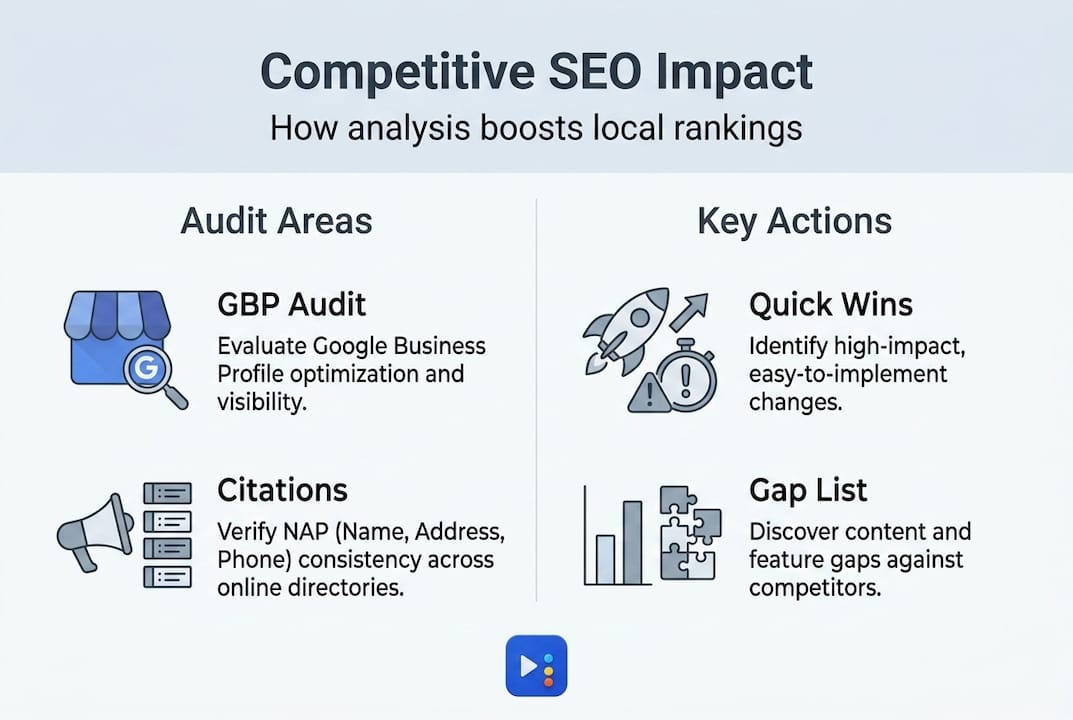
- Google Business Profile (GBP): Check your competitors' primary and secondary categories, whether they post regular updates, how they respond to reviews, and whether they use the Q&A section actively. A competitor with complete GBP attributes and weekly posts signals to Google consistent engagement.
- NAP consistency: NAP stands for Name, Address, and Phone number. Check whether your competitors have consistent NAP data across directories. Inconsistency is a common weakness you can outperform.
- Citations: These are mentions of your business on directories like Yelp, Angi, and local chambers of commerce. Count how many citations your top competitors have and where they're listed.
- Reviews: Look at volume, average rating, recency, and how they respond. A competitor with 300 reviews and thoughtful responses to every one signals strong local authority.
- Local backlinks: Identify links from local newspapers, neighborhood guides, Pflugerville city resources, or Austin-area blogs. These are powerful local trust signals.
- Location-specific content: Do they have individual pages for different neighborhoods or cities they serve? Content written specifically for Pflugerville, Georgetown, or Cedar Park performs better in local searches than generic service pages.
As Search Engine Journal notes, prioritizing GBP audits, NAP consistency, local citations, review volume and sentiment, local backlinks from chambers and newspapers, and location-specific content like neighborhood guides are the most impactful areas for local businesses.
Here's a simple comparison framework you can build in a spreadsheet:
| Audit element | Your business | Competitor A | Competitor B | Gap or opportunity |
|---|---|---|---|---|
| GBP categories | 2 | 4 | 3 | Add more relevant categories |
| Review count | 45 | 210 | 130 | Aggressive review generation needed |
| Weekly GBP posts | No | Yes | No | Start posting updates |
| NAP consistency | Inconsistent | Consistent | Consistent | Fix directory listings |
| Local backlinks | 3 | 18 | 9 | Target local press and chambers |
| Location pages | 0 | 3 | 1 | Create neighborhood-specific pages |
Real-world examples from Central Texas: Businesses that secure backlinks from the Pflugerville Chamber of Commerce, the Austin American-Statesman, Round Rock community blogs, or neighborhood Facebook group administrators see measurable improvements in local authority. These links are often easier to earn than national backlinks and carry strong geographic relevance signals for Google.

For more targeted SEO tricks for Central Texas businesses and local Pflugerville SEO tips that go beyond the basics, we've put together resources specific to your market.
Turning insights into action: Applying competitive findings to improve your SEO
Knowing what to fix is only half of the SEO equation. Here's how to use your audit to make real, impactful changes.
The most common mistake after completing a competitive audit is trying to fix everything at once. That leads to scattered effort and slow results. Instead, use a three-step process to move from analysis to execution with real focus.
Step 1: Identify your gaps. Using the comparison table you built in your audit, list every area where you trail your top competitors. Be specific. "Need more reviews" is not actionable. "Need 50 new Google reviews within 60 days to match Competitor A's volume" is a target you can actually work toward.
Step 2: Prioritize by impact and effort. Not all gaps are equal. Use this simple table to rank your next moves:
| Finding | Recommended action | Estimated impact | Effort level |
|---|---|---|---|
| Inconsistent NAP data | Audit and fix all directory listings | High | Low |
| Low review count | Launch a post-service review request campaign | High | Low |
| No GBP posts | Post 1 to 2 updates per week | Medium | Low |
| Missing location pages | Create pages for each service area | High | Medium |
| Few local backlinks | Reach out to local chambers and press | High | Medium |
| Weak keyword targeting | Target low-difficulty local keywords | High | Medium |
Step 3: Execute in order of quick wins first. Fixing NAP consistency and launching a review request campaign are both high-impact and low-effort tasks that can show results within 30 to 60 days. Location pages and backlink outreach take longer but compound over time.
Pro Tip: Focus on quick wins in the first 30 days to build momentum. Nothing motivates continued SEO investment like seeing your ranking improve after fixing something specific that your competitors are already doing right.
The data supports this prioritized approach. Businesses applying systematic competitive insights see 18% better predictive accuracy in their content decisions, which means less wasted effort and more of the right content reaching the right customers. Targeting keywords with low difficulty scores first also gives smaller businesses a 2.3x better shot at ranking quickly.
For businesses in Georgetown specifically, we've detailed the most common ranking barriers and how to resolve them in our Georgetown SEO strategies guide.
Our perspective: What most Central Texas businesses miss about competitive SEO analysis
Working with local businesses across Pflugerville, Austin, Round Rock, and the surrounding area has shown us a pattern that most guides won't talk about openly: business owners over-rely on tools and underinvest in the practical, human-centered signals that Google actually rewards.
We've seen businesses pay for expensive SEO software, pull impressive competitor data, and then completely ignore the review reply section of their GBP. That's a mistake. Google watches how you engage with your community. A competitor that responds thoughtfully to every review, including the negative ones, builds a trust profile that no keyword tool can replicate.
We've also seen businesses obsess over the biggest competitor in their market when the real opportunity sits with a mid-tier rival who has weak reviews and inconsistent citations. A service business in Austin dramatically improved their map pack position in under 90 days, not by chasing the dominant player in their niche, but by targeting the gaps left by a smaller competitor with poor review management and no location-specific content. They focused on their neighborhood, built a local content strategy around it, and climbed past that mid-tier rival quickly. That created momentum to go after bigger targets.
The uncomfortable truth is that competitive SEO analysis is only as useful as the action it inspires. Tools give you data. Strategy gives you direction. But it's the consistent, human execution, the review replies, the community engagement, the hyper-local content, that separates the businesses ranking in position one from everyone else. For a deeper look at where Austin businesses specifically go wrong, our Austin SEO pitfalls page covers the most common and costly mistakes we see.
Boost your visibility in Central Texas with local SEO experts
The competitive analysis process we've walked through gives you a clear, repeatable framework for finding gaps and making smart SEO moves. But we also know that running a business in Pflugerville, Round Rock, or Georgetown leaves very little time to audit competitors, fix citations, and build out location pages every week.

That's where our team comes in. At ourLocalSEO, we handle the research, the strategy, and the execution so you can focus on running your business. Whether you need a full competitive audit, help with GBP optimization, or a complete local SEO strategy built for your market, we're here as a hands-on partner. Start with our step-by-step local SEO guide to see exactly how we approach local rankings, or connect with our Central Texas SEO experts for a personalized conversation about your specific goals.
Frequently asked questions
How does competitive analysis specifically improve my local SEO rankings?
It reveals exactly what top competitors do to rank, so you can target gaps and outperform them in your local area. Businesses applying systematic competitive research achieve 18% higher predictive accuracy in their content decisions, which directly improves ranking outcomes.
What tools or methods are best for auditing competitors' local SEO?
Manual checks of Google Business Profiles, citation listings, review sites, and content are key, supported by ranking and backlink tools where possible. Search Engine Journal recommends prioritizing GBP audits, NAP consistency, local citations, and reviews as the highest-value starting points.
How many competitors should I analyze for best results?
Evaluating 8 to 12 direct, indirect, and aspirational competitors offers the most valuable insights for local SEO. Research shows that starting with 8 to 12 competitors across all three categories maximizes the gaps and opportunities you'll find.
What's the difference between direct and indirect SEO competitors?
Direct competitors offer the same products or services in your geographic area, while indirect competitors solve similar problems or target overlapping customer audiences in search. Both types compete for the same customer attention in Google results and deserve a place in your analysis.