

Most small business owners in Central Texas are chasing the wrong prize. They want to rank #1 on Google, full stop. But here's what that mindset misses: a nail salon in Pflugerville and one in Round Rock can target the same keyword and get completely different results depending on where the searcher is standing. Google's results are not a single, static list. They shift by city, neighborhood, and even device. If you're not monitoring your rankings at that granular level, you're making decisions based on incomplete data, and your competitors may already be capitalizing on the gaps you can't see.
Table of Contents
- What does it mean to monitor search rankings?
- The evolving nature of local search rankings
- Why search ranking monitoring still matters in 2026
- How to monitor local search rankings for real business results
- The real reason monitoring matters: Lessons from Central Texas
- Next steps: Supercharge your local leads
- Frequently asked questions
Key Takeaways
| Point | Details |
|---|---|
| Local differences matter | Search rankings can change across neighborhoods, directly affecting who finds your business. |
| Track more than positions | Combine ranking data with traffic and conversions to see real impact, not just numbers. |
| Benchmark for smarter moves | Comparing your performance with competitors helps you know when and what to improve. |
| Act on trends quickly | Regular monitoring lets you respond to changes in search visibility before you lose leads. |
What does it mean to monitor search rankings?
Search ranking monitoring is the practice of tracking where your business website appears in Google's results for specific keywords over time. It sounds simple, but there are layers to it that matter a lot for local businesses.
First, let's clarify what a "search ranking" actually is. When someone types "best nail salon near me" or "HVAC repair Georgetown TX" into Google, the search engine returns a list of results. Your ranking is your position in that list for a given keyword. The higher you appear, the more likely someone clicks your link.
But not all rankings are created equal. There are three types of results you need to understand:
- National rankings: Where you rank across all of the United States for a keyword. Mostly irrelevant for local businesses.
- City-level rankings: Where you rank when someone searches from a specific city like Austin or Round Rock.
- Hyper-local rankings: Where you rank for searches originating in a specific neighborhood, zip code, or even a few blocks.
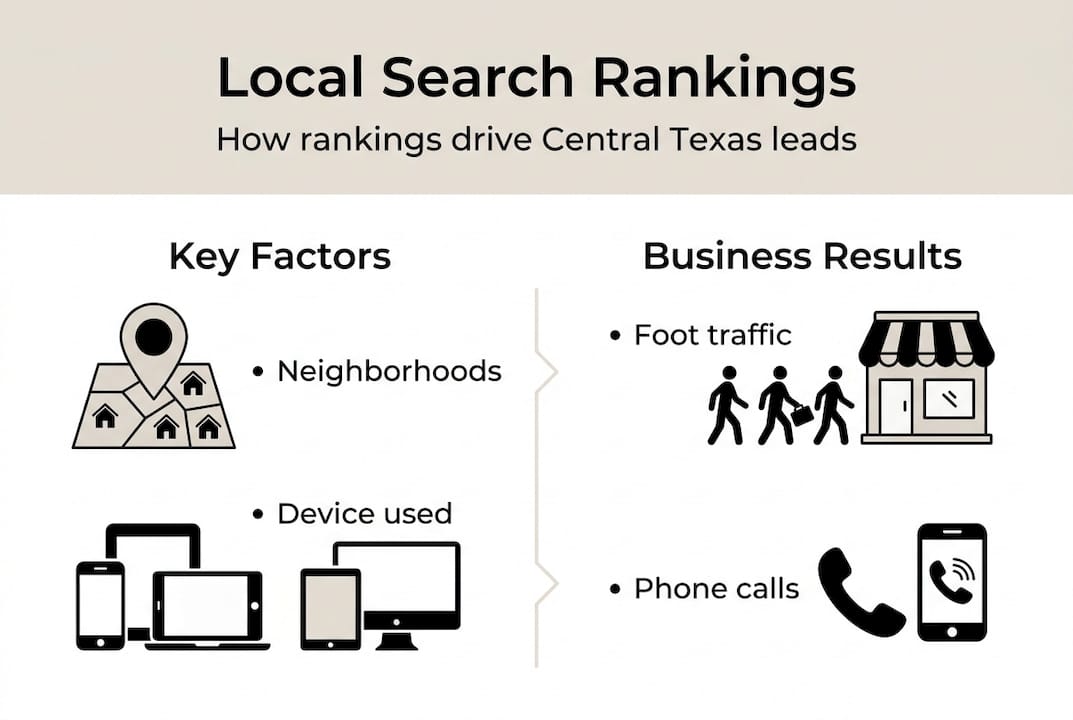
For a local business, hyper-local and city-level rankings are what drive real foot traffic and phone calls. Our local SEO guide walks through exactly how to build visibility at each of these levels.
There's also an important distinction between the local map pack and organic listings. The map pack is the block of three business listings with a map that appears near the top of Google's results. Organic listings are the traditional blue links below it. Both matter, and both can rank differently depending on location.
Google also personalizes results based on your search history, location, and device. This means rankings vary by neighborhood, even within the same city like Austin. A customer searching from East Austin sees different results than one searching from Cedar Park.
Pro Tip: Track your most important keywords at the city or neighborhood level, not just broadly. You'll catch ranking gaps your competitors are likely ignoring.
Here's a quick summary of what every small business owner should know about search ranking monitoring:
- Rankings are keyword-specific and location-specific
- The map pack and organic results are tracked separately
- Personalization means no two users see identical results
- Monitoring reveals trends, not just snapshots
- City and neighborhood tracking is more actionable than national tracking
The evolving nature of local search rankings
With those basics in place, it's important to understand how search ranking itself is changing, and what that means for your strategy.

Google's algorithm has grown significantly more sophisticated over the past few years. Personalization is now baked into every search. Someone in East Austin searching "best taco restaurant" will see different results than someone in Round Rock searching the same phrase. This isn't a bug. It's intentional, and it makes traditional rank tracking more complicated.
Another factor is JavaScript rendering. Many modern websites use JavaScript to load content dynamically. Google's ability to crawl and index JavaScript-heavy pages has improved, but it still creates inconsistencies in how and when your pages appear in results. Rank tracking is still vital, even as these technical challenges evolve.
"Near me" searches have grown dramatically in recent years, and they're almost entirely location-driven. Your ranking for "plumber near me" depends heavily on where the searcher is physically located at that moment.
This is why tools like Google Search Console (GSC) and GA4 are so valuable alongside traditional rank trackers. GSC shows you impressions (how often your site appeared in results) and click-through rate (CTR), which is the percentage of people who clicked after seeing your listing. These metrics add important context that raw position numbers can't provide alone.
Here's a real-world example of how rankings can differ across Central Texas cities for the same keyword:
| City | Keyword | Map Pack Position | Organic Position |
|---|---|---|---|
| Pflugerville | "nail salon near me" | #2 | #5 |
| Round Rock | "nail salon near me" | #4 | #8 |
| Georgetown | "nail salon near me" | #1 | #3 |
| Austin (East) | "nail salon near me" | #6 | #11 |
These differences are real and significant. A business that looks strong in Georgetown may be nearly invisible in Austin. Our Georgetown SEO strategies and Austin local search landscape pages show how we address each market specifically.
Key factors that influence your local rankings include:
- Your physical location relative to the searcher
- Search history of the individual user
- Device type (mobile vs. desktop results differ)
- Google Business Profile completeness and review count
- On-page SEO signals like location-specific content
Why search ranking monitoring still matters in 2026
Even with the latest Google changes, monitoring where your business stands is far from outdated. Let's see why.
There's a real tension in the SEO world right now. Some experts argue that because of personalization and JavaScript complexity, tracking exact rank positions is less meaningful than it used to be. There's truth to that. But the conclusion that rank tracking is dead is wrong. Rank tracking is mostly alive, and when paired with traffic and conversion data, it remains one of the most useful tools a local business has.
The smarter approach is to use rank monitoring as one input among several, not the only metric you watch.
| Method | Pros | Cons | Best use case |
|---|---|---|---|
| Rank tracking | Shows visibility trends, competitor gaps | Affected by personalization | Spotting content opportunities |
| Traffic monitoring | Reflects real user behavior | Doesn't show why traffic changed | Measuring campaign impact |
| Conversion tracking | Tied directly to revenue | Hard to attribute to specific keywords | Proving ROI to stakeholders |
The real value of SEO benchmarking is comparing your performance against competitors and industry norms, not just your own history. If your organic CTR is 2% but competitors average 5%, that's a gap worth closing regardless of your rank position.
Here are three ways rank monitoring supports smarter business decisions:
- Update content strategically: If a page drops from position 4 to position 9, that's a signal to refresh the content, add more local detail, or earn more reviews.
- Diagnose technical issues: A sudden ranking drop across multiple keywords often signals a site problem, like a slow page load or a broken link, before traffic data catches up.
- Seize new opportunities: If you notice you're ranking on page two for a high-value keyword, a focused push can move you to page one and meaningfully increase leads.
Pro Tip: Don't obsess over single-position swings. A move from #3 to #4 one week means almost nothing. Look for sustained trends over 4 to 8 weeks, and compare your movement to competitors. Our Pflugerville SEO tips page shows this approach in action for local markets.
How to monitor local search rankings for real business results
With the why in hand, let's get specific on the how, so your monitoring translates into leads and revenue.
Frequency matters. Checking rankings daily creates noise. Checking monthly means you miss fast-moving trends. Weekly monitoring hits the sweet spot for most small businesses. It gives you enough data to spot patterns without causing unnecessary anxiety over normal fluctuations.
For tools, start with what's free. Google Search Console is the most reliable source for impressions, CTR, and average position data directly from Google. GA4 (Google Analytics 4) tracks what happens after someone clicks, including which pages they visit and whether they convert. Together, impressions, CTR, and conversions via GSC/GA4 give you a far more complete picture than rank position alone.
For deeper local tracking, tools like BrightLocal, Whitespark, or Local Falcon let you track rankings by zip code or even pin specific locations on a map. This is especially useful for businesses serving multiple neighborhoods across Central Texas.
A well-designed website also plays a direct role in how you rank. Good website design best practices ensure your pages load fast, work on mobile, and give Google clear signals about your location and services. You can also learn from how other service businesses approach improving repair business visibility locally.
Here are the most common mistakes businesses make with rank tracking:
- Tracking only broad keywords instead of location-specific phrases
- Ignoring the map pack and focusing only on organic results
- Checking rankings manually from their own device (which skews results due to personalization)
- Treating rank as the only success metric instead of connecting it to leads
- Not benchmarking against local competitors
Pro Tip: Always set up a competitor comparison in your tracking tool. Knowing you dropped from #2 to #3 means little. Knowing your top competitor jumped from #5 to #1 means everything.
The real reason monitoring matters: Lessons from Central Texas
To close, let's cut through the noise with some real-world perspective.
We've worked with businesses across Pflugerville, Austin, Georgetown, and Round Rock, and we've seen the same pattern repeat. Owners fixate on being #1 for one broad keyword. Meanwhile, a competitor quietly builds strong visibility across five neighborhoods for ten specific phrases, and that competitor wins more customers.
Clients who tracked rankings across multiple locations consistently grew their leads faster than those who watched a single vanity metric. One med spa we worked with didn't rank #1 for anything. But they ranked in the top three for eight neighborhood-specific searches, and their call volume reflected it.
The takeaway is this: treat rank monitoring as a tool for making better business decisions, not a scoreboard. Use it to find gaps, respond to competitor moves, and prioritize where to invest your time. Our Central Texas SEO guide gives you the framework to do exactly that.
Next steps: Supercharge your local leads
If you're ready to act on what you've learned, here are the best next steps for your business.
Monitoring your local search rankings doesn't have to be complicated, but it does need to be intentional. At ourLocalSEO, we specialize in helping Central Texas small businesses track, understand, and act on their local search data.

Whether you're a restaurant in Georgetown, a med spa in Pflugerville, or a service business anywhere in Central Texas, we can build a monitoring strategy that connects rankings to real leads. Our Pflugerville SEO experts and Georgetown SEO services teams are ready to help. Start with our step-by-step local SEO guide to see exactly how we approach local visibility for businesses like yours.
Frequently asked questions
How do Google search rankings differ by neighborhood?
Google personalizes search results based on a user's exact location, so rankings vary by neighborhood, even within the same city. Two people searching the same keyword a few miles apart can see completely different business listings.
What is the best frequency for monitoring search rankings?
Weekly monitoring provides enough data to spot meaningful trends without getting distracted by daily noise. Rank tracking remains vital even as personalization makes results more complex.
What tools help track local rankings effectively?
Google Search Console, GA4, and dedicated local SEO platforms like BrightLocal or Local Falcon are the most effective options. Impressions, CTR, and conversions via GSC/GA4 give you a fuller picture than position data alone.
Is rank tracking still worth it despite personalization?
Yes. Rank tracking is mostly alive and most valuable when combined with traffic and conversion data. Personalization makes exact positions less reliable, but trend data and competitor comparisons remain highly actionable.