

Almost half of all Google searches have local intent, yet most small business owners in Central Texas assume that having a website or a Google Business Profile (GBP) is enough to show up when customers search nearby. That assumption costs real revenue every day. Local SEO is one of the most powerful tools available to small businesses, and it is also one of the most misunderstood. In this guide, we break down exactly what local SEO is, how Google ranks local businesses, which tactics actually move the needle, and what mistakes to avoid so your business can compete and win in markets like Round Rock, Georgetown, Pflugerville, and beyond.
Table of Contents
- Local SEO explained: What it is and why it matters
- How Google ranks local businesses: The three key factors
- Essential tactics for dominating local search in Central Texas
- Winning the hyper-local game: Advanced tips and common pitfalls
- What most small businesses get wrong about local SEO in Central Texas
- Supercharge your local SEO with expert help
- Frequently asked questions
Key Takeaways
| Point | Details |
|---|---|
| Local SEO basics | Local SEO means optimizing online presence for geographic searches to drive local customers to your business. |
| Three main ranking factors | Google ranks local businesses using relevance, distance, and prominence in reviews and citations. |
| Central Texas tactics | Use hyper-local keywords, audit directories, and engage regional links for true competitive advantage. |
| Avoid common pitfalls | Neglecting website, review management, or NAP consistency can tank your local visibility. |
| Track ROI by real actions | Measure local SEO by calls, directions, and new customer actions—not just rankings. |
Local SEO explained: What it is and why it matters
To start, let's break down what local SEO actually means and why it's a game-changer for Central Texas businesses.
Local SEO is the practice of optimizing your online presence to attract customers through relevant geographic searches. Think "Round Rock plumber," "nail salon near me in Cedar Park," or "best med spa Georgetown TX." These searches signal buying intent, and they happen constantly.
The difference between local SEO and traditional SEO comes down to geography and intent. Traditional SEO targets broad keyword rankings, often competing nationally or globally. Local SEO targets searchers in a specific city, neighborhood, or region who are ready to act. If you run a service-based business or a storefront in Central Texas, local SEO is almost always more valuable than chasing national rankings.
Here is why that matters so much right now:
- Map pack visibility: When someone searches "electrician in Austin," Google shows a map with three local businesses before the organic results. That is the local map pack, and getting into it drives significant traffic.
- High purchase intent: People searching locally are often ready to call, visit, or buy right now.
- Less competition: Ranking locally is often easier than ranking nationally, especially for small businesses.
- Trust signals: A well-optimized local presence builds credibility with both Google and potential customers.
The numbers back this up. A staggering 76% of people who search for something nearby on their smartphone visit a business within 24 hours, and 28% of those searches result in a purchase. For a nail salon in Pflugerville or a restaurant in Manor, that kind of conversion rate is hard to ignore.
"Local SEO is not just about showing up. It is about showing up in front of the right people at the exact moment they are ready to spend money."
Our local SEO guide walks through these fundamentals in more detail, including how to read the signals Google uses to evaluate your business. Understanding those local search ranking factors is the foundation for everything that follows.
How Google ranks local businesses: The three key factors
Now that you understand what local SEO is, let's uncover how Google decides which businesses get shown to customers.
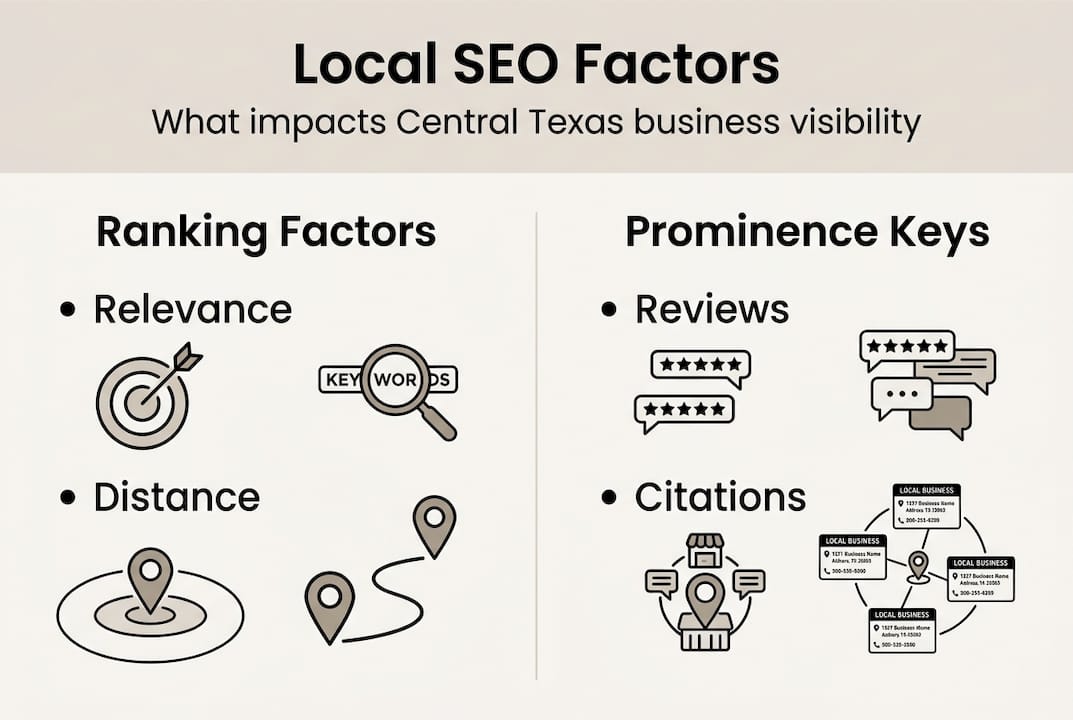
Google's local search algorithm is built on three core pillars: relevance, distance, and prominence. Understanding each one helps you see where your business has room to grow.

1. Relevance refers to how well your business listing matches what the searcher is looking for. If your GBP says you are a "beauty salon" but someone searches "eyelash extensions Cedar Park," Google may not consider you relevant unless your profile and website specifically mention that service.
2. Distance is how close your business is to the searcher or the location mentioned in the search. You cannot move your physical location, but you can improve the other two factors to compensate.
3. Prominence is the most controllable factor. It measures how well known and trusted your business is based on reviews, links, citations, and online content.
| Factor | Impact on ranking | Owner control |
|---|---|---|
| Relevance | High | High (via GBP and website content) |
| Distance | Medium | Low (fixed by location) |
| Prominence | Very high | High (reviews, links, citations) |
Here is what you can do right now to improve each factor:
- Update your GBP categories and services to match the exact language your customers use when searching.
- Build and respond to Google reviews consistently. Reviews account for roughly 15% of local ranking signals.
- Earn local backlinks from Central Texas organizations, chambers of commerce, and community sites.
- Add location-specific content to your website to signal geographic relevance.
Pro Tip: A fully optimized GBP can give you up to 2.3x more visibility in local search. But prominence is built over time through consistent reviews, fresh content, and quality links. Balance all three, not just one.
Our local SEO strategies page covers these ranking improvements in more depth, and if you are in Williamson County, our Round Rock local SEO tips show exactly how to apply them in that market.
Essential tactics for dominating local search in Central Texas
With Google's ranking factors in mind, here's how you can apply proven strategies to outshine your local competition.
The core methods for strong local SEO include Google Business Profile optimization, NAP consistency, local backlinks, location-specific content, mobile optimization, and schema markup. Let's look at each one practically.
Google Business Profile checklist:
- Claim and verify your GBP listing
- Choose the most accurate primary and secondary categories
- Add all services with descriptions
- Upload high-quality photos regularly
- Enable messaging and keep hours updated
- Post weekly updates to stay active in Google's eyes
NAP consistency means your business Name, Address, and Phone number are identical across every directory, website, and social profile. Even a small difference, like "St." versus "Street," can confuse Google and hurt your rankings.
Regional citation directories to prioritize in Central Texas:
| Directory | Why it matters |
|---|---|
| Yelp | High authority, heavily indexed by Google |
| Austin Chamber of Commerce | Strong local trust signal |
| Round Rock Chamber | Boosts Williamson County relevance |
| Georgetown Main Street | Hyper-local credibility |
| BBB (Texas chapter) | Trust and authority signal |
Location-specific content means writing pages or blog posts that mention your city and surrounding neighborhoods. A landscaping company in Cedar Park should have a page that talks about local soil types, seasonal challenges, and neighborhoods served.
Mobile and voice search are no longer optional. Most local searches happen on phones. If your site loads slowly or is hard to navigate on mobile, you are losing customers before they even see your content. Building local backlinks from regional sources further strengthens your authority.
Pro Tip: Do not overlook structured data markup (also called schema). Adding local business schema to your website tells Google exactly what you do, where you are, and how to contact you, which can improve how you appear in search results.
If you serve the Austin metro, our local SEO Austin page outlines market-specific tactics. We also have targeted guidance through our Georgetown local SEO tips resource.
Winning the hyper-local game: Advanced tips and common pitfalls
Stepping beyond the basics, let's look at advanced methods and local SEO traps common in Central Texas.
When you are in a competitive market like Austin or Round Rock, standard GBP optimization is not enough. You need to layer in advanced tactics that separate you from dozens of similar businesses.
Top mistakes Central Texas small businesses should avoid:
- Inconsistent NAP data across directories. Proximity bias is already hard to overcome, and inconsistent NAP information makes it even harder by damaging your visibility in AI-powered and voice search results.
- Ignoring reviews or responding poorly. Every review, positive or negative, is a public signal of your reputation.
- Keyword stuffing your GBP description. Google penalizes unnatural language.
- Not tracking actual business outcomes. Many owners watch rankings but ignore calls, direction requests, and form submissions.
- Skipping long-tail keywords. Phrases like "affordable HVAC repair Pflugerville TX" convert better than broad terms.
Strategies for generating and managing reviews:
- Ask every satisfied customer directly after service
- Send a follow-up text or email with a direct review link
- Respond to every review within 24 hours
- Thank positive reviewers by name when possible
- Address negative reviews calmly and professionally
For businesses with multiple locations across Central Texas, each location needs its own GBP listing, its own location page on your website, and its own set of local citations. Do not use the same content for every location page. Google can detect duplicate content, and it will not reward it.
"In hyper-local markets, the businesses that win are not always the biggest. They are the most consistently optimized across every touchpoint."
AI-generated search results and zero-click searches are also changing the game. Google increasingly answers queries directly in search results without the user clicking through. To stay visible, your content needs to directly answer specific local questions. Check out our Pflugerville local SEO advice for examples of how to structure content that works in this new environment. For data on what this looks like in terms of local search ROI, the numbers consistently favor businesses that invest consistently over time.
What most small businesses get wrong about local SEO in Central Texas
With so much local SEO advice out there, it is critical to distinguish hype from what truly works for Central Texas businesses.
We see one pattern repeat itself constantly. A business owner sets up their GBP, gets a few reviews, and then waits for the phone to ring. When it does not, they assume local SEO does not work for them. The real issue is that GBP alone is not enough. Sustained local SEO success requires consistent effort across content, citations, links, and reviews, typically over 3 to 6 months or more before you see compounding results.
The businesses we see winning in markets like Georgetown and Round Rock are not running shortcuts. They are publishing location-specific content, earning regional links, maintaining clean citations, and generating reviews week after week. Their local SEO success is not accidental. It is built.
One more thing worth saying directly: track what matters. Rankings are a proxy metric. What you actually want are calls, direction requests, form fills, and sales. If your local SEO efforts are not producing those, something needs to change regardless of where you rank.
Supercharge your local SEO with expert help
If you are ready to win in local search, dedicated guidance can accelerate your results.
We work with small businesses across Pflugerville, Austin, Round Rock, Georgetown, Cedar Park, and the surrounding Central Texas area. Our strategies are built around your specific market, your competition, and your goals, not generic templates.

From optimizing your GBP to building an SEO-ready website design that converts visitors into customers, we handle the technical and creative side so you can focus on running your business. Explore our local SEO tips to see what is possible, or check out our Georgetown local SEO help page for a market-specific starting point. Reach out for a free consultation and let's build a strategy tailored to where you are and where you want to go.
Frequently asked questions
What is the difference between local SEO and traditional SEO?
Local SEO targets searches with geographic intent, like "near me" or city-specific terms, while traditional SEO focuses on broad keywords with no location component. Local SEO is typically more relevant and cost-effective for brick-and-mortar and service-area businesses.
How long does it take to see results from local SEO?
Most small businesses see measurable improvements within 3 to 6 months when applying local SEO best practices consistently. Results compound over time, meaning the earlier you start, the greater the long-term advantage.
What is the most important local SEO ranking factor?
Prominence, which includes your reviews, backlinks, and citations, is the most controllable ranking factor and has the highest impact on visibility after physical distance. Building prominence consistently is what separates businesses that dominate the map pack from those that do not.
Why does Google show some businesses in the map pack but not others?
Google selects map pack businesses based on how relevant their listing is to the search, how close they are to the searcher, and how prominent they are online through reviews and links. Optimizing all three factors improves your chances significantly.
Do I need a website if I have a Google Business Profile?
Yes. A full website adds the relevance signals and credibility that GBP alone cannot provide, and it is essential for outranking competitors who rely solely on their profile. Your website is also where you own your content and customer journey completely.