

Most small business owners assume that using popular, broad keywords like "best restaurant" or "plumber near me" is enough to bring in local customers. The reality? Those generic terms are dominated by national chains and massive websites with enormous marketing budgets. What actually works for a nail salon in Pflugerville or a med spa in Georgetown is a targeted, location-specific keyword strategy built around how real Central Texas customers search. In this guide, we'll walk you through exactly how local keywords work, which types matter most, and how to apply them to your website so you attract more of the right customers, not just more clicks.
Table of Contents
- Why keywords matter for local SEO
- Types of local keywords and how to find them
- Prioritizing keywords for the highest local impact
- Where and how to use local keywords on your website
- What most local SEO guides miss about keywords
- Take your next step in local SEO
- Frequently asked questions
Key Takeaways
| Point | Details |
|---|---|
| Local keywords drive customers | Using the right local keywords helps your business get found by nearby searchers who are ready to buy. |
| Research tools matter | Keyword research tools like Google Autocomplete and GBP Insights reveal what your ideal customers actually search for. |
| Keyword types count | Mixing explicit city terms and implicit ‘near me’ searches catches a wider local audience. |
| Smart placement boosts results | Where you put keywords—on your site, profile, and content—matters as much as which keywords you choose. |
Why keywords matter for local SEO
Now that we've set the stage for local SEO's impact, let's look closer at the role of keywords in making your business discoverable where it matters most.
A keyword is simply the word or phrase a person types into Google when they're searching for something. Local SEO (search engine optimization) is the process of making your business show up when people in your area search for what you offer. These two concepts are inseparable. Without the right keywords, search engines have no clear signal about who you serve or where you're located.
Search engines like Google work by crawling websites and indexing content. When someone searches, Google matches their query to indexed pages based on relevance, location data, and authority. Local keywords give Google the context it needs to connect your business with nearby searchers. Without that context, you're essentially invisible to the customers closest to you.
"A local keyword strategy is not about getting the most traffic. It's about getting the right traffic from people who are ready to act."
What separates a local keyword from a general one comes down to intent and geography. Compare "pizza delivery" to "pizza delivery Round Rock TX." The first could come from anywhere. The second signals clear location intent. That specificity is exactly what helps a small local business compete without needing a massive advertising budget.
Here's what makes a keyword local:
- It includes a specific city, neighborhood, or region (for example, "Cedar Park hair salon")
- It uses proximity terms like "near me" or "close by"
- It references a local landmark or district
- It targets a service tied to a specific community
Local keyword research methodologies confirm that effective local SEO relies on identifying explicit, implicit, neighborhood, long-tail, and high-intent keywords using tools like Google Autocomplete, Keyword Planner, SEMrush, Ahrefs, and GBP Insights. Our local SEO guide breaks down how these elements work together for Central Texas businesses specifically.

Types of local keywords and how to find them
Understanding why keywords are crucial leads us to the next step: finding and categorizing the keywords that can actually drive customers to your door.
Not all local keywords work the same way. Each type serves a different purpose and captures customers at different points in their decision process. Let's break them down.
| Keyword type | Example | When it's most useful |
|---|---|---|
| Explicit (service + city) | "emergency plumber Austin" | Targeting searchers who know what they want and where |
| Implicit ("near me") | "nail salon near me" | Capturing mobile users searching on the go |
| Neighborhood/landmark | "salon near Domain Austin" | Reaching hyper-local customers in specific areas |
| Long-tail | "affordable med spa Botox Georgetown TX" | Lower competition, higher conversion |
| High-intent | "book facial appointment Pflugerville" | Ready-to-act customers who want to commit now |
Each type plays a role. Explicit keywords build general local authority. Implicit keywords capture mobile traffic. Neighborhood and landmark keywords help you reach customers in specific pockets of a city. Long-tail keywords are gold for small businesses because they face less competition and attract customers closer to making a decision. High-intent keywords, such as phrases that include words like "book," "hire," or "emergency," signal someone who is ready to act right now.
Here is a step-by-step process we recommend for finding the right local keywords:
- Start with Google Autocomplete. Type your core service into Google's search bar and note the suggestions that include location terms. These are real phrases people search.
- Use Google Keyword Planner. Filter results by location (for example, Austin metro area) to find search volumes specific to Central Texas.
- Check your Google Business Profile (GBP) Insights. Your GBP dashboard shows what search queries customers actually used to find your listing. This is some of the most accurate local data you'll get.
- Analyze competitors with SEMrush or Ahrefs. The local keyword research methodology from Search Engine Land recommends using keyword gap analysis to find terms your competitors rank for that you don't yet target.
- Review customer reviews and questions. The language customers use in reviews often reveals the exact phrases they searched before finding you.
Pro Tip: Search for your main service on Google Maps and look at what category labels appear in the sidebar. Those labels often reflect the exact keyword phrases Google associates with businesses like yours.
These methods, combined, give you a well-rounded picture of your local keyword landscape. Once you've gathered your list, the next step is figuring out which keywords deserve your immediate attention. To understand how ranking on Google Maps ties into this, check out our tips on how to boost Google Maps ranking for service businesses.
Prioritizing keywords for the highest local impact
Once you have a list of potential keywords, it's time to prioritize. Not all keywords are created equal when it comes to local business success.
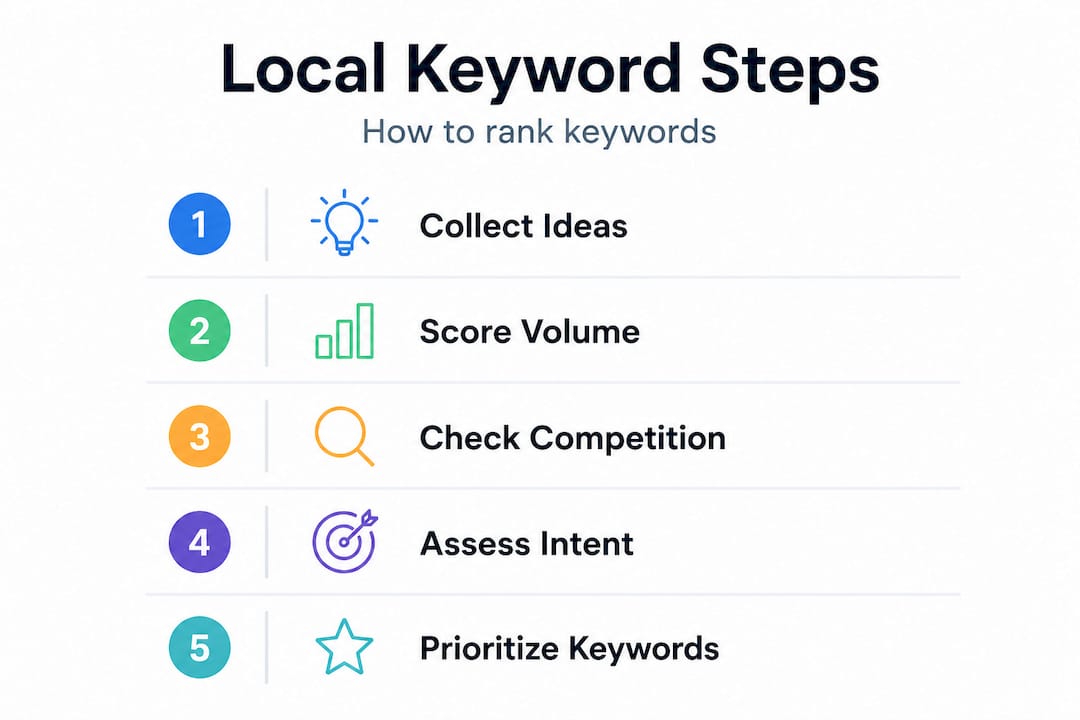
A long keyword list is useless without a clear way to rank what matters most. Three factors determine a keyword's real value for your business: search volume, competition, and conversion potential.
| Factor | What it means | How to assess it |
|---|---|---|
| Search volume | How many people search this phrase monthly | Google Keyword Planner, Ahrefs |
| Keyword difficulty | How hard it is to rank for this term | SEMrush difficulty score (0 to 100) |
| Conversion potential | How likely the searcher is to become a customer | Presence of action words, specificity, local intent |
According to local keyword research best practices, prioritizing based on volume, difficulty, and conversion potential is essential for creating a keyword strategy that delivers measurable ROI.
Here's how we think about keyword prioritization for Central Texas small businesses:
- Quick wins are keywords with moderate search volume (100 to 500 monthly searches), lower competition, and strong local intent. Examples: "lash lift Georgetown TX" or "HVAC tune-up Pflugerville."
- Long-term targets are keywords with high search volume and higher competition that take more time and content to rank for. Examples: "Austin med spa" or "Round Rock plumber."
- Conversion anchors are high-intent phrases where the searcher is ready to act. Even if they have lower volume, they often deliver the best leads.
The most common mistake we see is small businesses targeting only the highest-volume terms and completely ignoring the lower-volume, high-intent keywords. A keyword like "same-day AC repair Cedar Park" may only get 80 searches per month, but if someone types that in, they need help right now. That's a customer worth capturing.
A useful approach: score each keyword on a scale of 1 to 5 across volume, difficulty (where lower difficulty scores higher), and intent. Add those scores together and prioritize the highest totals first. This gives you a clear, data-backed starting point instead of guessing.
Pro Tip: Use your competitive analysis for local SEO to identify gaps where your competitors rank well but you don't. These gaps often reveal the most efficient keyword opportunities.
Where and how to use local keywords on your website
Now that you have a prioritized set of keywords, let's make sure you know exactly where to use them for local SEO results.
Knowing the right keywords is only half the equation. The other half is placing them correctly. Search engines read specific parts of your website more carefully than others. Putting your keywords in the right places signals clearly what your page is about.
Here is the order of placement priority for local keywords:
- Page title (title tag). This is the most important on-page SEO element. Include your primary keyword and location here. Example: "Affordable Nail Salon in Pflugerville TX | Salon Name."
- H1 heading. Your main visible page heading should include your primary keyword naturally.
- Meta description. This is the short description that appears under your page title in Google results. Include your keyword and a call to action.
- First 100 words of your page content. Google gives extra weight to keywords that appear early in the body text.
- Subheadings (H2 and H3). Use variations of your keyword in subheadings to reinforce the topic and help Google understand page structure.
- Image alt text. Describe images using keywords where it makes natural sense.
- Google Business Profile. Include keywords in your GBP business description, service descriptions, and posts.
- Schema markup. Schema is structured data code that helps Google understand your business's services, location, and offerings without confusion.
According to local keyword placement best practices, high-intent keywords like "emergency plumber Austin" should be naturally integrated into page content, meta tags, headings, GBP profiles, and schema for maximum local search visibility.
Here's what to avoid:
- Keyword stuffing. Repeating a keyword every few sentences looks unnatural and can actually hurt your rankings. Google's algorithm recognizes manipulation.
- Irrelevant keyword use. Adding location terms to pages that don't serve local customers creates confusion for both search engines and your visitors.
- Ignoring mobile optimization. Most local searches happen on phones. A well-structured, mobile-friendly page with your keywords in the right places performs significantly better.
Your website's structure matters just as much as the keywords themselves. A well-built site designed for local SEO makes it easier for search engines to crawl, index, and rank your pages. If your website isn't set up to support your keyword strategy, even the best keywords won't produce results. Explore our approach to website design for local SEO to see how we build sites that work for Central Texas businesses from the ground up.
What most local SEO guides miss about keywords
Having learned the mechanics and application, it's time to consider some advanced insights most SEO guides overlook.
Here's something we've observed working with businesses across Pflugerville, Austin, Georgetown, and Round Rock: most local SEO articles stop at telling you to add city names to your content. That advice, while not wrong, is incomplete. The businesses that actually win in local search are doing something most guides don't cover.
The first overlooked factor is searcher intent layering. Not every person who searches "nail salon Georgetown TX" is at the same point in their decision. Some are researching. Others are ready to book right now. Your keyword strategy needs to serve both audiences with different types of content, not just one optimized service page.
The second issue is over-reliance on high-volume "near me" keywords. Yes, implicit keywords drive traffic. But they're also intensely competitive and often dominated by businesses with hundreds of reviews and years of GBP history. For a newer or smaller business, hyper-local keywords tied to specific neighborhoods, intersections, or community landmarks often deliver faster, more qualified results. "Nail salon near Falcon Pointe Pflugerville" is an example almost no competitor is chasing, yet it's exactly how a nearby resident might search.
Third, most guides treat keyword strategy as a one-time task. In reality, local search behavior shifts constantly. New businesses open and compete for the same terms. Seasonal searches spike and fall. Customer language evolves. A keyword that drove strong traffic last year may be fading now, while a new phrase is gaining traction you haven't captured yet. Regularly revisiting your keyword list, at least every quarter, is non-negotiable.
Finally, local keyword success doesn't live only on your service pages. Blog content, FAQ pages, Google Business Profile posts, and even review responses all contribute to your overall local keyword footprint. A well-written post about "what to expect from a med spa facial in Round Rock" signals relevance, builds trust, and ranks for long-tail terms that a service page never would. This is the kind of layered, strategic thinking that separates businesses that dominate local search from those that just dabble in it.
Understanding how competitors use these strategies can sharpen your own approach. Our breakdown of competitive insight for local search shows exactly how to turn their gaps into your wins.
Take your next step in local SEO
If you want hands-on help applying these strategies or seeing real results, here's where you can start.
We work with small businesses across Pflugerville, Georgetown, Cedar Park, Round Rock, and the greater Austin area to build keyword strategies that produce real leads. Whether you're starting from scratch or need to sharpen what you already have, we tailor every approach to your specific location and market.

Our Local SEO services cover everything from keyword research and GBP optimization to on-page SEO and local content strategy. If you want to go deeper before reaching out, our local SEO guide is a great next resource. And if you're looking for fast, practical wins, our actionable SEO tricks page gives you techniques you can start using right away. We're here to help you get found by the customers who are already searching for exactly what you offer.
Frequently asked questions
How are implicit and explicit local keywords different?
Explicit keywords include a specific city name, such as "plumber Austin TX," while implicit keywords rely on proximity signals like "plumber near me." Both keyword types work together to capture the full range of local search behavior, and a strong strategy uses both.
What tools do most small businesses use for local keyword research?
The most practical local keyword research tools include Google Autocomplete, Google Keyword Planner, SEMrush, Ahrefs, and Google Business Profile Insights, all of which are accessible even without a large marketing budget.
Where should I place local keywords for best results?
Focus on your page title, H1 heading, meta description, first paragraph of body content, and your Google Business Profile description. Following local keyword placement best practices also means adding keywords to image alt text and schema markup for maximum visibility.
What is a high-intent local keyword?
A high-intent keyword indicates that the searcher is ready to take action right now, often using words like "book," "hire," "emergency," or "near me open now." These phrases typically convert at a much higher rate than general informational searches.
Should my local keyword list change over time?
Yes, absolutely. Local search behavior, competition, and customer language shift regularly, so reviewing and updating your keyword strategy at least every quarter keeps your rankings competitive and your content relevant.