

Local content marketing is defined as the creation and distribution of content specifically tailored to a geographic audience to build trust, visibility, and engagement within a defined community. Unlike general content marketing, this approach goes far beyond dropping a city name into a blog post. 85% of Gen Z consumers shop locally on a regular basis, and one in three consumers actively prefer supporting local businesses. That preference is your competitive edge. When you create content that reflects real local experiences, your business becomes the obvious choice over a national brand with no community roots.
What is local content marketing and how is it different from general content marketing?
Local content marketing targets community-specific needs, voices, and context. General content marketing targets broad audiences with universal messaging. That distinction matters more than most small business owners realize.
A national brand running a blog about "how to choose a plumber" speaks to everyone and connects with no one in particular. A Pflugerville plumber writing about "what to do when your pipes freeze during a Central Texas cold snap" speaks directly to a neighbor with a real problem. That specificity builds trust faster than any paid ad.

| Characteristic | Local content marketing | General content marketing |
|---|---|---|
| Audience scope | Defined geographic area | National or global |
| Content focus | Local events, voices, conditions | Universal topics and trends |
| Trust signals | Community citations, local partnerships | Brand authority, domain metrics |
| SEO goal | Local map pack and local search rankings | Broad keyword rankings |
| Measurement | Foot traffic, local engagement | Page views, national conversions |
Local SEO focuses on visibility in map packs and local listings. Local content marketing builds broader community awareness and preference. The two work together, but they are not the same thing. Your Google Business Profile gets you found. Your local content makes people choose you.
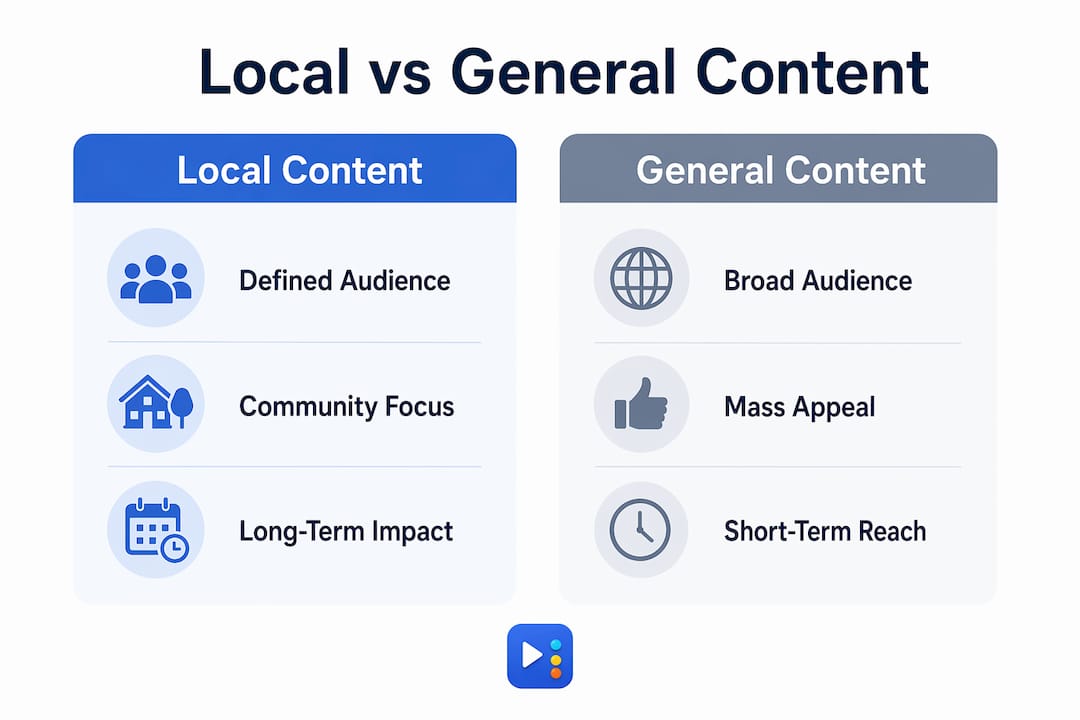
Local content compounds over time in a way paid media cannot replicate. A well-written blog post about a Round Rock community event keeps driving traffic for months. A paid ad stops the moment you stop paying. That long-term return is one of the strongest advantages of local content for small businesses operating on tight budgets.
What local marketing strategies and content types actually work?
Content types that perform well locally include blogs, videos, social media posts, and coverage of local events, all tailored to local audience interests and cultural context. Each format serves a different purpose in your local marketing mix.
Here are the most effective local content marketing strategies for small businesses:
- Neighborhood-specific blog posts: Write about local problems, seasonal issues, or community news relevant to your service area. A Cedar Park HVAC company writing about summer heat prep for Central Texas homes ranks for searches no national brand targets.
- Local event coverage: Attend or sponsor community events and document them with photos and short videos. This creates shareable content and signals community involvement to both Google and your neighbors.
- Customer testimonials with location context: Feature reviews that mention your city or neighborhood. "Best nail salon in Georgetown" carries more local weight than a generic five-star review.
- Google Business Profile posts: Publish weekly updates, offers, and photos directly to your GBP. This keeps your listing active and relevant in local search results.
- Geofencing campaigns: Geofencing works best within a tight 1–5 mile radius around your physical location, scheduled during peak hours like lunch or after work. A restaurant running a geofenced ad at 11:45 a.m. targeting people within two miles captures real buying intent.
- Localized social media content: Post about local news, tag local landmarks, and use neighborhood-specific hashtags. This builds organic reach within your actual community.
- Community partnership content: Co-create content with complementary local businesses. A med spa in Austin partnering with a local fitness studio for a wellness blog series reaches both audiences at once.
- Local landing pages: Build dedicated pages for each city or neighborhood you serve. These pages rank for hyper-specific searches and convert better than generic service pages. Local landing pages are one of the most underused tools in local SEO.
Pro Tip: When running geofencing campaigns, set your radius at 1–2 miles for urban areas and up to 5 miles for suburban markets. Schedule ads to run 30 minutes before peak hours to catch people before they make a decision.
Localizing content means adapting language, visuals, and product presentation to fit local cultural and consumer behavior. A barbecue restaurant in Austin should not use the same tone or imagery as one in Seattle. Authenticity is not a soft concept here. It directly affects whether local customers feel seen.
How do you build authentic local authority through content?
Local authority is not just about publishing content. It comes from being recognized as part of the community by both people and search algorithms. Unstructured citations such as local news mentions, event sponsorships, and partnerships with local businesses provide off-page validation that affects Google rankings and community credibility.
These are the most reliable ways to build genuine local authority:
- Get mentioned in local news: Pitch story ideas to local outlets like community blogs, neighborhood Facebook groups, or regional publications. A mention in a Round Rock community newsletter carries real SEO weight.
- Sponsor local events: Your business name on a Little League banner or a charity 5K generates both offline visibility and online citations when event organizers link back to your site.
- Partner with local businesses: Cross-promote with businesses that share your audience but do not compete with you. A Georgetown florist and a local wedding photographer are a natural pair.
- Feature local voices in your content: Interview local customers, community leaders, or neighborhood figures. This creates content that only you can produce, which is the definition of original local value.
- Avoid "postcode bolting": Simply adding a city name to generic content does not create local authority. Google and your readers both recognize the difference between genuine local relevance and lazy geographic tagging.
Pro Tip: Before publishing any locally focused content, ask yourself: could a business in any other city publish this exact piece? If yes, it is not truly local. Rewrite it with a specific neighborhood, event, or community reference that only applies to your market.
Local marketing integrates both online and offline channels including events, sponsorships, social media, and local PR. Offline credibility feeds digital visibility. When your business is active in the community, that activity generates the links, mentions, and signals that strengthen your local search presence. You can learn more about building those signals through local link building strategies designed specifically for small businesses.
How do you measure and improve your local content marketing results?
Measurement turns local content from a guessing game into a repeatable system. Local searches prompt 50% of mobile users to visit a store within 24 hours. That stat shows how quickly local content can translate into real foot traffic when it aligns with search intent.
Follow these steps to track and improve your local content marketing performance:
- Set up Google Business Profile insights: Monitor search queries, profile views, direction requests, and call clicks. These metrics show whether your local content is driving real actions, not just impressions.
- Track local keyword rankings: Use tools like Google Search Console to monitor how your pages rank for city-specific and neighborhood-specific searches. Watch for movement after publishing new local content.
- Measure foot traffic changes: If you run geofencing or local event campaigns, compare in-store traffic before and after. Many point-of-sale systems and Google Analytics can help correlate digital activity with physical visits.
- Monitor engagement on local social posts: Track shares, comments, and saves on posts tied to local topics. High engagement on neighborhood-specific content confirms you are hitting the right audience.
- Review and iterate monthly: Pull your top-performing local content each month. Identify what topics, formats, and locations drove the most engagement, then produce more of that content.
Effective local content marketing increases foot traffic and online orders while building stronger community ties. The businesses that win locally are the ones that treat measurement as a habit, not an afterthought. Aligning your content with near me search intent is one of the fastest ways to close the gap between content creation and actual customer visits.
Key Takeaways
Local content marketing builds measurable community trust and local search visibility by creating geographically specific content that general marketing strategies cannot replicate.
| Point | Details |
|---|---|
| Definition clarity | Local content marketing targets a defined geographic audience, not just any audience with a city name added. |
| Content compounds | Blog posts, event coverage, and local testimonials keep driving traffic long after paid ads stop. |
| Authority requires authenticity | Unstructured citations from local news, events, and partnerships strengthen both Google rankings and community trust. |
| Geofencing drives foot traffic | A 1–5 mile radius campaign timed to peak hours converts local intent into same-day store visits. |
| Measure what matters | Google Business Profile insights and local keyword rankings show whether content is producing real business results. |
Why local content marketing is the long game worth playing
I have worked with small businesses across Central Texas long enough to see a clear pattern. The ones that treat local content as a core part of their marketing consistently outperform the ones chasing paid ads alone. Not because content is trendy. Because it builds something paid media cannot: a reputation that lives in the community.
The mistake I see most often is businesses treating local content as a checkbox. They publish one blog post with a city name in the title and wonder why nothing changes. Real local authority comes from showing up consistently, covering topics that matter to your specific neighborhood, and being genuinely part of the community conversation.
The businesses I respect most in this space do something simple but rare. They create content that only they could create. A nail salon in Pflugerville writing about nail care tips for Central Texas summers. A Georgetown restaurant covering the story behind a local ingredient supplier. That kind of content cannot be copied by a national brand. It is defensible, specific, and deeply effective.
My honest advice: start with one piece of truly local content per month. Make it specific enough that someone in your city would share it with a neighbor. Build from there. The compounding effect of authentic local content is one of the most underrated growth strategies available to small businesses right now.
— Tran
How Yourlocalseo helps you put local content marketing into practice
Small businesses in Pflugerville, Austin, Round Rock, and across Central Texas work with Yourlocalseo to turn local content strategy into real search visibility and customer leads.

Yourlocalseo handles Google Business Profile optimization, local citation building, on-page SEO, and content strategy built around your specific service area. Every plan starts with understanding your local market, not applying a generic template. If you want a local presence that drives real foot traffic and phone calls, visit Yourlocalseo to see how we build it. We also offer a free consultation to walk through what local content opportunities exist in your market right now.
FAQ
What is local content marketing in simple terms?
Local content marketing is the practice of creating content specifically for a defined geographic audience to build trust and visibility within that community. It goes beyond adding a city name to generic content.
How does local content marketing differ from local SEO?
Local SEO focuses on appearing in map packs and local search listings. Local content marketing builds broader community awareness and preference through relevant, location-specific content that supports those SEO efforts.
What are the best examples of local content?
Strong examples include neighborhood-specific blog posts, local event coverage, customer testimonials that mention your city, and Google Business Profile posts tied to local news or seasonal topics.
How do I start local content marketing for my small business?
Start by publishing one piece of genuinely local content each month, such as a blog post about a local issue or event relevant to your service area. Pair it with active Google Business Profile updates and local social media posts.
Why does local content marketing matter for small businesses?
Local searches drive 50% of mobile users to visit a store within 24 hours. Local content positions your business to capture that intent before a competitor does.