
Most business owners assume that any page mentioning their city will rank locally. That assumption is costing them leads every single day. The real answer to why use local landing pages goes much deeper than dropping a city name into a generic service page. Properly built location pages are conversion-focused assets that align with exactly what nearby searchers are looking for, at exactly the right moment. This article breaks down what local landing pages actually are, the tangible benefits they deliver, and what separates pages that rank and convert from pages that get ignored.
Table of Contents
- Key takeaways
- Why use local landing pages
- Real benefits for small businesses
- What makes local pages succeed or fail
- How to create and optimize local landing pages
- Measuring and maintaining your local pages
- My honest take on why most local pages underperform
- Ready to build location pages that actually rank?
- FAQ
Key takeaways
| Point | Details |
|---|---|
| Local pages beat generic pages | Location-specific pages match searcher intent far better than a homepage, improving both rankings and conversions. |
| City-name swapping fails | Thin or duplicate pages with only a swapped city name risk penalties and rarely rank well long-term. |
| GBP links to location pages | Each Google Business Profile listing should point to its own dedicated landing page, not the homepage. |
| One page, two channels | A well-built local landing page supports both organic SEO and paid search campaigns simultaneously. |
| Ongoing management matters | Regular audits and content updates keep local pages competitive and prevent thin-content issues from developing. |
Why use local landing pages
A local landing page is a dedicated web page built to target a specific combination of service and location. Think "nail salon in Round Rock" or "HVAC repair in Pflugerville." The goal is to match the exact search a nearby customer is typing, then give that visitor every reason to call, book, or walk in.
This is different from what a landing page does in a general marketing sense. A generic landing page might promote a product to anyone, anywhere. A local landing page narrows the focus to a defined geography and a defined need at the same time.
Here is what separates a real local landing page from a standard service page or homepage:
- Geographic targeting: The page explicitly targets a city, neighborhood, or service area, not just a broad industry keyword.
- Service specificity: It focuses on one service or service category rather than listing everything the business does.
- Local signals: It includes the business name, address, phone number (NAP), operating hours, an embedded map, and locally relevant content.
- Conversion focus: The call to action is direct and local. "Call our Pflugerville team today" performs better than "Contact us."
- GBP alignment: Local landing pages function as the digital anchor for each Google Business Profile listing, tying the online profile to a substantive page on your website.
One nuance worth knowing: a page without a verified physical location can still rank organically for local keywords, but it will not appear in the Google Map Pack. For Map Pack inclusion, you need a verified Google Business Profile with a physical address pointing to that page.
Real benefits for small businesses
Investing time in local landing pages is not just an SEO checkbox. The benefits of local landing pages show up in rankings, lead quality, and actual revenue. Here is what changes when you do this right:
- Higher local search rankings: Pages built around specific location and service keywords consistently outrank generic service pages for geographic queries. Google rewards relevance, and a dedicated page signals it clearly.
- Better lead quality: Local pages tie your services explicitly to a location, which means the people who find you are already in your service area and ready to act. Fewer calls from people two counties away.
- Stronger conversion rates: Sending a local searcher to your homepage creates friction. They have to figure out whether you even serve their area. A local landing page removes that friction entirely by aligning intent with a focused experience.
- Trust through local proof: Pages that feature reviews from people in the same neighborhood, photos of local projects, or staff who live nearby build credibility fast. Social proof from the local community directly increases purchase confidence.
- Dual-channel efficiency: The same page that ranks organically can power a Google Ads campaign targeting the same geography. One page supports both channels because relevance signals work similarly across paid and organic search.
- Per-location performance tracking: When each location has its own URL, you can measure traffic, rankings, and conversions by location. That data tells you which markets need more investment and which are already winning.
Pro Tip: If you run PPC campaigns and send paid traffic to your homepage, you are almost certainly wasting budget. A local landing page built for the same keyword your ad targets will lower your cost-per-click and improve your conversion rate at the same time.
What makes local pages succeed or fail

This is where most businesses go wrong. They build location pages, see no results, and conclude that local landing pages do not work. In almost every case, the page was the problem, not the strategy.
Here are the most common failure modes, ranked by how often we see them:
-
City-name swapping without unique content. Copying a service page and replacing "Austin" with "Round Rock" is the fastest path to a thin-content penalty. Unique, locally relevant content is the single most reliable predictor of whether a local page ranks. Google has gotten very good at detecting pages that are structurally identical.
-
Launching hundreds of template pages at once. A common real-world failure is publishing dozens or hundreds of location pages that differ only by address and city name. This approach often leads to poor rankings or manual penalties. Each page needs locally specific proof: staff names, project photos, local FAQs, neighborhood references.
-
Linking Google Business Profiles to the homepage. Every Google Business Profile listing should point to its dedicated location page, not your homepage. This connection improves local pack visibility and click-through rates by 20 to 25 percent.
-
Creating doorway pages. A doorway page exists only to rank for a keyword and then redirect users elsewhere, or delivers no real value. Google penalizes these. Your local landing page needs to be a genuinely useful destination, not a stepping stone.
-
Ignoring mobile usability. Most local searches happen on phones. A page that loads slowly or requires pinch-and-zoom to read an address will lose that visitor immediately.
| Page type | What it looks like | Typical outcome |
|---|---|---|
| Thin template page | Copy-pasted service page with swapped city name | Poor rankings, possible penalty |
| Genuine location page | Unique content, local proof, correct NAP | Strong local rankings, good conversions |
| Doorway page | Keyword-optimized page with no real value | Manual penalty risk |
| Homepage as location page | Generic homepage linked from GBP | Missed Map Pack opportunity, lower CTR |
Pro Tip: For multi-location businesses, use a tiered investment approach. Give your top two or three markets fully custom pages with unique photography, local testimonials, and staff bios. Build simpler but still unique pages for secondary markets. Never publish pages that are identical except for the city name.
How to create and optimize local landing pages
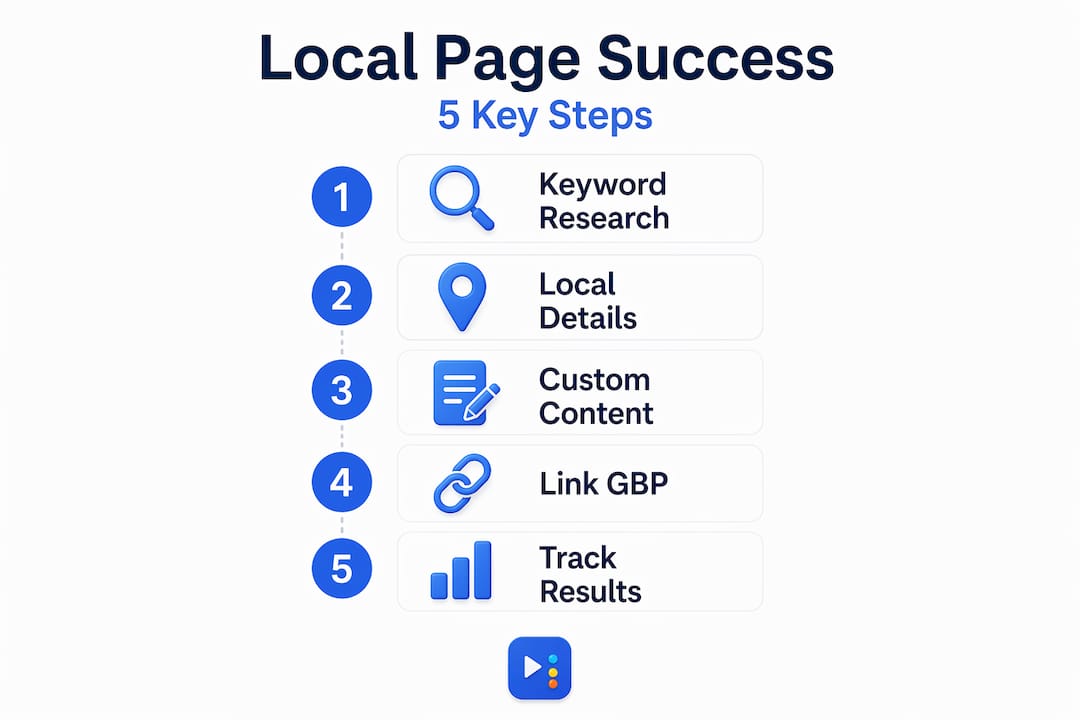
Creating a local landing page that actually ranks and converts is not complicated, but it does require intention. Here is a practical framework:
Research before you write
Start with keyword research focused on location plus service combinations. Look at what real people in your target city are searching for. Tools like Google Search Console can show you which geographic queries are already sending traffic to your site, and where gaps exist.
Build the content around local reality
Write content that could only apply to that specific location. Mention local landmarks, reference the neighborhoods you serve, include photos from jobs you have done in that city. Generic content that happens to mention a city name is not the same as content that is genuinely about serving people in that city.
Essential local landing page elements include:
- Accurate NAP (name, address, phone number) that matches your Google Business Profile exactly
- Embedded Google Map pointing to your business location
- Local operating hours, especially if they differ by location
- Location-specific FAQs that address questions unique to that market
- Photos of your team, your work, or your location in that city
- Reviews and testimonials from customers in that area
- A single, clear call to action that matches local intent ("Book your appointment in Cedar Park")
Connect your GBP precisely
Once the page is live, update your Google Business Profile to link directly to that location page URL. This creates the signal loop that Google uses to associate your business with a specific service area. A mismatched or missing link here is one of the most common local SEO mistakes we see.
Use the page for paid campaigns too
If you run Google Ads for any of your locations, point those campaigns to the matching local landing page rather than your homepage or a generic service page. The geographic and topical relevance of the page improves your Quality Score, which lowers your cost-per-click and pushes your ad higher.
Pro Tip: Use UTM parameters to track traffic arriving at each local page from paid campaigns separately from organic traffic. This gives you clean data to compare the cost and performance of each channel per location.
Measuring and maintaining your local pages
Building the pages is only step one. Keeping them performing requires ongoing attention. Here is what to track and when to act:
- Local search rankings: Monitor keyword rankings for your target location plus service combinations at least monthly. A drop in rankings often signals a content or technical issue on the page.
- Organic traffic by location: Use Google Analytics or Search Console to segment traffic by landing page URL. Pages losing traffic over time need a content refresh or stronger local signals.
- Conversion rate per page: Track calls, form submissions, and direction requests separately for each location page. Low traffic with high conversion is different from high traffic with low conversion, and each problem has a different fix.
- NAP consistency: Run periodic audits to confirm that the name, address, and phone number on each page matches your Google Business Profile and all directory listings exactly. Even a formatting difference can weaken local signals.
- Content freshness: Update pages when your services change, when you get new local reviews worth featuring, or when local events or context makes new content relevant. Pages that stay static for too long gradually lose authority.
For businesses expanding into new markets, a phased rollout works better than launching all location pages at once. Launch your two or three priority locations, monitor performance for 60 to 90 days, then use what you learn to improve the template before scaling.
My honest take on why most local pages underperform
I have worked with local businesses across Central Texas, from nail salons in Pflugerville to service contractors covering multiple Austin suburbs, and the pattern I keep seeing is the same. Business owners understand that they need location pages. They build them. Then nothing happens, and they decide local SEO does not work for their industry.
What actually happened is that the pages were never going to work. They were clones. Same content, different city. No local photos, no local reviews, no staff information tied to that area. Google is not going to reward a page that exists only to target a keyword. It rewards pages that genuinely serve the person searching.
The other mistake I see constantly is treating GBP management and website management as separate projects that never talk to each other. When your Google Business Profile links to your homepage while you have a perfectly good location page sitting on your website, you are leaving visibility on the table. The GBP and the location page have to work together.
My experience is that the businesses that win local search are the ones that treat their location pages as living assets, not one-time publishing tasks. They update them. They add new reviews. They refine the copy based on what is actually converting. That kind of ongoing management is what separates a page that ranks in month two from one that still ranks in year three.
— Tran
Ready to build location pages that actually rank?
At Yourlocalseo, we help small businesses across Pflugerville, Austin, Round Rock, Georgetown, Cedar Park, and surrounding Central Texas communities build local landing pages that drive real leads. We do not sell templates. Every page we build is written for your specific location, tied precisely to your Google Business Profile, and optimized for both organic rankings and paid campaigns.

Our local SEO services include location page creation, GBP optimization, citation building, and review generation, all managed together as a coordinated strategy. We also track rankings and conversions by location so you always know what is working. If you want to stop losing local customers to competitors with better-optimized pages, reach out to our team today.
FAQ
What is a local landing page?
A local landing page is a web page built to target a specific service and geographic area combination, such as "plumber in Georgetown, TX." It includes location-specific content, accurate contact details, and a focused call to action designed to convert nearby searchers.
Why use local landing pages instead of just a homepage?
Homepages are too broad to rank for specific local searches and create friction for visitors who want to confirm you serve their area. Local landing pages match searcher intent precisely, which improves both rankings and conversion rates.
Do local landing pages help with Google Maps rankings?
A verified Google Business Profile linked to a dedicated local landing page improves Map Pack visibility and click-through rates. Pages without a verified physical address can rank organically but will not appear in the Google Map Pack.
How many local landing pages does my business need?
You need one page per location and service combination that you actively want to rank for. A business serving five cities with three core services could benefit from up to 15 dedicated pages, provided each one has genuinely unique local content.
What is the biggest mistake businesses make with local pages?
The most common failure is publishing multiple location pages that differ only by city name. Thin or duplicate pages rarely rank and can trigger Google penalties. Each page needs unique content, local proof, and precise GBP alignment to perform.