

Customer reviews are a confirmed local search ranking factor, directly influencing where your business appears in Google's Map Pack alongside name relevance and physical proximity. Google treats review count, average rating, recency, and review content as measurable signals of business prominence. A nail salon in Pflugerville with 80 recent, detailed reviews will consistently outrank a competitor with 12 older ones, even if both businesses are equally close to the searcher. Understanding why reviews matter for ranking gives you a concrete lever to pull, not just a reputation management task to check off.
Why reviews matter for ranking in local search
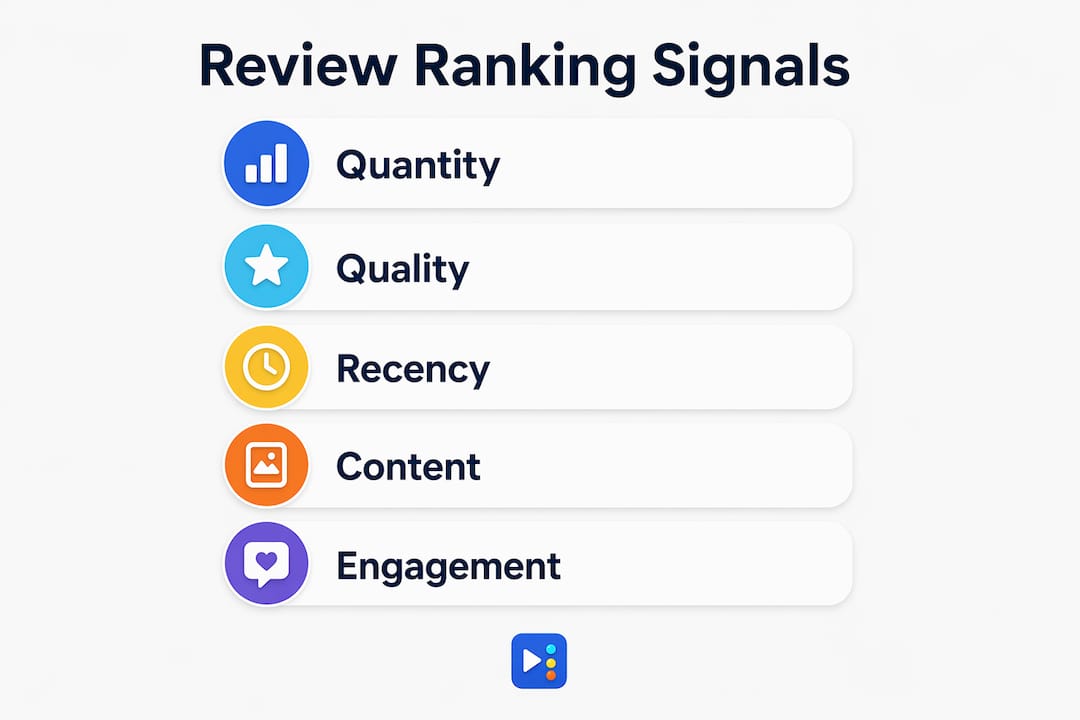
Google uses four distinct review signals to evaluate local businesses: quantity, quality, recency, and content. Each signal plays a different role in the local ranking algorithm, and review count and average rating rank alongside business name relevance and physical proximity in Map Pack visibility. That means your review profile is not a soft trust signal. It is a hard algorithmic input.
Here is how each signal works:
- Quantity: More reviews signal greater business prominence relative to nearby competitors. Volume alone does not guarantee top placement, but it raises your floor.
- Quality: Your average star rating affects both consumer trust and click-through rate. Ratings below 4.0 hurt both metrics simultaneously.
- Recency: Google favors businesses with reviews posted within the last 90 days. Older reviews lose ranking weight over time.
- Content: Keywords naturally mentioned in reviews, such as service names and neighborhood references, serve as additional relevance signals for Google's algorithm.
Reviews also provide verifiable third-party evidence of real customer experience, which directly supports Google's E-E-A-T quality standards. Google cannot verify what you say about yourself, but it can read what your customers say about you.
Pro Tip: Ask customers to mention the specific service they received and the city or neighborhood. A review that says "best deep tissue massage in Round Rock" carries more ranking weight than one that says "great place."

How reviews influence search results through user behavior
Reviews do not only affect ranking directly. They also shape the behavioral signals that Google uses to refine rankings over time. Interactive business pages with reviews engage visitors significantly longer than pages without them. Longer dwell time signals content quality to Google, which feeds back into long-term visibility.
Rich snippets add another layer. Implementing AggregateRating schema, the structured data markup that displays star ratings in search results, can increase click-through rate by 20–30% without changing your actual ranking position. That CTR lift sends Google a strong behavioral signal that your listing is the most relevant result, which can push your ranking up over time.
The cycle works like this: more reviews generate higher ratings, higher ratings produce better click-through rates, better click-through rates signal relevance to Google, and Google rewards that relevance with higher placement. Reviews are the starting point of that entire loop.
Pro Tip: Add AggregateRating schema to your website's service pages, not just your Google Business Profile. This pulls star ratings into organic search results and increases clicks from people who never reach the Map Pack.
Best practices for building a review profile that ranks
Consistency beats volume. A steady review velocity of 5–15 new reviews per month correlates strongly with improved Map Pack ranking. Bursty patterns, such as 40 reviews in one week followed by nothing for three months, look unnatural and are less effective than a steady drip.
Follow these steps to build a review profile that actually moves rankings:
- Ask at the right moment. Request a review immediately after a positive service interaction, while the experience is fresh. A text message with a direct link to your Google Business Profile review page converts far better than a follow-up email sent three days later.
- Target the 4.2–4.7 star range. This is the sweet spot for local prominence. Ratings in this range maximize both consumer trust and algorithmic favorability.
- Guide customers toward detail. Prompt them with a specific question: "What service did you get, and what did you like most?" Detailed responses that mention your services and location provide stronger ranking signals than generic praise.
- Respond to every review. A 50%+ response rate on positive reviews correlates with stronger Map Pack visibility. Your response adds keyword-relevant content to the listing and signals active engagement to Google.
- Never incentivize or fabricate reviews. Google's spam filters flag suspicious patterns. Fake reviews risk profile suspension, which erases every ranking gain you have built.
Pairing your review strategy with a fully optimized Google Business Profile multiplies the impact of each signal. Reviews alone will not rank a neglected profile.
Pro Tip: Build a simple review request workflow into your checkout or follow-up process. A QR code at the register or a one-tap link in a post-appointment text removes all friction from the ask.
Common misconceptions about reviews and search engine visibility
Several widely held beliefs about reviews actively hurt local businesses that follow them. Understanding the nuances separates businesses that rank from those that stall.
Perfect 5.0 ratings are not always better
A perfect 5.0 rating with a high volume of reviews can trigger Google's spam filters and reduce consumer trust due to perceived artificiality. Real businesses get occasional 3-star and 4-star reviews. A profile with 200 five-star reviews and zero negative feedback looks manufactured to both Google and potential customers.
Volume without recency loses its value
A business with 300 reviews, all posted before 2023, signals an inactive or declining operation. Consistent recent review flow is more impactful than a large volume of stale reviews. Google interprets fresh reviews as evidence that the business is currently operating and serving customers.
Here is a quick comparison of review profile patterns and their ranking impact:
| Review profile pattern | Ranking impact |
|---|---|
| High volume, all older than 12 months | Low. Signals inactive business. |
| Low volume, all recent (last 90 days) | Moderate. Recency helps but quantity limits prominence. |
| Steady velocity, mix of recent and historical | High. Signals active, established business. |
| Sudden spike, then silence | Suspicious. May trigger spam review. |
| 4.2–4.7 stars with detailed content | Highest. Combines trust, relevance, and algorithmic favor. |
Other common misconceptions worth correcting:
- Generic one-word reviews like "great" or "loved it" help your count but add negligible SEO value. Detailed reviews mentioning service names and locations provide far stronger signals.
- Your review count matters relative to your local competitors, not as an absolute number. Ranking in a small suburb requires far fewer reviews than ranking in a major metro.
- Review responses are not just courtesy. They add keyword-rich content to your listing and contribute measurable trust signals to Google's evaluation.
Understanding these nuances is what separates a review strategy that drives real local search visibility from one that just looks busy on the surface.
Key Takeaways
Customer reviews directly drive local search rankings through four measurable signals: quantity, quality, recency, and content, and businesses that manage all four consistently outrank those that focus on volume alone.
| Point | Details |
|---|---|
| Reviews are a confirmed ranking factor | Google uses review count, rating, recency, and content in its local ranking algorithm. |
| Recency outweighs volume alone | Reviews posted within the last 90 days carry more weight than a large pool of older ones. |
| The 4.2–4.7 star range ranks best | Perfect 5.0 ratings can trigger spam filters; moderate high ratings build more trust. |
| Detailed reviews outperform generic ones | Reviews mentioning services and locations add keyword relevance that generic praise does not. |
| Response rate signals engagement | A 50%+ response rate on reviews correlates with stronger Map Pack placement. |
What I've learned from building review strategies for local businesses
Working with small businesses across Central Texas, I have seen the same pattern repeat itself. A business owner spends months building a website, setting up their Google Business Profile, and running ads, then wonders why a competitor with a simpler online presence keeps outranking them. Nine times out of ten, the answer is reviews.
The hardest part is not getting the first review. It is building the habit of asking consistently. Most business owners ask when they remember, which means they ask in bursts. That burst pattern is exactly what Google's algorithm discounts. The businesses that rank well in the Map Pack treat review collection the same way they treat payroll. It happens on a schedule, not when someone remembers.
I also want to push back on the obsession with star ratings. Owners sometimes panic when they get a 3-star review. That review, if you respond to it thoughtfully and honestly, often does more for your ranking and your reputation than ten generic 5-star reviews. Transparency builds trust with real customers, and it signals to Google that your profile reflects genuine activity.
The most effective approach I have seen combines review velocity, detailed content prompts, and consistent responses into a single repeatable workflow. When that workflow connects to a broader local SEO strategy, including attracting local customers online through citations, on-page SEO, and Google Business Profile optimization, the ranking gains compound quickly.
— Tran
How Yourlocalseo helps you turn reviews into rankings
Yourlocalseo works with small businesses in Pflugerville, Austin, Round Rock, and surrounding Central Texas communities to build review strategies that produce real Map Pack results.

We handle the full review workflow: setting up request systems, monitoring incoming reviews, crafting keyword-rich responses, and tracking velocity month over month. Every review strategy we build connects directly to your Google Business Profile optimization so that each new review reinforces your overall local search presence. If your review profile is stalling your rankings, we can show you exactly where the gaps are and fix them.
FAQ
Do reviews directly affect Google rankings?
Yes. Google confirms that review count and average rating are core local search ranking factors, ranking alongside business name relevance and physical proximity in Map Pack results.
How many reviews do I need to rank locally?
The number depends on your local competitors, not an absolute threshold. What matters more than total count is maintaining a steady velocity of 5–15 new reviews per month.
Does responding to reviews help SEO?
Yes. Responding to reviews adds keyword-relevant content to your listing and signals active engagement. A 50%+ response rate on positive reviews correlates with stronger Map Pack visibility.
What star rating is best for local SEO?
The 4.2–4.7 star range produces the best results. Perfect 5.0 ratings with high volume can appear artificial and may trigger Google's spam filters.
Do review keywords actually help rankings?
Yes. Review text that mentions specific services and locations provides additional relevance signals to Google's algorithm, reinforcing your business's topical and geographic context.