

Salon meta tags are the HTML title and description elements that tell Google what each page on your website is about. Knowing how to optimize salon meta tags is the single most direct way to turn search impressions into booked appointments. Title tags and service pages drive 70–80% of on-page SEO results for salon websites. That number means your meta tags are not a minor detail. They are the foundation of your local search visibility.
What are the essential components of effective salon meta tags?
A salon meta tag has two parts: the title tag and the meta description. Each one does a different job, and both need to be written with precision.
The title tag is the blue clickable headline in Google search results. It tells Google and your potential clients what the page covers. The industry standard is 50–60 characters. Go longer and Google truncates it. Go shorter and you waste valuable keyword space. A strong title tag for a balayage service page looks like this: "Balayage Hair Color | Austin Salon | Studio Glow." It names the service, the city, and the brand in under 60 characters.

The meta description is the short paragraph under the title in search results. Titles under 60 characters and descriptions around 150–160 characters with a clear call to action improve click-through rates. A well-written meta description for a keratin treatment page might read: "Smooth, frizz-free hair starts here. Book your keratin treatment at our Austin salon today. Same-week appointments available." That sentence names the service, the location, and gives the reader a reason to click.
Common pitfalls to avoid:
- Keyword stuffing: Writing "Austin hair salon Austin balayage Austin color" reads as spam to Google and to clients.
- Generic descriptions: "We offer many hair services" tells Google nothing specific and gives clients no reason to click.
- Duplicate tags: Using the same title and description on every page confuses Google about which page to rank for which service.
- Missing location: Leaving out your city name removes you from local search results entirely.
Pro Tip: Write your meta description like a two-sentence ad. Lead with the benefit, end with a booking call to action. That structure consistently outperforms descriptive-only copy.
How to research and select the right keywords for salon meta tags
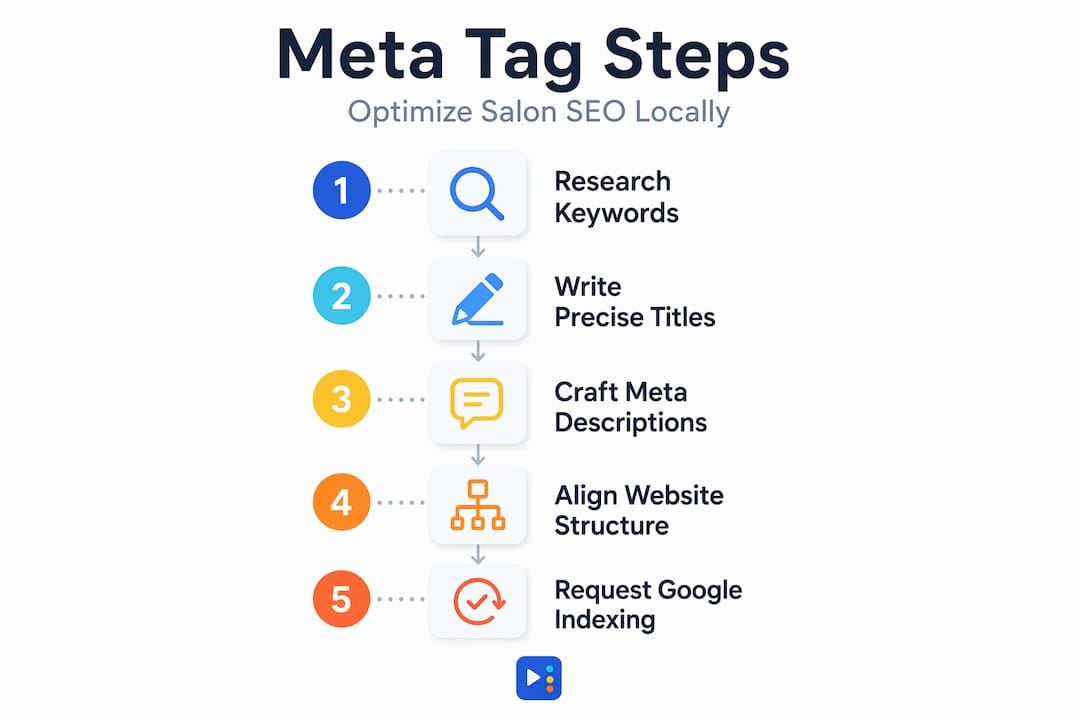
The right keywords connect what your clients type into Google with the exact services you offer. Generic terms like "hair salon" are too broad. Specific service and location combinations win local search.
Follow these four steps to build your keyword list:
- List every revenue-generating service. Write down balayage, keratin treatment, Brazilian blowout, highlights, haircut, color correction, and every other service you offer. Each one is a potential keyword and a potential page.
- Add your geographic modifiers. Pair each service with your city, neighborhood, or zip code. "Balayage in Round Rock" and "keratin treatment Cedar Park" are the types of phrases your clients actually search.
- Check search intent. A client searching "balayage near me" wants to book. A client searching "what is balayage" wants information. Target booking-intent phrases in your meta tags.
- Research local competition. Search your top services in Google and note what titles and descriptions appear in the local pack. Look for gaps where your competitors use vague language. That gap is your opportunity.
Service-specific meta tags tailored to each offering, such as "Balayage in Austin," increase your eligibility for relevant search queries. Generic pages cannot compete with pages built around a single service and a single location.
The table below shows how to move from a weak keyword to a strong meta tag phrase:
| Weak keyword | Strong meta tag phrase |
|---|---|
| Hair salon | Balayage salon in Austin, TX |
| Color services | Hair color correction |
| Treatments | Keratin treatment |
| Haircut | Women's haircut and blowout |
Pro Tip: Use Google's autocomplete and the "People also ask" box to find the exact phrases your local clients type. Those suggestions are real search data, not guesses.
How do meta tags connect to your website structure and Google Business Profile?
Meta tags do not work in isolation. They perform best when they match the structure of your website and align with your Google Business Profile categories and service listings.
The most effective approach is to create one dedicated landing page for each major service. Your balayage page gets its own URL, its own title tag, and its own meta description. Your keratin treatment page gets the same treatment. Consistent service and city keywords across your website and Google Business Profile are the key driver of local search relevance. When Google sees "balayage Austin" in your page title, your URL, your page content, and your GBP service list, it treats your page as the authoritative answer for that query.
Here is how to align each element:
- Service pages: Build a dedicated page for every major service. Use the service name and city in the title tag, URL slug, and H1 heading.
- Google Business Profile: Add the same services to your GBP service list. Use matching terminology. If your page says "balayage," your GBP should say "balayage," not "hair coloring."
- Schema markup: Add LocalBusiness and Service schema to your pages. This structured data helps Google understand your location, hours, and services without relying solely on your meta tags.
- Photos and staff bios: Quality photos and stylist bios build trust after a client clicks through from search results. Meta tags get the click. Photos and bios convert the click into a booking.
Local landing pages that combine precise meta tags with location-specific content are the most reliable path to ranking in the local map pack. Salons that align their GBP and website structure appear in local pack results within 60–120 days of consistent optimization. That timeline is realistic when every element points in the same direction.
Pro Tip: After updating your meta tags, log into Google Search Console and request indexing for each updated page. Google will crawl the new tags faster than waiting for the standard crawl cycle.
Common mistakes that hurt salon meta tag performance
Most salon websites make the same small errors that quietly kill their local search rankings. Recognizing these mistakes is the first step to fixing them.
- Duplicate titles and descriptions: Copying the same meta tags across multiple pages tells Google those pages cover the same topic. Google picks one to rank and ignores the rest. Every page needs a unique title and description.
- Keyword stuffing: Repeating your city name or service five times in a 60-character title triggers Google's spam filters. Write for the client first. One clear service plus one clear location is enough.
- Outdated content: A meta description promoting a summer special in december signals to Google that your site is not actively maintained. Updating meta tags to reflect new offers improves click-through rates and keeps your site timely.
- Missing calls to action: A meta description that only describes the service misses the chance to prompt a booking. Add "Book today," "Call now," or "Same-week appointments" to every description.
- Ignoring click-through rate data: Google Search Console shows you exactly which pages get impressions but few clicks. A low click-through rate on a high-impression page means your meta tags are not compelling enough. Rewrite them.
"Duplicate meta descriptions reduce page relevancy in Google's index, and keyword stuffing triggers ranking penalties. Both errors are common and both are fully preventable with a simple page-by-page audit."
Common salon meta tag mistakes including duplicate descriptions, missing location keywords, and keyword stuffing directly harm SEO performance. The fix is a quarterly audit. Open Google Search Console, check your top pages for duplicate tags, and rewrite any description that does not include a service name, a location, and a call to action.
Key takeaways
Salon meta tags drive local search visibility when they combine a specific service name, a city modifier, and a clear call to action on every individual page.
| Point | Details |
|---|---|
| Title tag length | Keep titles at 50–60 characters with service name and city included. |
| Meta description structure | Write 150–160 characters with a service benefit and a booking call to action. |
| Service-specific pages | Build one dedicated page per service and give each page unique meta tags. |
| GBP alignment | Match service keywords across your website and Google Business Profile exactly. |
| Regular updates | Audit and refresh meta tags quarterly to reflect new services and promotions. |
Why meta tags still matter more than most salon owners realize
Salon owners often ask me whether meta tags still matter when Google keeps changing its algorithm. My answer is always the same: meta tags are the one element you fully control. You cannot control how Google ranks your competitors. You cannot control what clients say in reviews. But you can write a title tag that says exactly what you do, exactly where you do it, and exactly why someone should click.
The mistake I see most often is treating meta tags as a one-time setup task. Salon owners write them once during a website build and never revisit them. Six months later, they have a summer promotion running on the floor but a meta description still advertising a spring special. That disconnect costs clicks every single day.
The salons that win local search in competitive markets like Austin and Round Rock are not necessarily the ones with the biggest budgets. They are the ones with the most specific, most current, and most consistent metadata across every page. A single well-written meta tag for a keratin treatment page in Cedar Park can outperform a generic salon homepage in a major city. Specificity beats scale in local SEO every time.
Combining precise meta tags with a fully built-out Google Business Profile and local search visibility tactics is the approach we recommend to every salon client. It is not complicated. It just requires consistency and attention to detail.
— Tran
Yourlocalseo helps salons rank where it counts
Yourlocalseo works with salons, nail studios, and med spas across Pflugerville, Austin, Round Rock, and the surrounding Central Texas area to build local search visibility that drives real bookings.

We handle the full picture: service page builds, meta tag writing, Google Business Profile setup, citation management, and review generation. Every strategy is built around your specific services and your specific location. If your salon is not showing up when clients search for your services nearby, your meta tags are likely the first place to fix. Visit Yourlocalseo to get a local SEO review tailored to your salon and start showing up where your clients are already looking.
FAQ
What is the ideal length for a salon title tag?
Salon title tags perform best at 50–60 characters. Include the service name, your city, and your salon name within that limit.
How do meta descriptions affect salon bookings?
A well-written meta description with a service name, location, and call to action increases click-through rates from search results. More clicks from qualified local searchers directly translate to more booking inquiries.
Should every salon service have its own meta tags?
Yes. Unique meta tags for each service outperform generic pages in local search. A dedicated balayage page with its own title and description ranks for balayage queries. A generic "services" page does not.
How often should I update my salon meta tags?
Review and update your meta tags at least once per quarter. Refresh descriptions to reflect seasonal promotions, new services, or staffing changes to keep your pages timely and relevant.
Do meta tags need to match my Google Business Profile?
Yes. Matching service keywords across your website meta tags and Google Business Profile strengthens your local search relevance and improves your chances of appearing in the local map pack.