

If you're a small business owner in Austin who's tired of chasing leads that go nowhere, you already understand the core problem. The lead generation process in Austin isn't just about getting more contacts. It's about getting the right contacts, moving them through a predictable system, and converting them into paying customers without burning through your week. Austin's market is competitive, local-savvy, and moves fast. A disconnected collection of tactics won't cut it. What works is a structured, step-by-step approach that ties your SEO, outreach, scoring, and follow-up into one coherent system.
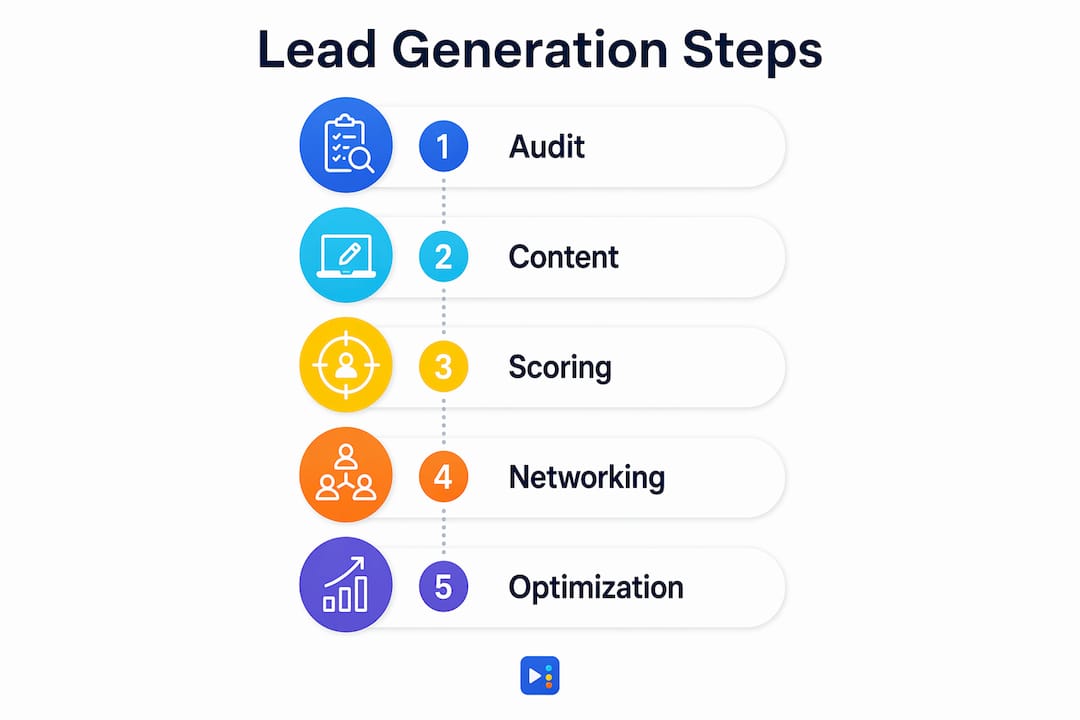
Key takeaways
| Point | Details |
|---|---|
| Audit before you scale | Map your current lead sources and find where qualified prospects are dropping off before spending more. |
| Build Austin-targeted SEO content | Use pillar and satellite content clusters around local keywords to attract high-intent buyers. |
| Score leads with behavioral signals | AI-based lead scoring cuts qualification time dramatically and focuses your sales effort on real prospects. |
| Networking supplements digital | Structured Austin events like Alignable speed networking add high-quality contacts your SEO won't reach. |
| Measure what moves revenue | Track cost per qualified lead, conversion rate, and qualification time to spot and fix weak points fast. |
Understanding the lead generation process in Austin
The professional term for what most people call "lead gen" is demand generation and conversion, and it starts long before a sale. It begins with understanding exactly where your current leads come from and where you're losing them.
Start by mapping every source that brings contacts into your business right now. For most Austin small businesses, that includes some combination of Google search, referrals, social media, local events, and directory listings. Write them all down. Then trace what happens to leads from each source after initial contact.
Here is what that audit typically surfaces:
- Google search leads often arrive with high intent but get lost if your contact form or call response is slow
- Referral leads convert well but arrive unpredictably with no system to scale them
- Social media leads can be high volume but low qualification, wasting sales time
- Event contacts tend to be forgotten after the first week without a follow-up workflow
Without a scoring layer, 70% of leads drop off at the qualification stage. That means most of the contacts you're collecting never become real opportunities, not because they weren't interested, but because no system was in place to identify and prioritize the good ones.
Use a simple spreadsheet or a free CRM like HubSpot to log lead source, first contact date, and current status. After 30 days, calculate how many leads from each source moved to a discovery call or quote request. That number tells you which channels earn more of your time and which ones are draining it.
Pro Tip: Don't optimize for the channel with the most leads. Optimize for the channel with the best lead-to-close ratio. A single high-quality referral beats ten cold social media contacts.
| Lead source | Avg. qualification rate | Effort to scale |
|---|---|---|
| Google organic search | 30% to 50% | Medium (SEO investment) |
| Referrals | 50% to 70% | Low (relationship-based) |
| Social media outreach | 5% to 15% | High (volume-dependent) |
| Local networking events | 35% to 55% | Medium (time investment) |
Building Austin-targeted SEO content clusters
Once you know where your best leads originate, the next step is building content that attracts more of them. For most Austin small businesses, that means investing in local SEO structured around what your buyers actually search for.
The framework that consistently works is the pillar and satellite model. Here is how to apply it to your Austin market:
- Create a pillar page around your core service. For example, "HVAC repair in Austin TX" or "mobile dog grooming Austin." This page targets your highest-value, most competitive keyword.
- Build satellite pages around related, lower-competition queries. Think "AC repair in South Austin," "HVAC maintenance tips for Austin summers," or "how much does AC repair cost in Austin." Each satellite page links back to the pillar.
- Use neighborhood-level pages to capture hyper-local searches. Austin buyers search for services "near me" and by neighborhood, so pages targeting Zilker, Mueller, or Cedar Park add real search value.
- Optimize every page for mobile. Check mobile SEO best practices before publishing, since the majority of local searches happen on phones.
- Build citations and local backlinks. Get listed in Austin-specific directories, local chambers of commerce, and community blogs. These off-page SEO signals tell Google your business is genuinely embedded in the local market.
Businesses deploying this kind of structured local content see real results. Deploying SEO-optimized pages focused on Austin keywords has been shown to elevate conversions by 22%. One local MSP using both SEO clusters and AI intent scoring increased inbound conversion from 8% to 34% after deploying the combined approach.
The local SEO workflow for Central Texas used by effective Austin businesses always combines on-page keyword targeting, internal linking between cluster pages, and consistent Google Business Profile updates.
Pro Tip: Before writing new content, search your target keyword in Google and look at the "People Also Ask" section. Each question there is a satellite page waiting to be built.
| SEO tactic | Impact on lead quality | Time to results |
|---|---|---|
| Pillar content pages | High: attracts transactional searches | 3 to 6 months |
| Neighborhood landing pages | High: captures hyper-local intent | 2 to 4 months |
| Google Business Profile posts | Medium: drives map pack clicks | Immediate to 30 days |
| Citation building | Medium: improves local authority | 1 to 3 months |
AI-driven lead scoring and smart routing
Getting leads to your website is step one. Knowing which ones deserve your immediate attention is step two, and this is where most Austin small businesses fall behind.

Lead scoring is the process of assigning a numeric value to each contact based on their behavior and fit. Traditional scoring required a sales rep to manually review every contact. AI-based scoring does it automatically using behavioral signals like which pages someone visited, how long they spent on your pricing page, whether they searched an Austin-specific term, or whether they opened three emails in a row.
The efficiency gains are significant. AI scoring reduces lead qualification time from four to six hours down to under five minutes per lead, while increasing close rates by 35%. Manual qualification, by contrast, consumes roughly 17 hours weekly per sales rep, time that could be spent on actual sales conversations.
Here is a practical setup approach for a small Austin business:
- Choose a CRM with built-in scoring. HubSpot, Zoho, and Pipedrive all offer entry-level scoring features that work for businesses without a dedicated marketing team.
- Define your ideal buyer profile. For an Austin plumbing company, a high-score lead might be someone who visited your emergency repair page, lives in Travis County, and submitted a contact form between 6pm and 9pm.
- Set threshold alerts. When a lead crosses a score of 85 out of 100, trigger an automatic notification via Slack or SMS so your team responds within minutes. In Austin's competitive service market, fast response on high-intent leads is the difference between winning and losing a job.
- Route by service type or territory. If you cover multiple Austin neighborhoods, route roofing inquiries from North Austin to one rep and South Austin requests to another.
Ignoring this step carries a cost. Austin SaaS and tech companies that skip AI qualification lose more than $500,000 annually in pipeline value. For a small service business, the loss is proportionally painful even if the dollar figure is smaller.
Pro Tip: Start simple. Pick two or three behavioral signals that your best past customers had in common and build your initial scoring model around those. You can refine it as data accumulates.
Austin networking events as a lead source
Digital leads are scalable. Relationship-based leads are durable. The strongest Austin customer acquisition process combines both.
Austin has an active small business networking scene, and structured events are underused by most service businesses. Alignable's Local Loop ATX speed networking events use small-group rotations and timed introductions to help business owners make multiple quality contacts in a single lunch. The format is designed for efficiency. You get a focused minute or two with each person, exchange cards, and move on. No awkward mingling required.
To get real value from these events, prepare before you arrive:
- Craft a ten-second introduction that names your business, your city or neighborhood, and one problem you solve. "We help Austin restaurants show up on Google Maps when locals are searching for lunch."
- Bring physical business cards with your website and phone number. Yes, they still work, and structured quick-connect formats at Austin Alignable events make card exchanges a core part of the process.
- Follow up within 24 hours with a short, personal email. Reference something specific from your conversation to stand out.
- Add contacts to your CRM immediately after the event and assign them a lead source tag so you can track whether networking contacts convert differently than digital leads.
The real power of networking is in referrals that arrive months later. A bookkeeper you met at a Chamber event in February might send you three clients by July. You cannot attribute that in Google Analytics, but it is real revenue.
Pro Tip: Attend the same recurring events consistently. People buy from people they recognize. Showing up twice a year won't build the trust that monthly attendance does.
Measuring and optimizing your lead gen results
Building the system matters. Measuring it matters just as much. Without tracking, you are guessing at what to fix.
The metrics that tell the truth about your Austin lead generation efforts are:
- Lead-to-qualified rate by source. This shows you which channels bring real buyers, not just browsers.
- Cost per qualified lead. Divide your monthly spend (time and money) on a channel by the number of qualified leads it produces. This exposes expensive channels that feel productive but aren't.
- Average qualification time. How long does it take from first contact to a confirmed appointment or quote? Shorter is almost always better.
- Conversion rate at each funnel stage. Where are people dropping off? If 60 people visit your pricing page but only three submit a form, that page needs work.
Connecting your CRM to attribution tools closes the measurement gap most Austin small businesses ignore. When your SEO, ads, and CRM talk to each other, you can see which exact keyword, ad, or referral source is generating closed revenue, not just leads.
Run simple A/B tests on your highest-traffic lead capture points. Test two versions of a contact form headline. Test a phone call button versus a form submission button on mobile. Test sending a follow-up email at 8am versus 12pm. Small improvements in conversion rates compound quickly when applied to consistent traffic.
Pro Tip: Review your numbers monthly, not quarterly. A bad month caught early is a fixable problem. A bad quarter caught late is a cash flow crisis.
My take on why disconnected tactics fail Austin businesses
I've worked with small businesses across Austin and the surrounding Central Texas area, and I see the same pattern repeatedly. A business owner tries Google Ads, gets some calls, stops because the leads weren't great. They build a website, wait for traffic that never comes. They go to one networking event and don't follow up. Each effort is treated as a standalone experiment instead of a piece of a connected system.
What I've learned is that the businesses growing steadily in this market aren't doing more things. They're doing fewer things better, and they've connected those things so each one feeds the others. Their SEO brings in warm traffic. Their website converts that traffic into scored leads. Their CRM routes the best leads immediately. Their networking fills in the gaps where search doesn't reach.
Lead generation works best as a system, not a collection of campaigns. The moment you start treating your lead flow as infrastructure rather than a series of experiments, everything gets easier and more predictable. That shift in thinking is the one I push every Austin client toward first.
— Tran
How Yourlocalseo helps Austin businesses generate real leads
At Yourlocalseo, we build and manage the exact system this guide describes for small businesses across Austin, Pflugerville, Round Rock, and the surrounding Central Texas region.

We handle local SEO content clusters built around your highest-value Austin keywords, Google Business Profile optimization that puts you in the map pack where buyers are looking, and website design that turns visitors into form submissions and phone calls. Every service we offer is tied to measurable outcomes, not vanity traffic. If your current local SEO setup isn't producing qualified leads consistently, we can show you exactly where the gaps are and what it takes to fix them. Reach out to our team and let's map out a lead generation approach built specifically for your Austin market and your customers.
FAQ
What is the first step in a lead generation process?
The first step is auditing your existing lead sources to identify where qualified prospects are dropping off. Without this baseline, any new tactic you add solves the wrong problem.
How long does local SEO take to generate leads in Austin?
Neighborhood landing pages and Google Business Profile updates can produce results within 30 days. Pillar content pages targeting competitive Austin keywords typically take three to six months to rank and drive consistent traffic.
What lead capturing techniques work best in Austin?
High-intent Google search combined with optimized contact forms produces the highest qualification rates for Austin service businesses. Structured local networking events add relationship-based leads that SEO alone cannot generate.
How does AI lead scoring help small businesses in Austin?
AI scoring uses behavioral signals to rank leads automatically, reducing qualification time from hours to minutes and increasing close rates by up to 35%, letting you focus on the prospects most likely to buy.
Do I need a CRM to run an effective lead generation process?
Yes. Even a free CRM like HubSpot gives you the visibility to track lead sources, score contacts, and measure conversion rates. Without it, you're making decisions based on memory rather than data.