
If your business isn't showing up when someone nearby searches for your services, you're handing customers directly to your competitors. In Central Texas, where cities like Round Rock, Georgetown, Cedar Park, and Pflugerville are growing fast, local search visibility has never been more valuable or more competitive. The good news is that small businesses here still have a real speed advantage over national brands in local search results. This step-by-step workflow gives you a clear, up-to-date path to improve your rankings, attract ready-to-buy customers, and build a local SEO foundation that holds up long-term.
Table of Contents
- Understand your local SEO goals and Central Texas advantages
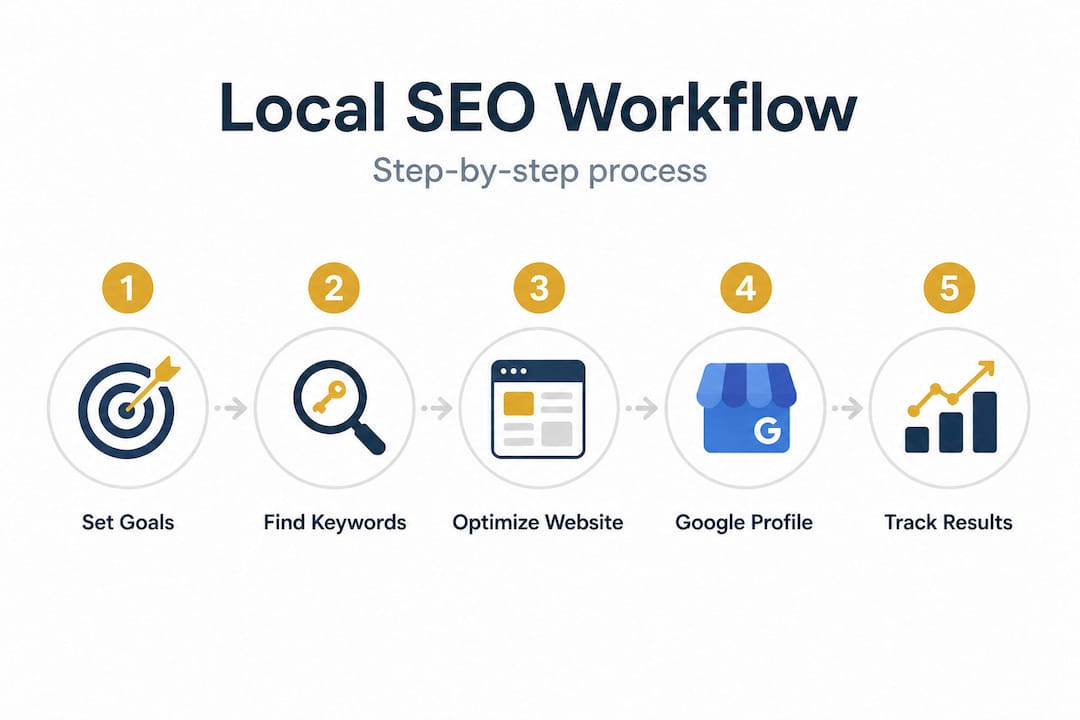
- Local keyword research: The foundation of your workflow
- Optimize your website for local signals
- Manage and optimize your Google Business Profile (GBP))
- Track your progress and avoid common local SEO missteps
- Why a focused workflow beats chasing SEO gimmicks in 2026
- Get expert help and fast-track your Central Texas local SEO
- Frequently asked questions
Key Takeaways
| Point | Details |
|---|---|
| Quick local SEO wins | Central Texas small businesses can secure faster results with the right workflow. |
| Focus on authenticity | 2026 Google updates now reward trustworthy content and penalize tricks. |
| GBP is king | A well-optimized Google Business Profile is the most important driver for local visibility. |
| Avoid thin content | Only create location pages if each has unique, valuable information for your audience. |
| Monitor and adapt | Track your results monthly and adjust efforts based on real performance data. |
Understand your local SEO goals and Central Texas advantages
Local SEO (local search engine optimization) is the practice of making your business easy to find when someone nearby searches for what you offer. Think "nail salon near me" or "HVAC repair Round Rock TX." These are high-intent searches from people ready to spend money right now.
Understanding Central Texas business visibility starts with recognizing what sets local SEO apart from general website traffic strategies. Unlike broad organic SEO, local SEO focuses on getting you into the Google local map pack (the three business listings that appear above regular search results). That placement drives calls, directions requests, and website visits from people in your exact service area.
Here's why Central Texas is a particularly strong opportunity right now:
- Less competition than major metros. Pflugerville, Georgetown, Manor, and Cedar Park are growing quickly but still lack the dense competition you'd fight in downtown Austin.
- Google's 2026 algorithm shift rewards authenticity. The 2026 update favors genuine signals over spam, and small Texas markets see faster ROI as a result.
- Community trust travels fast. Local reviews and word-of-mouth in tight-knit communities like those across Central Texas carry significant SEO weight.
Google currently values these key performance signals for local search:
- Accurate and consistent NAP (Name, Address, Phone) data across the web
- Genuine customer reviews with steady frequency
- Relevant, location-specific content on your website
- Optimized Google Business Profile (GBP) with complete service details
- Engagement signals like calls, clicks, and direction requests
We also recommend reviewing boosting local rankings strategies as you set your baseline goals. The opportunity in Central Texas is real. You just need a smart process to take advantage of it, and that starts with the right keywords.
Local keyword research: The foundation of your workflow
With your SEO goals set, the first tactical step is finding the search phrases your best local customers actually use. Keyword research sounds technical, but at its core it's about understanding how people ask for your services in your area.
How to identify your best local keywords:
- List your core services in plain language (e.g., "haircut," "plumbing repair," "teeth whitening")
- Pair each service with your city or neighborhood (e.g., "plumber in Georgetown TX," "med spa Pflugerville")
- Add "near me" and question-based variations (e.g., "best nail salon near me," "how much does AC repair cost in Round Rock")
- Use Google Autocomplete and the "People also ask" section to find real search phrasing
- Validate volume with Google Keyword Planner, Ubersuggest, or similar tools
The keyword research methodology recommends targeting phrases with 50 to 1,000 monthly searches. That range is the sweet spot for local businesses: enough traffic to matter, not so competitive that ranking takes years.
Here's how to map keywords to the right pages on your website:
| Keyword type | Best page to target |
|---|---|
| Brand + city (e.g., "hair salon Austin") | Homepage |
| Specific service + city | Dedicated service page |
| Neighborhood or suburb | Location-specific page |
| Question-based ("how to," "what is") | Blog post or FAQ section |
| "Near me" phrases | Homepage + GBP listing |
This structure helps Google understand exactly what you offer and where you serve. For deeper guidance on putting these into practice, see our homepage SEO strategies for local business visibility.
Pro Tip: Always prioritize search intent over raw traffic volume. A keyword with 80 monthly searches and strong buying intent ("emergency plumber Cedar Park") is more valuable than one with 800 searches from people who are just browsing.
Optimize your website for local signals
Once you know your keywords, it's time to align your website with Google's latest expectations and technology shifts. Your website is the foundation everything else is built on. If it sends the wrong signals, even a perfect GBP listing won't fully compensate.
Website essentials every Central Texas business needs:
- Consistent NAP data. Your business name, address, and phone number should appear in the same format on every page, in your footer, and across every directory listing.
- Clear service area declaration. Mention the cities and communities you serve on your homepage and service pages. Don't make Google guess.
- Unique content for each location page. If you serve multiple cities, each page needs original content, not copy-pasted text with the city name swapped out.
The 2026 Core Update penalizes thin, duplicated content, and it specifically targets pages that exist only to rank for multiple locations without providing real value. This is a common mistake and a costly one.
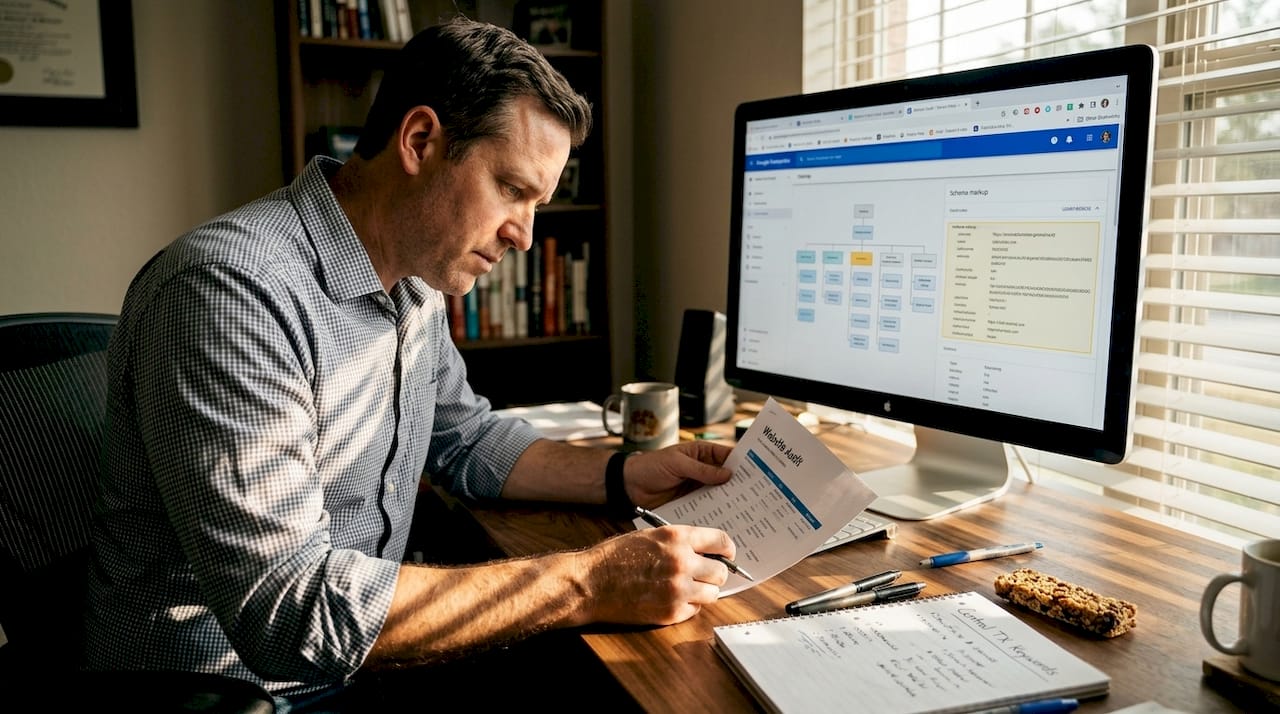
Structured data for AI and voice search: Structured data (also called schema markup) is code you add to your website that tells search engines exactly what your business is, where it's located, and what it offers. With AI-geared local SEO in 2026 becoming more prominent, structured data also helps AI assistants and voice search tools surface your business in spoken query results.
Here's a quick comparison of on-page SEO approaches:
| Practice | 2026 status | Why it matters |
|---|---|---|
| Unique location pages with original content | Recommended | Avoids thin content penalties |
| Keyword stuffing in titles/meta tags | Penalized | Triggers algorithmic flag |
| LocalBusiness schema markup | Highly recommended | Boosts AI and voice search visibility |
| Duplicate service pages with swapped city names | Penalized | Flagged as manipulative |
| Clear, descriptive service descriptions | Recommended | Improves rankings and conversions |
Use structured data for local search as part of your technical setup. It's no longer optional for businesses that want to compete in 2026 and beyond.
Pro Tip: Run your site through Google's Rich Results Test tool to confirm your structured data is installed correctly. Errors in your schema are invisible to the naked eye but very visible to Google.
For more specifics on improving Google ranking through on-page signals, we cover the full checklist in detail. Getting your website fundamentals right before building on top of them is always the smarter move.
Manage and optimize your Google Business Profile (GBP)
With your on-site SEO in place, the next step is maximizing your presence in Google's local ecosystem through your Google Business Profile. Your GBP listing is what appears in the map pack, and it's often the very first interaction a potential customer has with your business.
Steps to optimize your GBP in 2026:
- Claim and verify your profile at business.google.com
- Enter your exact legal business name (no keyword stuffing)
- Select the most specific and accurate primary category
- Add complete service details including descriptions and pricing where applicable
- Define your service area if you don't have a public storefront
- Upload high-quality photos of your location, team, work, and products
- Set accurate business hours including holidays and special hours
- Enable messaging and keep response times fast
"Service-area businesses thrive using accurate service ranges in their GBP, and avoiding keyword-stuffing in GBP names is critical post-2026 update. Google actively monitors profile names for manipulation."
Reviews are one of the most powerful ranking factors in local search. Ask every satisfied customer to leave a review, and respond to every review you receive, positive or negative. A thoughtful response to a negative review shows Google (and potential customers) that you're engaged and professional.
For a full walkthrough, our guide on optimizing your Google Business Profile covers every field and feature in detail. We also recommend reading up on managing local listings to ensure your business information stays consistent across all platforms, not just Google.
Pro Tip: Post to your GBP at least twice a month. Share offers, events, team updates, or tips. These posts signal to Google that your profile is active and relevant, which supports your ranking.
Track your progress and avoid common local SEO missteps
With all core steps set up, ongoing monitoring and adjustment keep your local SEO gains secure and compounding. Many small business owners do the setup work and then never check back. That's a mistake. Local SEO requires consistent attention to stay ahead.
Tracking tools worth using:
| Tool | What it measures | Cost |
|---|---|---|
| Google Business Profile Insights | Profile views, calls, direction requests | Free |
| Google Search Console | Search rankings, clicks, impressions | Free |
| BrightLocal | Local rank tracking, citation audits | Paid |
| Moz Local | Citation consistency, listing management | Paid |
| Google Analytics 4 | Website traffic sources and conversions | Free |
Here's what to review every month:
- GBP insights: Are calls and direction requests increasing? If they're flat, your profile may need more photos, posts, or review activity.
- Search Console rankings: Which keywords are you appearing for? Are your local keywords moving up over time?
- Website traffic: Is organic search sending more visitors? Are they staying on your site or leaving immediately?
Warning signs that your local SEO may be flagged post-2026 update include sudden drops in map pack rankings, loss of review visibility, or a GBP profile suspension. The 2026 update penalizes manipulative tactics, and genuine local signals are now what separate businesses that rank from those that don't.
Practices to avoid completely:
- Buying reviews or using review pods
- Using a virtual office address as your business location
- Creating duplicate GBP listings
- Spamming keyword variations in your business name or categories
Use our local SEO checklist to run a monthly audit. We also recommend bookmarking our guide on boosting Google visibility for ongoing reference as Google's algorithm continues to evolve.
Pro Tip: Set a recurring calendar reminder on the first Monday of every month to review your GBP insights, check your top keyword rankings, and respond to any new reviews. Thirty minutes a month protects the work you've already put in.
Why a focused workflow beats chasing SEO gimmicks in 2026
Here's something we've seen play out repeatedly with Central Texas small businesses: the ones who chase quick wins consistently end up further behind than when they started.
We understand the appeal. When your competitor seems to be outranking you and you're not sure why, it's tempting to try whatever's trending in a Facebook group or a sketchy SEO forum. But 2026 is the worst year in recent memory to take that approach.
The 2026 algorithm favors genuine signals over spam and quick tricks, and consistent, real practices win over hacks at every level of the market. What does that mean practically? It means businesses that earn authentic reviews, publish real content, and maintain accurate listings are the ones that rank and stay ranked.
Tricks might move the needle for a few weeks. Then they get caught, and you spend months recovering. We've worked with businesses in Pflugerville and Georgetown that lost years of progress by chasing shortcuts that were already outdated by the time they tried them.
A solid Central Texas SEO strategies approach isn't glamorous. It's a repeatable system: keyword research, on-page optimization, GBP management, review generation, monthly tracking. It compounds over time. Every step you take builds on the last, and the results are durable because they're built on signals Google actually trusts.
Download our SEO checklist and use it as your running list. Cross items off systematically instead of jumping between tactics. The businesses that win long-term in local search are disciplined, not clever.
Get expert help and fast-track your Central Texas local SEO
Executing this workflow takes time and consistency, and we know you're already managing a full business. That's exactly where we come in.

At ourLocalSEO, we specialize in helping Central Texas small businesses show up where it counts, in the local map pack, in organic search results, and in front of customers who are ready to buy. Whether you need hands-on local SEO help in Pflugerville, targeted strategy from Georgetown local SEO experts, or you're just getting started and want a clear starting point, our free local SEO guide gives you a no-cost foundation to build from. We work with nail salons, restaurants, service businesses, and med spas across the region, and every strategy we build is specific to your location and your goals.
Frequently asked questions
How quickly can a small business in Central Texas see local SEO results?
Most Central Texas small businesses see improved visibility within 2 to 3 months, largely because smaller TX markets have lower competition than major urban centers, making faster ROI realistic.
Is it better to focus on Google Business Profile or getting more backlinks for local SEO?
For local search in 2026, your GBP outperforms backlinks in terms of direct ranking impact, so prioritize a fully optimized, active profile before building a backlink strategy.
Should I create a separate location page for every neighborhood I serve?
Only create location pages if you can write original, useful content for each one; thin or duplicate pages are penalized after the 2026 Google update and can hurt your overall rankings.
Can service-based businesses without a storefront succeed at local SEO?
Absolutely. Google allows service-area businesses to set a defined coverage area instead of displaying a physical address, so you can rank locally without a retail location.
How can I check if my local SEO is working?
Review your Google Business Profile insights, Search Console keyword rankings, and incoming calls or form submissions each month to track whether your local visibility is trending in the right direction.