

Running a small business in Central Texas means you are up against more competition than ever before. Nail salons in Round Rock, HVAC companies in Pflugerville, restaurants in Georgetown — every one of them is fighting for the same top spots on Google. The good news is that ranking higher in local search does not require a massive budget or an in-house marketing team. It requires knowing which actions actually matter, then doing them consistently. This article breaks down the highest-impact SEO tactics, matched to the way real Central Texas businesses operate, so you can make smart decisions about where to spend your time.
Table of Contents
- Start with your Google Business Profile
- Build locally-relevant service and location pages
- Optimize for site health and mobile usability
- Compare the impact of SEO actions for various Central Texas businesses
- What most guides miss about local SEO for small businesses
- How YourLocalSEO helps Central Texas businesses grow
- Frequently asked questions
Key Takeaways
| Point | Details |
|---|---|
| Google Business Profile first | Completing and optimizing your GBP drives immediate local visibility in search and maps. |
| Relevant service pages | Tailored pages for services and locations you really serve help capture 'service + city' searches. |
| Prioritize mobile usability | A fast, mobile-friendly site earns Google rankings and converts more local customers. |
| Authenticity beats shortcuts | Being clear and honest about your coverage and services leads to better SEO results than keyword-stuffing. |
Start with your Google Business Profile
Your Google Business Profile (GBP) is the single most powerful tool in local SEO, and it costs nothing to use. The GBP controls visibility in both Google Search and Google Maps, including the Local Pack (the three-business box that appears at the top of search results). If your profile is incomplete or unclaimed, you are essentially invisible to customers who are already looking for you.
Claiming your GBP is step one. After that, filling out every available field is what separates businesses that show up from those that do not. Here is what to prioritize:
- Name, address, and phone number (NAP): These must be accurate and match your website exactly. Inconsistencies confuse Google and lower your ranking.
- Business categories: Your primary category carries the most weight. Choose the most specific category that describes your core service. For deeper guidance on this, our post on business category impact explains how small category changes can shift your ranking quickly.
- Hours of operation: Keep these current, including holiday hours. Customers and Google both rely on them.
- Photos: Businesses with photos receive significantly more clicks. Add images of your space, team, work samples, and products. Update them regularly.
- Services and products: Use the services section to describe what you offer. This feeds into keyword relevance without any extra effort.
- Reviews: Actively request reviews from happy customers. Respond to every review, positive or negative. This signals engagement to Google.
For service-area businesses like plumbers or mobile detailers, you do not need a physical storefront address to rank well. You can set your GBP to display a service area instead of a street address. This is a critical feature that many service businesses overlook. For a full walkthrough, our guide on boosting Google Maps visibility covers this step by step.
Pro Tip: Log into your GBP dashboard at least once a month. Google sometimes suggests edits from third-party sources, and those suggestions can override your accurate information if you do not catch them in time. Also check out our Google Business Profile tips for a detailed optimization checklist.
Once you've set the foundation for local visibility, the next step is creating relevant local content on your website.
Build locally-relevant service and location pages
Your website needs to support the work your GBP is doing. The most effective way to do this is by creating dedicated pages for each service you offer, written with local search terms in mind. A general "Services" page that lists everything in one place is not nearly as effective as individual pages targeting specific searches like "teeth whitening Georgetown TX" or "commercial landscaping Cedar Park."
Here is a practical framework for building these pages:
- List every service you offer. Even if some seem minor, each one is a potential search query someone types into Google.
- Assign each service its own page. The title tag and H1 heading should include the service name plus your city or region. For example: "AC Repair in Pflugerville, TX."
- Write genuine, useful content. Each page should explain the service, who it is for, what the process looks like, and why a customer should choose you. Aim for at least 400 words of original content per page.
- Add your NAP to every page. Your business name, address, and phone number should appear consistently across your site, ideally in the footer.
- Include local signals. Mention neighborhood names, nearby landmarks, or community references where they fit naturally. This adds geographic relevance without forcing keywords.
Creating dedicated, locally-relevant service pages and avoiding thin or duplicate pages is one of the most practical steps you can take to improve rankings. The key word there is "dedicated." Do not create a page for Pflugerville, another for Hutto, and another for Manor that all say the same thing with just the city name swapped. Google recognizes thin content and it will suppress those pages rather than reward them.
Pro Tip: If you are a service-area business covering multiple cities, use your GBP service area settings to cover those locations rather than creating a separate page for each one. Only build a location page when you have a genuine physical presence, a dedicated service team, or a significant customer base there. Our post on improving Google ranking has more detail on this approach, and our Central Texas SEO checklist walks through the full page-building process.
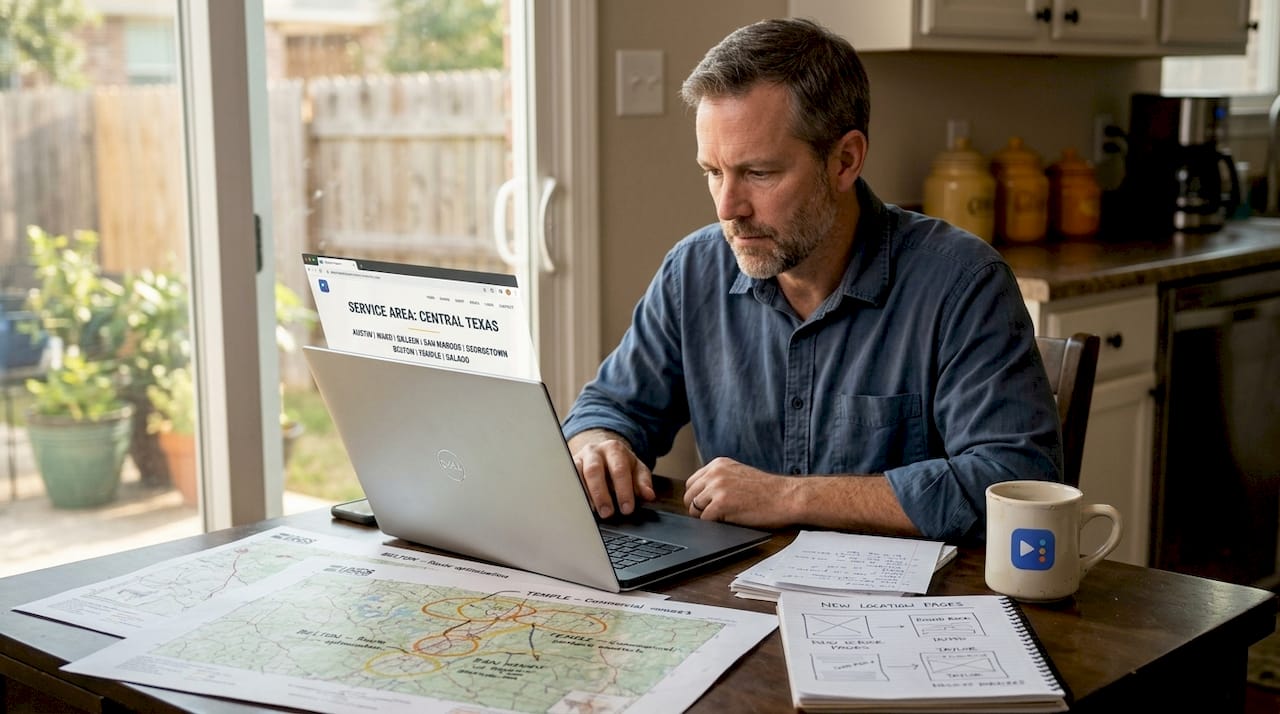
With website pages tailored to local search intent, technical site health becomes essential to maximize their impact.
Optimize for site health and mobile usability
You can have the best GBP in Round Rock and the most thorough service pages in Central Texas, but if your website is slow or broken on a phone, it will cost you rankings and customers. Google now factors mobile usability into how it ranks sites, and poor site experience can suppress rankings just as much as missing keywords can.
Here are the core technical items to check and fix:
- Mobile responsiveness: Open your site on your phone. Does it load cleanly? Is the text readable without zooming? Are buttons large enough to tap? If not, your site needs a responsive design update.
- Page speed: Slow sites lose visitors fast. Use Google's free PageSpeed Insights tool to check your score and follow the recommendations. Compress large images, remove unused plugins, and use a reliable hosting provider.
- Click-to-call functionality: Your phone number should be a tappable link on mobile. This is especially important for service businesses where customers call first.
- Contact information visibility: Your address, phone number, and hours should be easy to find within seconds of landing on your site. Do not hide them behind multiple clicks.
- Google Search Console: Set this up if you have not already. It shows you which search queries bring people to your site, flags errors like broken pages or crawling issues, and helps you track your ranking progress over time.
Here is a quick comparison of key technical factors and their impact on local rankings:
| Technical factor | Impact on local SEO | Difficulty to fix |
|---|---|---|
| Mobile responsiveness | High | Medium |
| Page speed | High | Medium |
| Accurate NAP in footer | High | Low |
| Click-to-call button | Medium | Low |
| Google Search Console setup | Medium | Low |
| SSL certificate (HTTPS) | Medium | Low |
| Broken links (404 errors) | Low to medium | Low |
Pro Tip: Check your site's performance using Google Search Console alongside PageSpeed Insights. The Console shows you real search data, while PageSpeed shows you technical bottlenecks. Using both together gives you a clearer picture of what to fix first. Our articles on homepage SEO strategies and Central Texas SEO workflow can guide you through the process systematically.
After optimizing site structure and technical health, it is helpful to see how these tips compare for different business types.
Compare the impact of SEO actions for various Central Texas businesses
Not every business benefits equally from the same SEO tactics. A restaurant in Austin has different priorities than a mobile mechanic covering Pflugerville, Manor, and Hutto. Understanding which actions have the highest return for your industry helps you focus your effort where it counts.
For mechanics and home-service businesses, clear and honest location and service coverage via GBP service areas and selective location pages outperforms creating many near-duplicate city pages with only name swaps. Being specific and truthful about where you serve builds trust with both Google and potential customers. For tips on keeping your listings accurate across the region, our guide on managing listings in Central Texas is a useful next step.
Here is a breakdown by business type:
| Business type | Highest-impact action | Secondary priority |
|---|---|---|
| Restaurant or cafe | GBP optimization and photo updates | Customer reviews and menu listings |
| Nail salon or med spa | GBP reviews and service listings | Service pages with treatment keywords |
| Plumber or HVAC | Service-area settings on GBP | Individual service pages per city served |
| Retail store | GBP with product photos | Local inventory and in-store hours |
| Mobile mechanic | Honest service-area coverage on GBP | One strong service page per core offering |
| Law firm or consultant | Location page with genuine local content | GBP with practice area details |
A few patterns stand out across all industries:
- Retail and restaurant businesses depend heavily on GBP photos and reviews because customers often make quick decisions based on visual appeal and social proof.
- Service businesses with wide coverage areas get more from clearly defined service zones than from a stack of thin location pages.
- Every business type benefits from review generation. Reviews are one of the most direct ranking signals for local search.
For a broader look at what is working across Central Texas, our post on boosting Google visibility covers tactics that apply across multiple industries.
With the most effective actions identified for your business type, let's bring some experienced wisdom to choosing what actually moves the needle.
What most guides miss about local SEO for small businesses
Most local SEO guides focus on volume. More pages, more keywords, more locations. But in our experience working with small businesses across Central Texas, the businesses that outperform their larger competitors are the ones that prioritize accuracy and authenticity over quantity.
Here is what we see consistently: business owners spend time creating five location pages when they only genuinely serve two of those cities. Those extra pages do not help. They dilute the authority of the pages that actually matter, and they create a confusing experience for real customers who arrive expecting local service and get a page that reads like a template.
The same principle applies to GBP content. A business description stuffed with keywords like "best nail salon Pflugerville best nail salon Austin best nail salon Round Rock" does not read like a real business, and Google is getting better at recognizing that pattern. A clear, honest description of what you do, who you serve, and what makes your service worth choosing will outperform keyword stuffing every time.
The hard truth about location pages is that you get more from honest service-area coverage than from duplicating city-specific pages. We have seen this play out in markets across Central Texas. A plumber in Pflugerville with one well-built GBP and two strong service pages will often outrank a competitor with ten thin city pages and a neglected profile.
Small businesses have a real advantage in local search: they can be specific, responsive, and genuine in ways that large national chains cannot. The businesses that win in local SEO are the ones that lean into that. Update your hours when they change. Respond to reviews within 24 hours. Keep your service descriptions honest and current. These are not glamorous tactics, but they are the ones that build lasting visibility.
Our essential SEO checklist for Central Texas businesses captures these principles in a format you can apply directly to your own situation.
How YourLocalSEO helps Central Texas businesses grow
Knowing what to do is the first step. Actually getting it done, consistently and correctly, is where most small business owners need support.

At YourLocalSEO, we work directly with businesses across Pflugerville, Austin, Round Rock, Georgetown, Cedar Park, Manor, and the surrounding area to handle the strategies covered in this article. From GBP setup and optimization to building out service pages and fixing technical site issues, every plan we build is tailored to your specific business and market. We are not running generic playbooks. We understand what Central Texas customers search for and how local competition in this region actually works. Explore our local SEO tricks for quick wins you can apply right away, or review our detailed local SEO guide to see the full strategy we use with our clients. Let's get your business found.
Frequently asked questions
How can a small business in Central Texas improve Google Maps visibility?
Fully optimize your Google Business Profile with accurate contact info, updated photos, and a steady stream of customer reviews. GBP controls visibility directly in both Google Maps and the Local Pack, making it your most important starting point.
Should I create a location landing page for every town nearby?
No. Only build location pages for cities where you genuinely serve customers or have a real presence. Dedicated, locally-relevant pages outperform thin duplicates that simply swap city names.
Why is mobile usability important for local SEO?
Most local searches happen on phones, and Google ranks mobile-friendly sites higher. Poor site experience can hurt your rankings just as much as missing keywords or an incomplete GBP.
What SEO action offers the quickest visibility boost?
Claiming and fully completing your Google Business Profile is the fastest path to local visibility. GBP is the highest-leverage action for small businesses because it directly controls how you appear in Google Search and Maps results.