

Most business owners and marketers already know they "should" be blogging. But knowing you should do something and understanding exactly why it works are two different things. The role of blogs in SEO goes far beyond filling your website with text. Done right, a blog is one of the most cost-effective tools you have for climbing search rankings, earning credibility, and pulling in organic traffic month after month. With AI now shaping how Google surfaces answers, 81% of marketers still see positive results from blogging. That number matters.
Table of Contents
- Key takeaways
- How blogs improve SEO rankings
- Blog content strategies that actually work in 2026
- Measuring the SEO benefits of your blog over time
- Common blogging mistakes that hurt SEO
- My honest take on blogging and SEO
- Let Yourlocalseo build your blog SEO strategy
- FAQ
Key takeaways
| Point | Details |
|---|---|
| Blogs expand your keyword reach | Each post targets different search queries, giving Google more reasons to rank your site. |
| Quality beats volume | One well-researched post outperforms ten thin articles that nobody searches for. |
| SEO results take time | Expect 3 to 6 months before a new blog post starts ranking consistently on Google. |
| Topic clusters build authority | Linking related posts together signals deep expertise to both Google and AI-driven search. |
| Consistency compounds results | Regular publishing creates a traffic snowball effect that grows stronger over time. |
How blogs improve SEO rankings
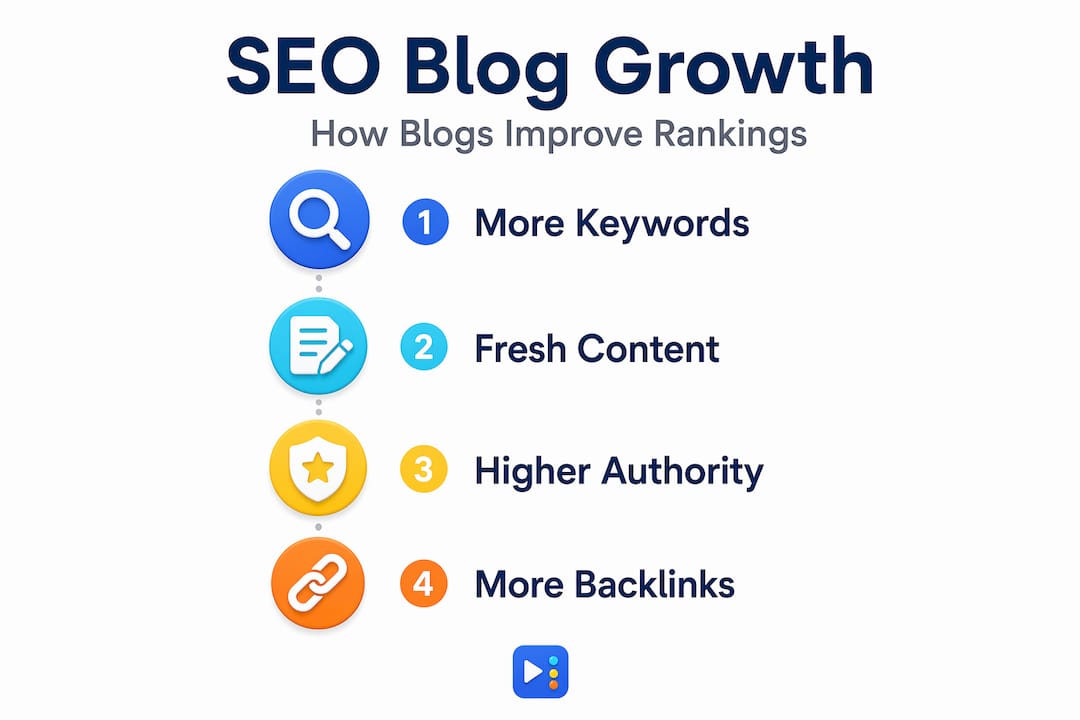
Search engines rank pages, not websites. Every blog post you publish is a new page Google can index, which means more opportunities to appear in search results. A static website with five service pages can only rank for a handful of terms. A website with fifty well-written blog posts can rank for hundreds or even thousands of search queries.
Here is how the mechanics work in practice:
- Keyword coverage: Each post targets a specific question or topic, capturing long-tail searches like "how often should I service my HVAC in Austin" that your homepage never would.
- On-page SEO signals: Blog posts give you room to include your target keyword in the title tag, meta description, headers, and body text naturally, without cramming everything onto a service page.
- Internal linking: Posts create natural opportunities to link to your service pages and other blog articles, building a connected site structure that passes authority where you need it.
- Fresh content signals: Google crawls active sites more frequently. Consistent publishing tells the algorithm your site is alive, updated, and worth indexing.
- Backlink attraction: Blog posts attract more quality backlinks than most other page types because they offer genuine educational value that other sites want to reference.
The importance of blogging for SEO also shows up in how Google evaluates expertise. Businesses with libraries of content are more trusted by Google, which improves both rankings and conversion rates. You are not just writing for traffic. You are building a credibility asset.
Pro Tip: Before you write any post, check what Google is already ranking for that topic. The structure, depth, and angle of top results will tell you exactly what readers expect to find.
Blog content strategies that actually work in 2026
The biggest shift in effective SEO strategies for blogs over the last two years is not technical. It is philosophical. The question is no longer "how often should I post?" It is "am I publishing content that someone actually searched for and will find useful?"
Search engines prize content that answers real questions and demonstrates expertise over content that merely checks a keyword density box. That changes how you plan your editorial calendar. Here is a practical process for building blog content that earns rankings:
- Start with your customers' real questions. What do people ask before buying your service? What objections come up in sales conversations? Successful blogging starts with those questions and answers them directly and clearly.
- Do keyword research to confirm search volume. Use tools like Google Search Console, Ahrefs, or even the "People Also Ask" boxes in Google to find the exact phrasing your audience uses.
- Build topic clusters. Instead of writing random isolated posts, structuring blogs into topic clusters enhances site authority and visibility, especially in AI-driven search results. Write a pillar post on a broad topic, then support it with five to ten related posts that link back to it.
- Prioritize evergreen content. Posts that answer timeless questions keep driving traffic for years. Seasonal content fades. A post titled "How to choose a local plumber" will outperform "Best plumbers for the holidays" over a two-year window.
- Update older posts regularly. Refreshing a post with new data, better examples, or expanded answers often earns faster ranking improvements than writing a brand-new post from scratch.
- Be patient. The average new blog post takes 3 to 6 months to rank on Google. If you quit at month two, you will never see the payoff.
Pro Tip: Aim for at least four posts per month consistently. Publishing four posts monthly for six months can grow your organic clicks to between 2,000 and 5,000 per month. That is not a prediction. It is a documented result.
For local businesses in Central Texas, you can also apply these same principles with a geographic angle. Check out our practical SEO tips to see how localized blog content fits into the bigger picture.
Measuring the SEO benefits of your blog over time
Publishing consistently matters, but so does knowing whether your work is paying off. Without tracking, you are flying blind. Here are the key metrics that tell you whether your blog is actually moving the needle:

| Metric | What it measures | Where to track it |
|---|---|---|
| Organic sessions | Visitors arriving from search engines | Google Analytics 4 |
| Keyword rankings | Position of specific posts in Google | Google Search Console |
| Click-through rate | How often searchers click your result | Google Search Console |
| Backlinks earned | Sites linking to your blog posts | Ahrefs or Google Search Console |
| Time on page | Whether readers find the content useful | Google Analytics 4 |
Beyond the numbers, think about how to sustain the benefits over time:
- Refresh high-performing posts every 6 to 12 months to keep them accurate and competitive. A post that ranked well 18 months ago may be slipping because a competitor updated theirs.
- Repurpose blog content into social media posts, email newsletters, and Google Business Profile updates. One well-researched post can fuel a month of content across platforms.
- Build internal links from new posts to older ones. This practice passes link authority throughout your site and helps Google discover and re-crawl older content.
The compounding nature of SEO blogging is the part most people underestimate. A post written today may not rank for six months. But that same post could drive 500 visitors a month for the next three years. Multiply that across dozens of posts and the math starts to look very different than paying for ads. For a deeper look at what to measure and how to report it, our SEO reporting guide walks through the whole process.
Common blogging mistakes that hurt SEO
Getting the benefits of blogs in SEO requires avoiding a handful of mistakes that are surprisingly common, even among businesses that are actively trying to do things right.
- Writing content nobody searches for. Publishing posts about your company awards or internal news generates almost zero organic traffic. Every post should map to a search query someone is actually typing.
- Publishing thin or generic content. A 300-word post that barely addresses the topic signals low quality to Google. Go deep. Cover the topic completely. Consistent quality content outperforms sporadic posting every time.
- Neglecting internal links. Blogs that exist as isolated pages on your site contribute far less SEO value than those woven into a connected structure. Link between related posts and to relevant service pages.
- Ignoring AI search behavior. In 2026, AI-generated answer panels in Google increasingly pull from well-organized, authoritative content. Well-organized blogs help AI-driven search engines recognize your site as an authority. Disorganized content that lacks structure is less likely to get surfaced.
- Starting strong and going dark. Inconsistency is the single biggest killer of blog SEO results. Posting fifteen articles in January and then nothing for four months does not compound. It stalls.
Pro Tip: Before publishing any post, ask yourself: "Would a potential customer find this genuinely useful?" If the honest answer is no, either improve the post or choose a different topic.
Learning how blogs and search engine rankings connect is only half the battle. You also need a solid foundation. Our guide to improving Google rankings covers the on-page and off-page factors that make your blog work harder.
My honest take on blogging and SEO
I've worked with enough small businesses to say this clearly: blogging is the most underutilized SEO asset for local business owners. Not because they do not try, but because they expect it to work like a paid ad. It does not. It works like a 401(k) retirement plan for your marketing. The contributions you make today feel small. The compounding value becomes obvious in year two or three.
What I have found from actual client work is that the businesses who succeed with blog-driven SEO are not the ones publishing the most. They are the ones who picked ten or fifteen genuinely useful topics, wrote real answers, and kept going even when rankings were slow to move.
The advice I give every time: do not overthink it. Start with the question your last five customers asked you. Write a complete, honest answer. Publish it. Then repeat. That is the whole strategy. The technical details matter, but they are secondary to simply being useful on a consistent schedule.
With AI reshaping search in 2026, the businesses that will win are the ones Google trusts as genuine experts. A well-maintained blog is still the clearest way to demonstrate that expertise over time.
— Tran
Let Yourlocalseo build your blog SEO strategy
If you run a local business in the Austin, Pflugerville, or Georgetown area and blogging feels like one more thing you do not have time to figure out, you are not alone.

At Yourlocalseo, we build blog-driven SEO strategies tailored to your market, your services, and the questions your customers are already searching for. From keyword research and content planning to on-page optimization and local SEO services, we handle the pieces that actually move your rankings. If you are in the Georgetown area, check out our Georgetown SEO services to see how we approach local search visibility for businesses like yours. We focus on real results, not vanity metrics.
FAQ
Do blogs really help with SEO?
Yes. Blogs create additional indexed pages that target specific search queries, attract backlinks, and signal consistent activity to Google, all of which improve your search rankings.
How long does it take for a blog to rank on Google?
A new blog post typically takes 3 to 6 months to rank on Google, depending on competition, domain authority, and how well the post is optimized.
How often should you blog for SEO results?
Publishing four posts per month consistently is a strong starting point. Maintaining that frequency for six months can produce 2,000 to 5,000 monthly organic clicks.
What type of blog content ranks best?
Content that directly answers questions your audience is searching for, built around a specific keyword and organized into topic clusters, consistently outperforms generic or promotional posts.
Can small businesses compete with larger sites through blogging?
Yes, especially by targeting local and long-tail keywords. A nail salon in Pflugerville writing about "best gel nail services in Pflugerville" will face far less competition than a generic keyword, and that specificity is exactly where small businesses win.