

Most small business owners assume an SEO audit is just a checklist of broken links and missing keywords. That assumption leaves real money on the table. A thorough SEO audit examines your entire digital footprint, from technical site health to how your business shows up in local map results and even AI-powered search tools like ChatGPT and Google's AI Overviews. AI visibility benchmarks show that sites often score poorly on traditional technical metrics yet still get cited in AI-driven results, which completely reframes how you should think about audits. This guide breaks down exactly what an SEO audit covers and how to use one to get found by more customers across Central Texas.
Table of Contents
- What is an SEO audit? The essentials for local businesses
- What does an SEO audit cover? Key areas for visibility
- Where most audits fall short: AI search and local relevance
- Prioritizing fixes: What matters most for Central Texas businesses
- How to act on your SEO audit: Practical next steps
- The uncomfortable truth most experts won't tell you about SEO audits
- Want expert help transforming your audit into local leads?
- Frequently asked questions
Key Takeaways
| Point | Details |
|---|---|
| Audit scope matters | A comprehensive SEO audit checks technical health, content, links, and local relevance. |
| AI search changes the rules | Sites can earn local AI citations even with technical flaws, so audits must include visibility checks for new search tools. |
| Prioritize local relevance | Fixing GBP/category mismatches can boost local rankings for beauty and service industries. |
| Turn audits into action | Organize audit findings by urgency and address critical issues first for best results. |
| Perfect isn't necessary | Focus on fixes that deliver more calls, bookings, or reviews—not just on having a flawless audit report. |
What is an SEO audit? The essentials for local businesses
An SEO audit is a systematic process for assessing how well a website is optimized to rank and be discovered in search, and increasingly in AI-driven search, identifying problems and opportunities to prioritize improvements. Think of it less like a pass/fail test and more like a health checkup for your business's online presence.
For a nail salon in Round Rock or a med spa in Georgetown, this matters because your customers are searching on their phones right now. If your site has crawl errors, outdated information, or a Google Business Profile (GBP) that doesn't match your actual services, you're losing those customers to a competitor down the street.
A complete SEO audit for a local business covers six core areas:
- Technical health: Is your site crawlable, fast, secure, and mobile-friendly?
- Content quality: Is your content relevant, locally focused, and genuinely helpful?
- On-page SEO: Are your meta titles, headings, and schema markup properly set up?
- Link profile: Do you have local citations and credible backlinks pointing to your site?
- Competitor benchmarking: How do you stack up against the businesses ranking above you in search?
- Local and AI search visibility: Does your business appear correctly in the local map pack and AI-generated answers?
Here's a quick comparison to show how a basic audit differs from a full local SEO audit:
| Audit type | What it checks | Best for |
|---|---|---|
| Basic technical audit | Broken links, crawl errors, HTTPS, speed | Any website |
| On-page SEO audit | Meta tags, headings, content structure | Sites with poor keyword rankings |
| Local SEO audit | GBP, citations, map pack visibility, reviews | Service and retail businesses |
| AI visibility audit | GEO scores, brand mentions, structured data | Businesses targeting AI-driven traffic |
| Full audit | All of the above combined | Businesses serious about growth |
"The goal of an SEO audit is not just to find what's broken. It's to reveal exactly where your biggest opportunities are hiding so you can act on them strategically."
We recommend starting with your local SEO checklist before running a full audit, so you understand what a healthy baseline looks like for businesses in Central Texas.
What does an SEO audit cover? Key areas for visibility
With a clear definition in mind, let's dig into exactly which pieces an audit puts under the microscope. A well-scoped audit, as defined by SEMrush, evaluates current visibility and performance, runs technical crawling for errors, reviews content quality, checks on-page SEO, analyzes backlinks and brand mentions, and benchmarks you against competitors. Each of these areas can make or break your local rankings.
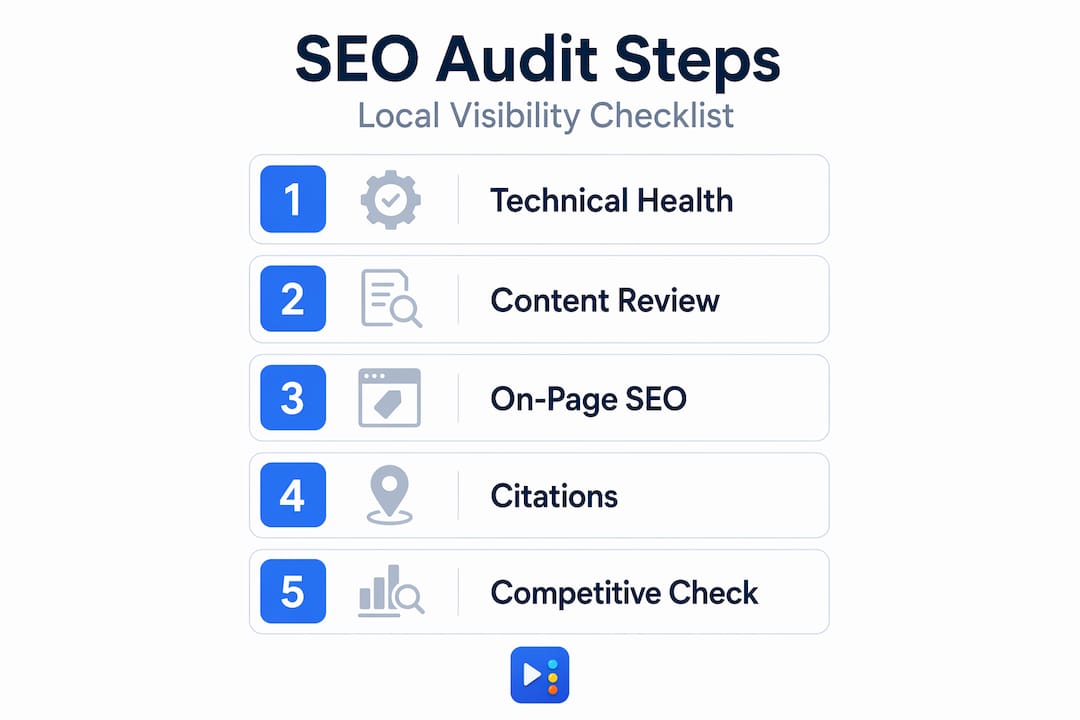
Here's what each area actually means in practice for a service business in Central Texas:
Technical crawling and indexation Search engines need to be able to access and read your website. Crawl errors, blocked pages, and slow load times all hurt your ability to rank. For a local business with a smaller site, even one or two broken pages can drag down your overall performance. Make sure your site runs on HTTPS, which is a basic security standard that Google factors into rankings. Learn more about site security for SEO and why it matters beyond just rankings.
Content quality and local signals Your content needs to speak directly to the people searching in your area. Generic content about "nail care tips" won't rank you in Pflugerville. Locally focused content that mentions your city, your services, and your community builds relevance for local search. Thin pages with fewer than 300 words or duplicate content across multiple pages are common problems we see on small business sites.

On-page SEO elements This includes your page titles, meta descriptions, H1 and H2 headings, image alt text, and schema markup (structured data that helps search engines understand what your page is about). For a beauty salon, schema markup can tell Google you're a local business, your hours, your address, and even your price range.
Link profile and citations Local citations are online listings that mention your business name, address, and phone number. Inconsistent citations across Yelp, Google, Facebook, and industry directories confuse search engines and hurt your local rankings. Learn how to manage local listings properly to build trust with both Google and potential customers.
Competitive benchmarking An audit isn't complete without knowing what your competitors are doing right. If three nail salons in your area are all outranking you, the audit should reveal what they have that you don't, whether it's more reviews, better on-page content, or stronger citation profiles. There are proven ways to improve Google ranking that go beyond just fixing technical errors.
Pro Tip: Run a quick competitor check by searching your main service keyword in your city. Note which businesses appear in the top three map results. Their strengths become your roadmap.
Where most audits fall short: AI search and local relevance
While all audits check technical items, the rise of AI in search is creating new blind spots. Here's what you need to watch.
AI-powered search tools like Google's AI Overviews and ChatGPT are increasingly being used by consumers to find local businesses. And the data here is genuinely surprising. A 2026 benchmark study of 501 audited sites found an average technical SEO score of just 49 out of 100, yet the same sites averaged a GEO (AI engine citation) score of 87 out of 100. That's a massive gap. Sites with technical problems were still being cited by AI search tools at a high rate.
What does that mean for your nail salon or med spa? It means two things. First, technical SEO isn't the whole picture anymore. Second, you can gain AI-driven visibility even if your site isn't technically perfect, but only if you're doing the right things with your content and local presence.
"Your business can appear in an AI chat answer even if your website has crawl errors. What drives that visibility is brand authority, content relevance, and local signals, not just clean code."
Local beauty and service businesses benefit especially from this shift. When someone asks an AI assistant "best nail salon near me in Georgetown," the tools pull from review platforms, business directories, and locally relevant content. If your Google visibility strategy doesn't account for these newer search behaviors, you're only seeing half the picture.
A smart audit in 2026 must now include a check on how your business appears in AI-generated results. This means looking at brand mentions across the web, structured data on your site, and whether your GBP information is complete and consistent everywhere your business is listed.
Prioritizing fixes: What matters most for Central Texas businesses
Now that you know what matters for modern visibility, how do you prioritize what to fix? Let's break this down.
Not every audit finding deserves equal attention. Common edge cases that change what you fix first include: pages being crawled but not indexed, incorrect canonical tag chains, broken internal links after site migrations, and GBP category mismatches that hurt local relevance.
Here's a practical order of priority for local service and beauty businesses:
- Fix indexation issues first. If Google can't index your pages, nothing else matters. Check Google Search Console for any pages marked "Discovered, not indexed" or "Crawled, not indexed."
- Resolve GBP category mismatches. If your GBP is listed as "Beauty Supply Store" instead of "Nail Salon," you're targeting the wrong searches. This single fix can dramatically improve your map pack placement.
- Correct NAP inconsistencies. Your Name, Address, and Phone number must match exactly across all listings. Even small differences like "St." vs. "Street" confuse Google.
- Fix broken internal links. If pages on your own site lead to dead ends, it signals poor site quality and dilutes your link equity.
- Improve on-page content for your top service pages. Thin or generic content on your core service pages is often the biggest missed opportunity for local ranking gains.
A real-world example: a beauty salon in Georgetown came to us with almost no map pack visibility despite having a decent-looking website. After an audit, we found their GBP was categorized incorrectly and several of their service pages were indexed under duplicate URLs. After correcting the GBP category and fixing the canonicalization issues, their map ranking moved into the top three within 60 days, and their online booking rate increased noticeably.
If you want to optimize your Google Business Profile correctly, it starts with verifying it properly. You can learn how to verify your Google Business Profile in Texas and make sure your foundation is solid before anything else.
Pro Tip: If you run a salon, check out this targeted guide on how to rank your salon on Maps for step-by-step guidance specific to beauty businesses.
How to act on your SEO audit: Practical next steps
After reviewing your audit's findings and priorities, it's time to transform analysis into results. The biggest mistake business owners make is running an audit and then letting the report collect digital dust. SEO audits are most valuable when they lead to prioritized, actionable improvements, not just a long list of problems.
Here's a simple system for acting on your audit findings:
- Categorize every issue. Label each finding as Urgent (blocking rankings or indexing), Important (limiting growth), or Minor (nice-to-fix when you have time). This alone makes the process far less overwhelming.
- Tackle urgent issues in week one. Focus exclusively on critical errors first. GBP mismatches, indexation problems, and broken pages fall into this category.
- Schedule important fixes over 30 to 60 days. Content improvements, citation cleanup, and on-page optimization take time to do right. Build them into your schedule so they actually happen.
- Set a quarterly mini-audit routine. Google updates its algorithm frequently, and AI search behaviors shift. A quarterly check on your core pages keeps you ahead of changes before they hurt your rankings.
- Track results with simple benchmarks. Monitor your map pack ranking for your top two or three keywords, your website traffic from organic search, and your monthly call or booking volume. If these move in the right direction, your fixes are working.
For businesses that want to go deeper on specific tactics, we recommend reviewing Google Maps visibility strategies and homepage SEO tips as two high-impact areas to prioritize early.
Pro Tip: Even a 30-minute monthly check on your GBP for new questions, reviews, and photo updates can significantly improve your local ranking momentum over time.
The uncomfortable truth most experts won't tell you about SEO audits
Here's the perspective we've developed after working with dozens of small businesses across Pflugerville, Georgetown, Cedar Park, and the broader Central Texas market: chasing a perfect audit score is often the wrong goal entirely.
We've seen nail salons with technically messy websites dominate local search because they had 200 five-star reviews, an active GBP with fresh photos, and content that genuinely reflected their community. We've also seen businesses with clean, technically optimized sites that ranked nowhere, because they hadn't invested in the things that actually build local trust.
No website is ever technically perfect. New content creates new issues. Plugins conflict. Pages get accidentally blocked. If you wait until your audit is "clean" to focus on customer experience, review generation, or local content, you'll be waiting forever.
The businesses winning in Central Texas aren't always the ones with the best audit scores. They're the ones who've built real local authority through consistent reviews, accurate business information, and content that matches what their customers actually search for. A Central Texas SEO checklist is a great tool, but it's a starting point, not a finish line.
Our advice: run your audit, fix what blocks your rankings, and then redirect your energy toward customer engagement, review generation, and local visibility. That's where the real growth lives.
Want expert help transforming your audit into local leads?
Running an audit is one thing. Knowing exactly what to fix and in what order is where most business owners get stuck. That's where we come in.

At ourLocalSEO, we work hands-on with nail salons, med spas, and service businesses across Central Texas to turn audit findings into real improvements in rankings, calls, and bookings. Whether you need a full audit or targeted support, our local SEO services are built for businesses like yours. If you're in the Georgetown area, check out our specialized SEO services in Georgetown TX. And if your website needs a refresh to support your SEO work, our website design for local business team can help you build a site that converts visitors into customers. Reach out today and let's put your audit to work.
Frequently asked questions
How often should I perform an SEO audit on my business website?
Most small businesses benefit from a full audit once per year, with smaller check-ins quarterly for key pages or after significant site changes like a redesign or new service launch.
What's the difference between a technical SEO audit and a local SEO audit?
A technical audit checks your site's code, structure, and crawlability, while a local audit focuses on your GBP, citations, map pack ranking, and review presence to improve visibility for customers searching in your area.
Why does my business appear in AI search chat results, even with technical site problems?
AI engines may cite your business based on local relevance and brand mentions, even with weaker technical SEO. A 2026 benchmark found average AI citation scores of 87 out of 100 on sites that averaged just 49 out of 100 for technical SEO.
What are the most critical SEO audit issues for a beauty or service business?
The most urgent issues are GBP category mismatches, inconsistent local citations, pages that aren't being indexed, and service pages with thin or generic content that doesn't target local keywords.
Can I do an SEO audit myself or do I need an expert?
You can handle many basics yourself using free tools like Google Search Console, but an expert audit catches subtle issues faster and gives you a clear action plan, which saves significant time for busy business owners.