

Most digital marketers treat images as an afterthought. You write the content, pick a photo that looks decent, and move on. That approach is costing you rankings. The role of images in SEO has shifted dramatically as Google's AI systems now evaluate images for context, originality, and semantic relevance, not just file names. Understanding how images affect SEO in 2026 means rethinking every visual on your site, from how you write alt text to where you physically place an image on a page.
Table of Contents
- Key Takeaways
- How search engines and AI interpret images today
- Core elements of image optimization for SEO
- Strategic image placement and context
- Images, user engagement, and broader SEO benefits
- My honest take on image SEO after working with local businesses
- Ready to put your image SEO to work?
- FAQ
Key Takeaways
| Point | Details |
|---|---|
| Images are active SEO signals | Google's AI evaluates images for content, context, and relevance, not decoration. |
| Alt text accuracy matters more than keywords | Descriptive, honest alt text outperforms keyword-stuffed alternatives every time. |
| Original images signal authority | Unique photos and screenshots build E-E-A-T trust that stock images cannot replicate. |
| Image placement changes visibility | Images placed near relevant text are more likely to appear in AI Overviews and answer panels. |
| Technical and semantic layers both count | Missing either crawlability or contextual annotation limits your image SEO results significantly. |
How search engines and AI interpret images today
Search engines have moved far beyond reading file names. Google Gemini's multimodal AI evaluates images based on image content, alt text, surrounding text, page structure, and overall page authority as combined relevance signals. That means every element around your image contributes to how Google understands and ranks it.
This matters because AI Overviews include image thumbnails in over 70% of results. If your images are not machine-readable and properly annotated, you are invisible in that real estate. Getting into AI Overviews is one of the highest-impact visibility wins available right now.
Here is what Google's AI actually looks at when it processes an image on your page:
- Image content itself: The visual data, objects, colors, and entities detected within the image
- Alt text accuracy: Whether the alt text truthfully describes what is shown, not what you want to rank for
- Surrounding text: Headings, paragraphs, and captions near the image that establish topical relevance
- Structured data: ImageObject schema that provides author attribution and machine-readable context
- Page authority: The overall trust and credibility of the page hosting the image
Generic stock images are a real liability here. Reverse image search detects duplicates across the web, and images appearing on thousands of other sites dilute your topical relevance signals. When you use a photo that also appears on 500 competitor pages, Google has no reason to associate it with your unique expertise.
Pro Tip: Replace your top three most-trafficked page hero images with original photos or screenshots specific to your business. This single change can improve your E-E-A-T signals noticeably within a few months.
The shift from basic filename matching to AI interpreting images within page context means you need to think about every image as a content asset, not a visual accessory.
Core elements of image optimization for SEO
Getting image optimization right requires attention to both what search engines read and how they access your images technically. These two layers work together, and skipping either one limits your results.
Here is a practical, ordered process for optimizing any image before it goes live:
-
Write descriptive alt text. Describe what is actually in the image, accurately and specifically. Keyword-stuffed alt text provides weak or negative signals. "Woman receiving facial treatment at Austin med spa" beats "med spa facial SEO best skincare treatment Austin."
-
Use an original image. Photographs you took, screenshots of your own tools or results, and custom diagrams all signal firsthand experience. This directly supports Google's E-E-A-T evaluation framework.
-
Name your file descriptively. "nail-salon-pflugerville-tx-gel-manicure.jpg" tells Google far more than "IMG_4872.jpg." File names are still read as a relevance signal.
-
Add a caption. Captions are parsed as body text by both search crawlers and AI systems. A well-written caption expands your topical coverage beyond what alt text alone can achieve.
-
Implement ImageObject schema. Author attribution in ImageObject schema strengthens E-E-A-T signals and improves your eligibility to be cited in AI-generated answers.
-
Optimize format and file size. Use WebP or AVIF formats for fast loading. Compress without sacrificing visual quality. Slow-loading images hurt both user experience and crawl efficiency.
-
Confirm crawlability. Check your robots.txt and ensure Google can access your images. An image blocked from crawling cannot rank anywhere.
Here is a quick reference for image format choices:
| Format | Best Use Case | SEO Benefit |
|---|---|---|
| WebP | General photography and graphics | Fast load times, modern browser support |
| AVIF | High-quality images needing small file size | Superior compression, excellent for Core Web Vitals |
| SVG | Logos and icons | Scalable, lightweight, renders sharply on all screens |
| PNG | Screenshots and images with transparency | Lossless quality, ideal for instructional visuals |
Pro Tip: Run your images through Google Search Console's URL Inspection tool to confirm they are indexed. Many site owners are surprised to find their most important images are blocked or returning indexing errors.
For small businesses trying to optimize website images for local search, starting with these seven steps creates a strong technical and semantic foundation.
Strategic image placement and context
Where you put an image on a page matters almost as much as the image itself. Images placed within or immediately after relevant content sections are significantly more likely to be surfaced in AI Overviews and answer snippets than images floating in unrelated page zones.
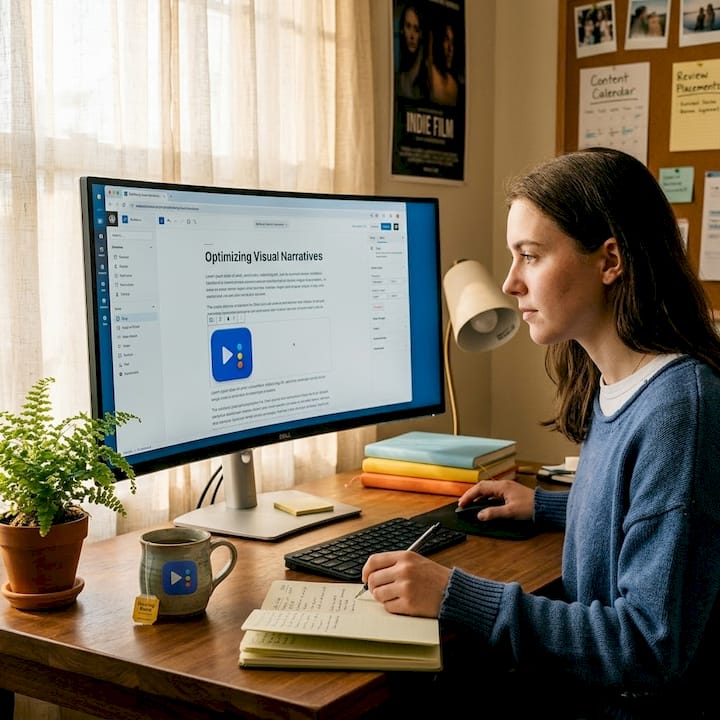
This is one of the most consistently overlooked factors in image SEO. Most pages drop a decorative banner at the top, scatter a few photos in the middle, and call it done. That structure does not help Google connect any image to a specific topic.
Effective placement looks like this:
- Match image to the nearest heading. If a section is about "gel manicure aftercare," the image in that section should show gel manicure aftercare, not a generic nail salon interior.
- Place images inside FAQ sections. FAQ content is frequently pulled into AI Overviews. An image embedded within or directly after a FAQ answer has a stronger chance of being included as a supporting thumbnail.
- Avoid decorative images in important content zones. A generic stock photo sitting between two high-value content sections creates a relevance gap that weakens the signals around it.
- Align captions with user queries. If users search "what does a lip filler treatment look like," a caption that mirrors that language, paired with an original photo, positions you well for AI-generated answers.
- Keep important images above the fold when possible. Images that load within the initial viewport receive more engagement signals, which feed back into overall page performance.
The underlying logic here is simple. Google's AI reads your page the way a reader would. If an image appears in the middle of text about a specific topic and carries matching alt text and a descriptive caption, every signal points in the same direction. Consistency of context is what wins in AI-powered search.
Images, user engagement, and broader SEO benefits
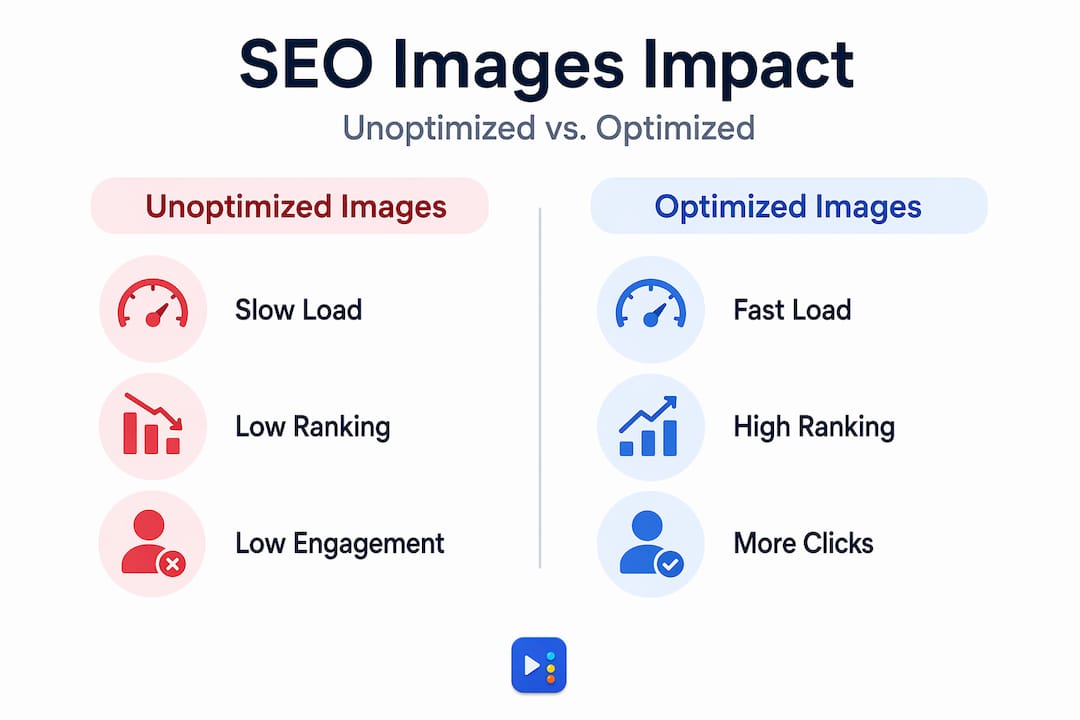
The importance of images in SEO goes beyond rankings in Google Image Search. Pages with relevant images attract attention and measurably improve user engagement metrics like time on page and bounce rate, both of which influence how search algorithms evaluate your content's quality.
Visual content also creates entirely new traffic channels. Google Images and Google Lens drive referral visits that standard text search cannot capture. Google Lens uses entity extraction and image embeddings combined with schema markup to rank images in visual search. For product-based businesses and local service providers, this is a real source of discovery traffic that most competitors ignore.
Here is a comparison of optimized versus unoptimized image approaches across key performance areas:
| Performance Area | Unoptimized Images | Optimized Images |
|---|---|---|
| Google Images visibility | Low or none | Eligible for ranking and AI Overviews |
| Page load speed | Slow, hurts Core Web Vitals | Fast, supports positive Core Web Vitals |
| User engagement | Higher bounce rates | Longer session times, more page interaction |
| Local SEO impact | Minimal | Boosts Google Business Profile and Maps visibility |
| Visual search eligibility | Not indexed for visual search | Eligible via Google Lens and entity recognition |
For local businesses specifically, the SEO benefits of images extend to Google Business Profile. Uploading relevant images to your GBP directly supports local map pack rankings and drives genuine engagement from nearby customers. A nail salon in Pflugerville that posts fresh, original photos of its work consistently outperforms one that never updates its profile visuals. That is a direct competitive advantage built through image strategy.
My honest take on image SEO after working with local businesses
I have reviewed hundreds of websites for clients ranging from med spas in Round Rock to restaurants in Cedar Park. The pattern I see repeatedly is that images are treated as decoration added at the last minute. The logo looks great. The blog post is well-written. And then there is a stock photo of a smiling woman that has nothing to do with the actual topic.
What I have learned is that the businesses gaining traction in AI-driven search are not necessarily writing more content. They are making their existing content more credible with original visuals, accurate annotations, and smart placement. One client replaced five stock images on their service page with original before-and-after photos and saw their page start appearing in AI Overviews for treatment-related queries within six weeks. That is not a coincidence.
My contrarian view: most SEOs still focus image efforts almost entirely on alt text. Alt text matters, but image-to-text proximity and schema markup are where real differentiation happens in 2026. If you spend 20 minutes on alt text and zero minutes on placement strategy and structured data, you are leaving most of the value on the table.
Start integrating image decisions into your content planning process, before you write a single word. Know what original image you will create for each section before the page goes live. That mindset shift is what separates teams getting AI Overview placements from those still wondering why their rankings plateaued.
— Tran
Ready to put your image SEO to work?
At Yourlocalseo, we work with small businesses across Pflugerville, Austin, and Central Texas to build local search visibility that drives real leads. Image optimization is built into everything we do, from technical audits that catch crawlability errors to content strategy that places visuals where they generate the most signal.

If you are ready to stop guessing and start seeing your pages rank in AI Overviews and local search, our local SEO services cover image metadata, structured data, and full on-page optimization tailored to your market. We handle the technical details so you can focus on running your business. Reach out today to get a strategy built around your specific location and industry.
FAQ
What is the role of images in SEO?
Images contribute to SEO by providing contextual relevance signals, supporting E-E-A-T, and creating visibility in Google Images, AI Overviews, and visual search. Properly optimized images with accurate alt text, descriptive captions, and ImageObject schema improve both ranking potential and user engagement.
How does alt text affect SEO?
Alt text helps search engines and AI systems understand what an image shows. Accurate, descriptive alt text improves accessibility and strengthens relevance signals, while keyword-stuffed alt text can hurt visibility according to current Google guidelines.
Do images help with local SEO?
Yes. Uploading original, relevant images to your Google Business Profile directly supports local map pack rankings and improves click-through rates from nearby customers searching for your services.
What image format is best for SEO?
WebP and AVIF are the best formats for SEO in 2026 because they deliver smaller file sizes without quality loss, which supports fast page load speeds and better Core Web Vitals scores.
How often should I add new images for SEO?
Consistency matters more than volume. Adding original, contextually relevant images when you publish new content or update existing pages signals freshness and keeps your visual SEO assets current.