

Most small businesses treat SEO and branding as two separate strategies. One is technical. The other is creative. But that separation is exactly what holds back their search visibility. The role of branding in SEO has shifted dramatically. 60% of users now consult AI platforms before running a traditional Google search, which means being recognized as a credible brand is no longer optional. It is the new ranking factor. If your business does not register as a known, trusted entity across the web, you are invisible to both AI and search engines alike.
Table of Contents
- Key takeaways
- The role of branding in SEO and why it changed
- How branding directly impacts your SEO performance
- Branding strategies for SEO in the age of AI search
- Web design as a brand trust signal for local SEO
- A step-by-step approach to brand-focused SEO
- My honest take on branding and SEO for small businesses
- Ready to build brand authority that ranks?
- FAQ
Key takeaways
| Point | Details |
|---|---|
| Branding is now an SEO signal | Search engines and AI tools evaluate brand mentions, citations, and reputation as authority indicators. |
| Brand recognition drives clicks | Users click on familiar brands even when those brands rank below unknown competitors. |
| AI search rewards real brand presence | Consistent mentions across authoritative sources help your business appear in AI-generated answers. |
| Web design reinforces brand trust | A professional, consistent website design directly reduces bounce rate and improves engagement signals. |
| Small businesses can compete with strategy | Targeted brand-building tactics like reviews, PR, and structured data level the playing field locally. |
The role of branding in SEO and why it changed
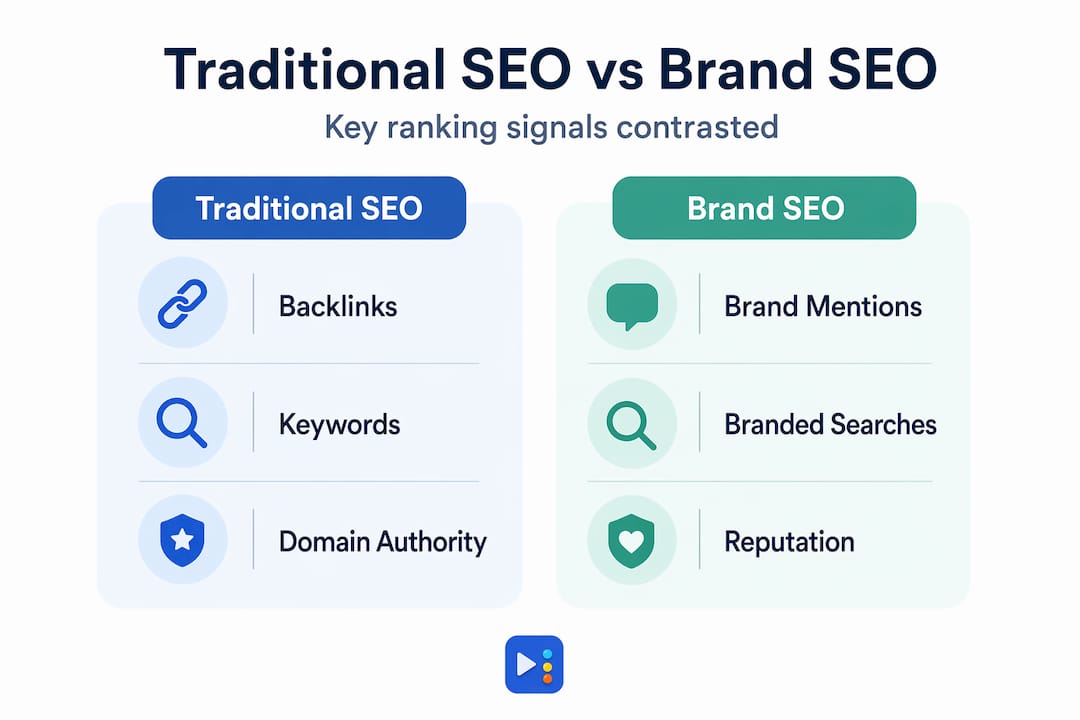
For years, SEO success meant acquiring backlinks and targeting the right keywords. That model still matters, but it no longer tells the full story. Brand signals now outweigh raw backlink counts in how search engines measure authority. Google, and increasingly AI-powered search tools, look at the full picture of how your brand exists across the web.
Brand authority refers to the credibility and recognition your business has earned through external validation. Think of it as the difference between what you say about yourself and what others say about you. Authority is created when others consistently cite and recognize your brand across the web, not just through content you publish yourself.
Here is how brand authority differs from traditional SEO signals:
| Signal Type | Traditional SEO | Brand-Centric SEO |
|---|---|---|
| Primary metric | Backlink volume | Unlinked brand mentions and citations |
| Content goal | Keyword coverage | Topical credibility and expert recognition |
| Trust indicator | Domain authority score | Consistent NAP and media presence |
| AI visibility | Not considered | Core ranking factor in AI answers |
Branded queries matter too. When users search your business name directly, that search volume tells Google people already trust and seek out your brand. Combining consistent NAP (name, address, phone number), structured data markup, and a presence in authoritative directories creates the kind of signal profile that both Google and AI tools use to validate your business as a real, reputable entity.
How branding directly impacts your SEO performance
The practical effects of branding on SEO show up in ways that are measurable. Brand recognition improves click-through rates even when a known brand ranks below a competitor. Users scroll past position one to click on the name they recognize. That behavior sends a direct signal to Google that your result is more relevant.
The SEO and brand identity connection also shows up in organic link acquisition. Strong brands attract backlinks naturally. When you publish something worth citing, journalists, bloggers, and industry sources link to you without being asked. That happens because your brand already has credibility in the market.
Here is where the branding impact on SEO becomes most visible for small businesses:
- Higher click-through rates: Familiar brand names pull more clicks even at lower positions, which improves your ranking over time.
- Lower bounce rates: Users who recognize your brand arrive with trust already established. They stay longer and explore more pages.
- Organic backlink attraction: A reputable brand earns mentions and links from news coverage, directories, and industry publications.
- Social proof signals: Reviews, ratings, and social mentions reinforce your authority to both users and search algorithms.
- Reduced paid search dependency: When users search your brand name directly, you capture that traffic without competing on expensive keywords.
Pro Tip: Monitor your branded search volume in Google Search Console. If it is flat or declining, your brand-building efforts need attention before your rankings will meaningfully improve.
The relationship between social proof and SEO is particularly underrated for small businesses. A nail salon in Pflugerville with 200 detailed Google reviews communicates brand authority in a way that no keyword strategy can replicate on its own.
Branding strategies for SEO in the age of AI search
The shift toward AI-powered search means small businesses now need to think about Answer Engine Optimization (AEO) alongside traditional SEO. AEO focuses on making your brand a cited entity in AI-generated answers through consistent citations in authoritative databases, structured data, and strategic media presence. If ChatGPT, Perplexity, or Google's AI Overview does not know your business exists, you are missing a growing portion of discovery traffic.
Here is a practical framework for branding strategies that support SEO in 2026:
- Claim and optimize every directory listing. Google Business Profile, Yelp, Bing Places, and industry-specific directories create the citation network AI tools pull from.
- Publish original research or expert commentary. Unique, insightful content earns AI citations and media mentions that compound your brand authority over time.
- Build a knowledge panel presence. Structured data markup (Schema.org) helps Google understand who you are, what you do, and where you operate.
- Pursue media placements and PR. Brands visible in trusted media sources gain compounding SEO benefits including AI citations, backlinks, and social shares.
- Maintain consistent brand messaging across platforms. Your tone, visuals, and value proposition should be identical on your website, Google Business Profile, and all social channels.
| Tactic | SEO Benefit | AI Visibility Benefit |
|---|---|---|
| Citation building | Local ranking signals | Validates brand as a real entity |
| Structured data markup | Rich results eligibility | Helps AI parse and cite your brand |
| PR and media coverage | High-authority backlinks | Direct citation source for AI answers |
| Review generation | Trust and click-through signals | Reputation signals recognized by AI |
Pro Tip: When pitching local media or contributing guest content, always reference your business name, location, and category in the same consistent format. This trains search engines and AI tools to recognize you as a specific, credible entity.
Web design as a brand trust signal for local SEO
Your website is where brand perception meets SEO performance in real time. Websites with trustworthy design see lower bounce rates and stronger SEO outcomes, especially in local markets where users are making fast trust decisions about who to call.
For a service business in Central Texas, your website may be the first time a potential customer interacts with your brand. If the design feels outdated, loads slowly, or lacks clear brand identity, users leave. That bounce rate hurts your rankings. Conversely, a well-designed site that communicates credibility instantly keeps users engaged and signals quality to Google.
Here is what brand-aligned web design does for your local SEO:
- Consistent visual identity (colors, fonts, logo placement) builds immediate recognition and reinforces trust.
- Clear service messaging aligned with local keywords tells both users and Google exactly what you do and where.
- Fast load times and mobile responsiveness reduce bounce rates and improve Core Web Vitals scores.
- Testimonials and reviews embedded on-page provide social proof that reduces hesitation and increases conversion.
- Location-specific pages with consistent NAP and neighborhood references strengthen your relevance signals for local searches.
A restaurant in Georgetown, TX ranking for "best brunch near me" will not hold that position if their website confuses visitors or fails to communicate brand identity within three seconds of landing. The technical SEO can get you to the first page. The brand experience determines whether users stay, convert, and come back. You can explore how local search rankings connect to these design and brand factors for Central Texas businesses specifically.
A step-by-step approach to brand-focused SEO
Knowing the theory is one thing. Here is how you actually implement it as a small business with limited time and budget:
- Define your brand positioning. Write one sentence that explains who you serve, what you do, and why you are different. Every piece of content and every directory listing should reflect this.
- Audit your current brand signals. Check your NAP consistency across all directories using a tool like BrightLocal or Moz Local. Inconsistencies confuse search engines and erode trust.
- Optimize your Google Business Profile. This is the single highest-return branding and SEO asset for local businesses. Add photos, update categories, and post weekly. Review our Google Business Profile optimization guide for specific steps.
- Generate and respond to reviews consistently. Reviews are both a brand signal and a local ranking factor. A steady stream of recent, detailed reviews outperforms a one-time burst.
- Create content that earns citations. Publish guides, FAQs, or local resource content that journalists and other sites want to reference. This builds the unlinked mentions that branded web mentions strongly correlate with AI visibility.
- Track your branded search volume monthly. Rising branded queries indicate your brand-building is working. Flat or declining volume means awareness efforts need adjustment.
Pro Tip: Set up Google Alerts for your business name, owner name, and primary service plus your city. This tells you when you are being mentioned online, and you can use those mentions to request backlinks or citations.
The importance of branding in SEO becomes most obvious when you run this audit and realize how many signals your business is either building or missing right now. Use this local SEO checklist to cross-reference your current efforts against what actually moves rankings locally.
My honest take on branding and SEO for small businesses
I have worked with enough small businesses in Central Texas to say this plainly: most of them are under-invested in branding and over-focused on tactics. They want to know which keywords to target while completely ignoring whether their brand even registers as trustworthy to a first-time website visitor.
Here is what I have found to be true. Modern SEO success depends on integrating brand visibility, trust, and multi-signal authority, not just chasing backlinks or keyword volume. The businesses I have seen dominate local search over time are not the ones with the most content. They are the ones that built real reputation through reviews, media mentions, and consistent brand presentation across every platform.
The conventional SEO playbook still works as a foundation. But if you stop there, you are building on sand. AI search tools do not just index your website. They evaluate your brand's presence and credibility across the entire web. A med spa in Austin with 300 detailed reviews, a professional website, and three media mentions will outrank a competitor with better technical SEO but zero brand signals, and that gap will only widen in 2026.
My advice: stop treating branding as a luxury you will invest in later. It is already an SEO investment. Every review you earn, every media mention you get, and every consistent directory listing you maintain is compounding your search authority right now.
— Tran
Ready to build brand authority that ranks?
At Yourlocalseo, we work with small businesses across Pflugerville, Georgetown, Round Rock, and Central Texas to connect brand strategy with real SEO results. We know that getting found on Google requires more than keywords. It requires a brand presence that search engines and AI tools recognize and trust.

Our local SEO services are built around exactly this: Google Business Profile optimization, citation building, review generation, and web design that reinforces your brand while supporting your rankings. If you are ready to stop guessing and start building a brand that Google actually sees, get your local SEO strategy started today. We treat every client as a partner, not a project.
FAQ
What is the role of branding in SEO?
Branding functions as an authority signal in SEO by building recognition, earning citations, and generating branded search queries that search engines use to validate credibility. Strong brands rank more consistently and attract organic backlinks without active outreach.
Can branding improve SEO for a small business?
Yes. Consistent reviews, directory listings, PR mentions, and a professional website all feed brand signals into Google's algorithm, directly improving local rankings and click-through rates for small businesses.
How does brand recognition affect click-through rates?
Known brands earn more clicks even when ranking below a competitor, because users trust familiar names. That click behavior signals relevance to Google and can push your ranking higher over time.
What are brand signals in SEO?
Brand signals include unlinked mentions, NAP consistency across directories, branded search volume, review count and quality, media coverage, and structured data. These tell search engines your business is real, reputable, and relevant.
How does AI search change the importance of branding?
AI tools like ChatGPT and Google's AI Overview pull answers from brands they recognize as authoritative. Brands consistently mentioned across trusted sources gain AI citations without needing to be in the number one organic position.