

Google algorithm updates are systematic changes to how Google evaluates and ranks web content across its entire search engine. Understanding google algorithm updates is no longer optional for digital marketers, business owners, and SEO professionals. The March and May 2026 core updates each rolled out over roughly 12 days, reshaping rankings across industries and triggering traffic swings that caught many sites off guard. Tracking these changes through tools like the Google Search Status Dashboard gives you a reliable signal for when rollouts begin and end, so you can time your analysis correctly.
How do Google algorithm updates impact search rankings and organic traffic?
Google's core updates cause ranking volatility across thousands of queries simultaneously. That volatility is by design. Google applies changes in phases, meaning your rankings may swing up and down before settling into a new baseline. Reacting to mid-rollout data leads to bad decisions.
The traffic impact goes beyond simple position changes. AI Overviews reduce outbound clicks to publishers by nearly 40%, while zero-click searches have risen sharply. That means fewer searchers ever reach your website, even when you rank well.
The May 2026 core update accelerated a trend called disintermediation. Travel aggregators lost up to 11% in visibility, while direct brand sources gained between 8.2% and 9.5%. Google is rewarding the original source over the middleman.
Key effects to watch after any core update:
- Ranking shifts across broad keyword sets, not just individual pages
- Traffic drops on informational content competing with AI Overviews
- Sector-specific volatility in travel, finance, health, and news
- Gains for direct brands and losses for aggregator-style sites
- Stabilization lag of one to two weeks after the official completion notice
Pro Tip: Wait at least one full week after Google posts the completion notice on the Search Status Dashboard before pulling conclusions from your analytics. Data collected during the rollout window reflects a system in flux, not a final state.
What are the main types of Google algorithm updates?
Google runs several distinct update types, and each one targets a different part of the ranking system. Knowing which type hit your site tells you exactly where to focus your recovery effort.
| Update type | Primary focus | Frequency | Key signal evaluated |
|---|---|---|---|
| Broad core update | Overall ranking quality | Several times per year | E-E-A-T, content relevance, entity authority |
| Spam update | Link and content spam | Periodic named releases | SpamBrain AI spam signals |
| Helpful Content system | Content written for people | Integrated into core | User satisfaction, depth, originality |
| AI-powered ranking | AI Overview eligibility | Continuous | Entity authority, structured data, trust |
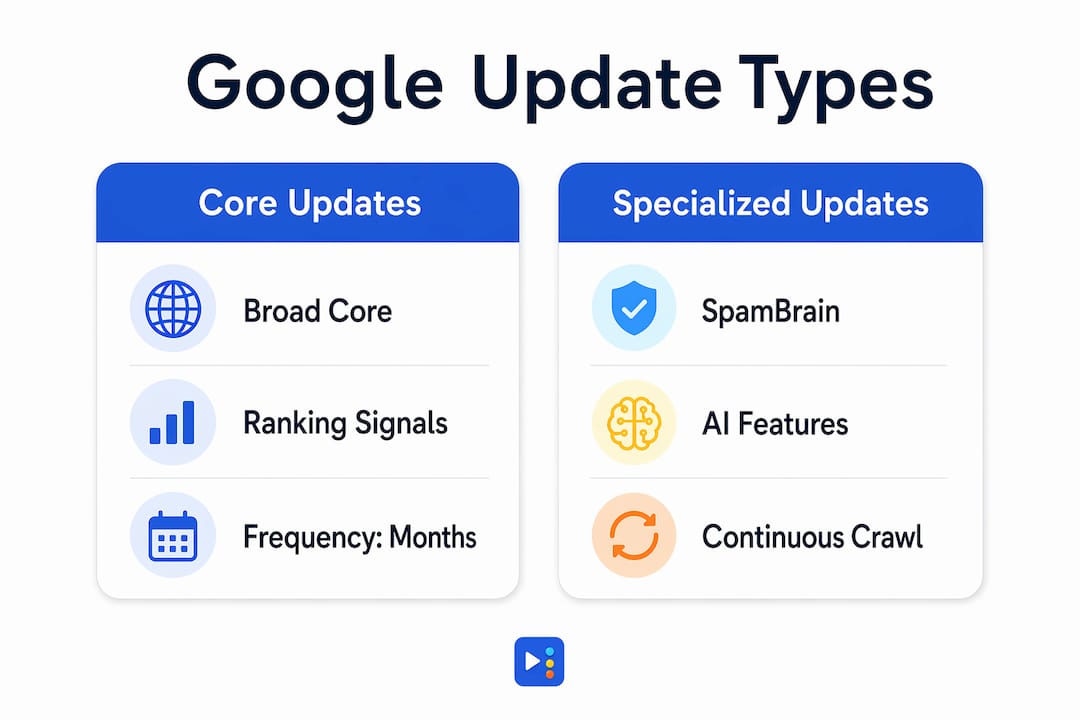
Broad core updates recalibrate how Google weighs hundreds of ranking signals at once. No single page or tactic triggers them. They reflect Google's evolving understanding of what makes content genuinely useful.
SpamBrain operates continuously at crawl time, evaluating link quality and content manipulation on every page Google processes. Periodic named spam updates, like those announced in march and june 2026, represent public disclosures of major threshold changes rather than new systems switching on.
Google's AI-powered features now influence both classic rankings and AI Overview eligibility. Google evaluates pages as entities tied to brand or topic authority, not just as individual documents. A page about "Austin HVAC repair" ranks better when the entire site signals authority on HVAC topics in Austin, not just when that one page is well written.
How to adapt to algorithm updates and recover rankings
Recovery from a core update is not a sprint. Ranking restoration typically takes 3–6 months of focused, iterative improvement. That timeline reflects how long it takes Google to recrawl, reindex, and re-evaluate your changes at scale.
Distinguish algorithmic changes from manual actions
Manual actions are explicit and appealable through Google Search Console. Algorithmic demotions carry no message and no appeal process. If you see a penalty notice in Search Console, you can submit a reconsideration request. If you see nothing but a traffic drop, you are dealing with an algorithmic change and the only path forward is content and technical improvement.
Build E-E-A-T signals across your site
E-E-A-T stands for Experience, Expertise, Authoritativeness, and Trustworthiness. Addressing E-E-A-T signals correlates strongly with ranking restoration after core updates. Practical steps include:
- Add author bios with real credentials and professional history
- Publish original research, case studies, or firsthand data
- Earn mentions and links from recognized industry sources
- Update outdated content with current facts and dates
- Fix thin pages by merging or expanding them with genuine depth
Stabilize before you react
Avoid major site changes until at least one week after the official completion notice. Ranking fluctuations during rollout reflect a system applying changes in stages, not a final verdict on your content. Pulling pages, changing URLs, or restructuring navigation during a live rollout creates noise that makes diagnosis nearly impossible.
Pro Tip: Use Google Search Console's Performance report filtered by page to identify which URLs lost the most clicks after a core update. Fix those pages first. Spreading effort across your entire site dilutes impact and slows recovery.
For local businesses, improving Google ranking requires the same E-E-A-T discipline applied to local signals: consistent citations, a complete Google Business Profile, and location-specific content that demonstrates real expertise in your market.
What 2026 algorithm trends should marketers watch?
The pattern across 2026 updates points to four clear shifts that will shape SEO strategy for the rest of the year.
-
AI Overviews are compressing organic traffic. Outbound clicks dropped from 0.62 to 0.37 per search when AI Overviews appear. That is a structural change, not a temporary dip. Sites that depend on informational traffic must build brand recognition so users seek them out directly.
-
Disintermediation favors original sources. Google is routing searchers to the brand, clinic, or business that actually provides the service rather than to comparison or aggregator sites. Direct brands gained 8.2–9.5% in visibility during the May 2026 update while aggregators lost ground.
-
Update announcements are faster and less detailed. Google's updates have become more frequent with less public explanation. SEO professionals who wait for Google to explain what changed will always be behind. Focus on building durable authority signals instead of chasing each announcement.
-
AI and classic search are converging. Traditional ranking signals and AI content visibility now operate within the same evaluation framework. Optimizing for one without the other leaves ranking potential on the table.
"The sites winning in 2026 are not the ones reacting fastest to updates. They are the ones that built enough entity authority and content depth that updates tend to reward them rather than penalize them. Original research, clear authorship, and consistent topical focus are the three signals that matter most right now."
Monitoring your local SEO performance through both rank tracking and Google Search Console gives you the clearest picture of how each update affects your specific market and query set.
Key Takeaways
Adapting to Google algorithm updates requires patience, E-E-A-T investment, and a clear distinction between algorithmic changes and manual actions.
| Point | Details |
|---|---|
| Wait before reacting | Analyze data only after one full week post-rollout completion to avoid misreading volatile signals. |
| E-E-A-T drives recovery | Author credentials, original research, and authoritative links are the fastest path to ranking restoration. |
| AI Overviews cut clicks | Outbound clicks drop nearly 40% when AI Overviews appear, making brand recognition a critical traffic strategy. |
| Disintermediation is real | Direct brand sources gained 8.2–9.5% in the May 2026 update while aggregators lost significant visibility. |
| Recovery takes months | Expect 3–6 months of consistent improvement before core update impacts fully reverse. |
What I've learned from watching updates hit real businesses
The most damaging mistake I see after a core update is panic. A business loses 20% of its traffic on day three of a rollout and immediately starts deleting pages, changing titles, and restructuring the site. Two weeks later, the rankings stabilize on their own. The site is now harder to crawl and the owner has no clean baseline to measure from.
The businesses that recover fastest are the ones that do nothing reactive for the first two weeks, then run a disciplined audit. They identify which pages lost the most clicks, check whether those pages have thin content or weak authorship signals, and fix them one by one. That process is slow and unglamorous. It works.
The AI Overview shift is the one trend I think most local businesses are underestimating. If you run a nail salon in Pflugerville or a med spa in Round Rock, you may not feel the AI Overview impact yet because local queries still drive map pack results. But informational content supporting your site, the "how long does a gel manicure last" type posts, is losing clicks fast. Building your Google Business Profile and local search presence is more valuable now than writing blog posts that compete with AI-generated answers.
The long game is entity authority. Google wants to know that your brand is the recognized expert on a topic in a specific location. Every citation, every review, every piece of original content you publish contributes to that signal. Updates tend to reward that kind of depth. They punish thin sites that exist only to capture traffic.
— Tran
How Yourlocalseo helps businesses stay visible through algorithm changes
Algorithm changes hit small businesses hard when their SEO foundation is weak. Yourlocalseo works with service-based businesses across Pflugerville, Austin, Round Rock, and Central Texas to build the kind of local search presence that holds up through updates.

We focus on Google Business Profile optimization, citation building, on-page SEO, and review generation. These are the signals that boost Google visibility over time and keep your rankings stable when the next core update rolls out. If your traffic dropped after a recent update or you want to build a stronger foundation before the next one, visit Yourlocalseo to see how we can help.
FAQ
What is a Google core update?
A Google core update is a broad recalibration of Google's ranking signals that affects search results across many queries, languages, and industries simultaneously. Core updates are not targeted at specific sites but reflect Google's evolving standards for content quality and relevance.
How long does a Google core update take to roll out?
The March and May 2026 core updates each lasted about 12 days from start to finish. Google posts official start and completion notices on the Search Status Dashboard.
How do I know if a core update affected my site?
Check Google Search Console's Performance report for a drop in clicks or impressions that aligns with a known update window. Algorithmic changes carry no notification in Search Console, so you must correlate traffic drops with Google's public update announcements.
Can I appeal a Google algorithm penalty?
Manual actions are appealable through Search Console's Manual Actions report. Algorithmic ranking changes are not appealable. The only path forward for algorithmic demotions is improving content quality, E-E-A-T signals, and technical SEO over time.
How can I protect my rankings from future algorithm updates?
Build entity authority through consistent topical content, strong author credentials, and authoritative backlinks. Sites with deep E-E-A-T signals and original research tend to gain visibility after core updates rather than lose it.