

Social proof is defined as third-party validation signals, including reviews, testimonials, and user-generated content, that search engines and AI models use to assess a brand's credibility and rank it accordingly. The role of social proof in SEO has shifted from a nice-to-have trust signal to a core ranking factor, especially as Google's E-E-A-T framework and AI-driven search tools increasingly rely on verifiable, external validation to decide which brands to recommend. 97% of consumers read reviews before purchasing, yet trust in a single review dropped from 79% to 42% between 2024 and 2025. That shift tells you everything: volume, diversity, and recency now matter more than any one glowing testimonial.
How does social proof influence search engine rankings and user trust?
Social proof affects SEO through two distinct channels: direct signals and behavioral metrics. Both matter, and ignoring either one leaves rankings on the table.
Direct ranking signals
Google's E-E-A-T framework, which stands for Experience, Expertise, Authoritativeness, and Trustworthiness, treats social proof as a core input. Reviews and testimonials strengthen the Trustworthiness pillar directly. Star ratings displayed in search results through structured data markup increase click-through rates. Higher CTR signals to Google that your listing is relevant, which reinforces rankings over time.

Brand mentions across third-party platforms, even without a backlink, register as entity signals. Google's Knowledge Graph connects these mentions to your business profile. The more consistent and widespread those mentions are, the stronger your topical authority becomes.
Behavioral metrics social proof drives
When a visitor lands on your page and sees 400 five-star reviews, they stay longer. When they see zero, they leave fast. That difference in time on page and bounce rate feeds directly into Google's quality assessment. Products with reviews convert 270% better than those without. Better conversion rates reduce the "pogo-sticking" behavior that signals poor content quality to search engines.
Here is a quick breakdown of the social proof types that move SEO metrics:
- Star ratings and review counts on Google Business Profile and Yelp lift local map pack rankings
- Testimonials with named clients increase time on page and reduce bounce rate
- User-generated content (UGC) on forums, Reddit, and review platforms builds topical entity density
- Influencer endorsements generate brand mentions and referral traffic that diversify your link profile
- Case studies with specific outcomes satisfy E-E-A-T's Experience and Expertise criteria
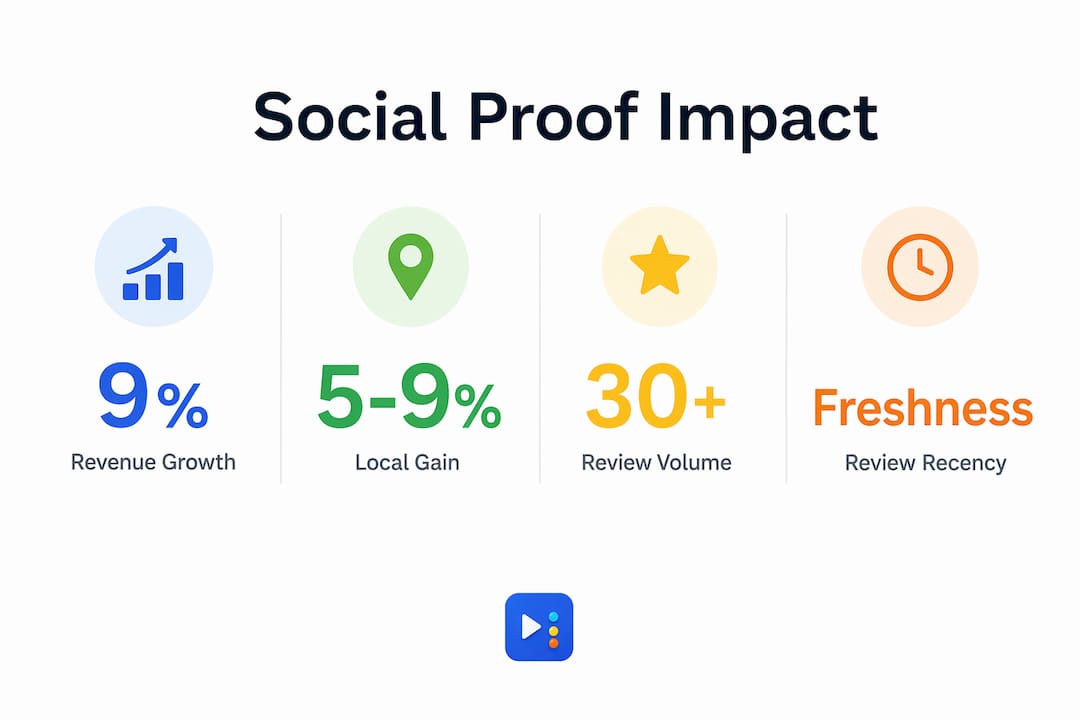
A one-star increase on Yelp drives 5–9% revenue growth for local businesses. That revenue growth is a downstream effect of better trust signals producing better rankings and higher conversion rates working together.
What forms of social proof are most effective for SEO in 2026?
Not all social proof carries equal weight with search engines or AI recommendation engines. The format and structure of your proof determines whether machines can read and cite it.
UGC and text-based reviews
AI models prioritize user-generated content as the primary verification layer because it provides high entity density and firsthand experience markers that brand-created content simply cannot replicate. Without UGC, AI tools like ChatGPT, Perplexity, and Google's AI Overviews hedge or omit brand recommendations entirely. That is a direct traffic loss you may not even be tracking yet.
AI systems specifically use narrative, text-heavy reviews from trusted platforms like Google Business Profile and Trustpilot as authenticity signals. A 200-word review describing a specific experience at your Austin nail salon carries more AI citation weight than a hundred one-line reviews saying "great service."
Atomic claims vs. long-form testimonials
Atomic claims are short, structured proof statements that link a specific client, outcome, and date. They are optimally machine-readable for B2B SEO and high-stakes service categories. An example: "Pflugerville restaurant increased Google reservations by 40% in 90 days after GBP optimization." That sentence contains a named entity, a measurable outcome, and a time frame. AI can extract and cite it. A paragraph of vague praise cannot be cited the same way.
| Social proof type | AI readability | SEO impact |
|---|---|---|
| Logo walls (image-based) | Very low | Minimal |
| Named client list (plain text) | High | Strong entity signal |
| Star ratings with review count | Medium | CTR and local rankings |
| Narrative UGC reviews | Very high | E-E-A-T and AI citations |
| Atomic claims with outcomes | Very high | B2B authority and citations |
Logo walls are effectively invisible to AI crawlers. Listing partner and client names as plain text is the only way to make that social proof machine-readable. If your homepage shows client logos as images with no alt text or accompanying text, you are losing entity verification credit.
Pro Tip: Add a "Trusted by" section to your homepage that lists client or partner names as plain text, not just logos. Pair each name with a one-sentence outcome statement to maximize AI citation potential.
What are best practices and pitfalls when using social proof for SEO?
Getting social proof onto your site is step one. Structuring it correctly for both humans and machines is where most businesses fall short.
How to structure social proof for maximum impact
- Use schema markup for reviews. Implement Review and AggregateRating schema on product and service pages. This enables rich snippets in Google Search, which directly increases CTR.
- Place social proof near calls to action. A testimonial positioned directly above a "Book Now" button reduces friction at the decision point. Conversion rate improvements feed back into your SEO behavioral signals.
- Respond to every review. Google treats owner responses as an engagement signal on your Google Business Profile. Responding also demonstrates active management, which supports local search rankings for near-me queries.
- Prioritize recency. A review from three years ago carries less weight than one from last month. Build a system that consistently generates fresh reviews, not a one-time push.
- Diversify your platforms. Reviews on Google, Yelp, Facebook, and industry-specific platforms like Healthgrades or Houzz create a multi-platform trust footprint that is harder for competitors to match.
The boomerang effect: a pitfall most marketers miss
Negative framing of social proof statistics can backfire by normalizing undesirable behavior. If you write "Join the 30% of businesses that haven't optimized their reviews yet," you are inadvertently telling readers that not optimizing is common. Positive injunctive framing works better. "Join 500+ businesses that rank higher with verified reviews" sets a norm you want people to follow.
Pro Tip: Audit your existing social proof copy for negative framing. Replace any stat that highlights what people are NOT doing with one that highlights what successful businesses ARE doing.
Authenticity is non-negotiable. Fake reviews on Google Business Profile violate Google's policies and can trigger a manual penalty. Beyond penalties, AI now treats user reviews as a verification layer rather than marketing claims. Fabricated reviews lack the linguistic patterns and entity specificity that AI looks for. They do not help your AI citation rate, and they put your entire profile at risk.
How can you measure the impact of social proof on SEO?
Tracking social proof effectiveness requires connecting review activity to SEO outcomes. Most businesses collect reviews without ever measuring what those reviews actually do for rankings or revenue.
Key metrics to track
- Google Business Profile insights: Track profile views, direction requests, and calls before and after a review generation campaign
- Organic CTR in Google Search Console: Rising CTR on pages with review schema indicates rich snippets are working
- Bounce rate and time on page: Use Google Analytics 4 to compare pages with testimonials against pages without them
- Local map pack position: Tools like BrightLocal track your ranking in the local 3-pack over time
- AI citation mentions: Search your brand name in ChatGPT, Perplexity, and Google's AI Overviews monthly to check whether you are being recommended
Brands with strong, verified social proof earn more AI citations than those relying solely on traditional backlinks or domain authority. That is a measurable competitive advantage you can track by monitoring AI recommendation frequency over time.
For local businesses in markets like Austin, Round Rock, or Cedar Park, local SEO keyword strategies that incorporate UGC signals compound the effect. Reviews that naturally include location-specific keywords, like "best med spa in Pflugerville," feed both your review profile and your on-page keyword relevance simultaneously.
Focusing on review freshness, volume, and interaction boosts both search rankings and consumer conversion rates. Set a monthly review target, assign someone to respond within 48 hours, and review your GBP insights quarterly to confirm the trend is moving in the right direction.
Key takeaways
Social proof works in SEO because it satisfies both human trust requirements and AI verification criteria at the same time, making it one of the highest-leverage activities for any local business.
| Point | Details |
|---|---|
| UGC outperforms brand content | AI models cite user reviews over brand claims; prioritize Google Business Profile and Trustpilot reviews. |
| Text beats images for AI | List client names and outcomes as plain text, not logo walls, to gain entity recognition. |
| Atomic claims drive citations | Short, specific proof statements with client, outcome, and date are the most machine-readable format. |
| Recency and volume both matter | A steady stream of fresh reviews outperforms a one-time burst of older ones for rankings. |
| Measure AI citation frequency | Check ChatGPT and Perplexity monthly to confirm your social proof is generating AI recommendations. |
Why I think most businesses are still treating social proof as a marketing add-on
After working with local businesses across Central Texas, I keep seeing the same pattern. A business owner collects 50 reviews, puts a widget on their homepage, and considers the job done. That approach worked in 2019. It does not work now.
The shift I have watched happen in real time is that AI search tools have become the new gatekeepers. When someone asks ChatGPT or Perplexity to recommend a med spa in Austin, those tools are not scanning your backlink profile. They are looking for verifiable, third-party confirmation that your business is legitimate and delivers results. That confirmation comes from reviews, UGC, and structured proof statements, not from your "About Us" page.
The businesses I see winning in local search right now are the ones treating review generation as an ongoing operational process, not a marketing campaign. They ask for reviews at the point of service. They respond to every single one. They structure their testimonials as specific outcome statements rather than generic praise. And they check their AI citation rate the same way they check their Google rankings.
The uncomfortable truth is that traditional backlink building, while still relevant, is no longer sufficient on its own. A nail salon in Pflugerville with 300 recent, detailed Google reviews and zero backlinks will outperform a competitor with 20 reviews and a solid link profile in local and AI-driven search. Social proof has become the trust currency of modern SEO, and the businesses that treat it that way are the ones pulling ahead.
— Tran
Ready to turn your reviews into real rankings?
At Yourlocalseo, we build local SEO strategies that treat social proof as a core ranking asset, not an afterthought. From Google Business Profile optimization and review generation systems to on-page schema markup and citation building, we connect every piece to your actual search visibility.

We work with nail salons, med spas, restaurants, and service businesses across Pflugerville, Austin, Round Rock, Georgetown, and Cedar Park. If you want a strategy that builds trust with both Google and your customers, we are ready to help. Reach out to Yourlocalseo and let's build a social proof system that drives real leads.
FAQ
Does social proof directly improve Google rankings?
Social proof improves rankings both directly and indirectly. Review schema markup enables rich snippets that increase CTR, while strong review volume and recency strengthen Google Business Profile rankings in the local map pack.
What type of social proof is best for AI search visibility?
Narrative, text-based reviews on platforms like Google Business Profile and Trustpilot are the most effective. AI models use these as verification signals and cite them when recommending businesses in search results.
How many reviews do I need to see an SEO impact?
There is no fixed threshold, but review volume, recency, and diversity all contribute. A consistent flow of fresh, detailed reviews across multiple platforms outperforms a large but stagnant review count.
Can fake reviews hurt my SEO?
Fake reviews violate Google's policies and can trigger manual penalties on your Google Business Profile. AI models also detect the lack of specificity in fabricated reviews, which reduces your citation rate in AI-driven search tools.
How does social proof fit into a local SEO strategy?
Social proof supports local customer acquisition by building trust signals that improve map pack rankings, increase CTR, and generate AI recommendations for location-specific queries like "best [service] near me."