

Citation building is the process of creating consistent, accurate listings of your business name, address, and phone number across online directories, platforms, and websites to strengthen your local search visibility. Every time Google sees your business information confirmed on a trusted platform, such as Google Business Profile, Yelp, or a local chamber of commerce directory, it gains more confidence that your business is real, located where you say it is, and worth showing to nearby searchers. For local businesses competing in markets like Austin, Round Rock, or Pflugerville, citations are not optional extras. They are foundational local ranking signals that directly affect whether you appear in the local map pack.
What is citation building and why does it matter for local SEO?
Citation building, also called local citation building in the SEO industry, is the structured practice of placing your business's core information on authoritative online platforms to build trust with search engines and potential customers. Citations build local prominence, which Google treats as a key ranking factor for local search results. More prominence means a stronger chance of appearing when someone searches "nail salon near me" or "HVAC repair in Cedar Park."
The information that matters most in any citation is your NAP: name, address, and phone number. Many SEO professionals now extend this to NAPW, adding your website URL as a fourth critical element. Each platform where your NAPW appears consistently adds another data point confirming your business's legitimacy to Google's local search algorithm.

The importance of citation building goes beyond rankings. When a potential customer finds your business listed accurately on Yelp, Angi, and your Google Business Profile, that consistency builds trust before they ever visit your website. Inconsistent or missing listings, on the other hand, create doubt. A customer who finds two different phone numbers for your business on two different directories will often move on to a competitor.
What are structured and unstructured citations, and why both matter
Search Engine Land defines two distinct citation types: structured and unstructured. Understanding the difference helps you build a citation strategy that covers all the ways your business appears online.
Structured citations are formal directory listings with dedicated fields for your business name, address, phone number, website, hours, and category. Think Google Business Profile, Yelp, Facebook Business, Bing Places, and industry-specific directories like Houzz for contractors or Zocdoc for healthcare providers. Structured citations are easier for search engines to parse because the data sits in predictable, machine-readable fields.
Unstructured citations are mentions of your business information on blogs, news sites, local event pages, or social media posts. A local Austin food blog mentioning your restaurant's address in a review is an unstructured citation. A neighborhood Facebook group post recommending your plumbing service with your phone number qualifies too. These mentions do not follow a standard format, but they still signal relevance and authority to search engines.
Here is a side-by-side comparison of the two types:
| Feature | Structured citations | Unstructured citations |
|---|---|---|
| Format | Standardized directory fields | Free-form mentions on any platform |
| Examples | Google Business Profile, Yelp, Bing Places | Local blogs, news articles, social media |
| Search engine readability | High. Easily parsed by algorithms | Moderate. Requires context interpretation |
| Management approach | Claim, verify, and update listings | Monitor mentions and encourage coverage |
| SEO impact | Foundational and scalable | Builds authority and contextual relevance |
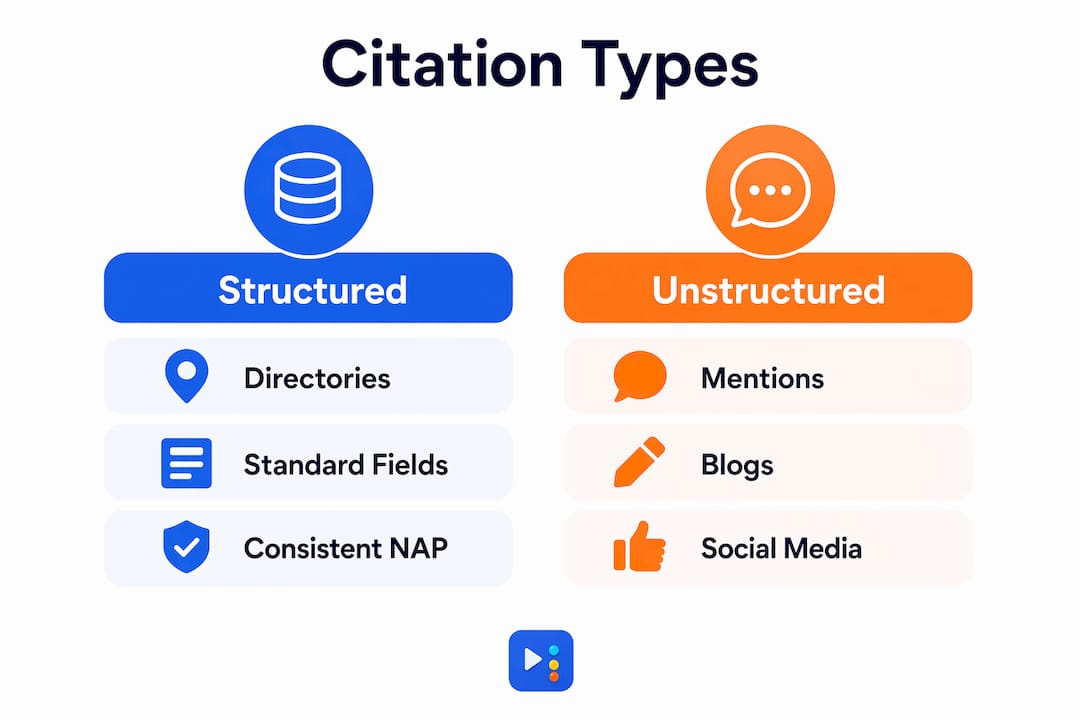
The strongest citation profiles combine both types. Structured listings establish legitimacy while unstructured mentions build contextual authority across the broader web. A med spa in Georgetown that appears on Yelp, Google, and a local wellness blog carries far more weight than one that only appears on a single directory.
How to build citations effectively: a step-by-step process
The citation building process follows a clear sequence. Skipping steps, especially the audit phase, is one of the most common mistakes local businesses make.
-
Run a citation audit first. Before adding any new listings, identify what already exists. Search your business name on Google, check major directories manually, or use a tool like BrightLocal to surface existing citations. Look for inconsistencies in your address format, outdated phone numbers, or duplicate listings. Running an audit before building prevents you from amplifying existing errors across new platforms.
-
Establish a canonical NAP record. Decide on the exact format for your business name, address, and phone number, and write it down. "Suite 100" versus "Ste. 100" may seem trivial, but inconsistency at that level confuses search engines. Your canonical record becomes the single source of truth for every listing you create or update.
-
Build and claim your Google Business Profile. Google Business Profile is the single most important local citation for any business. Claim it, verify it, and fill out every field completely. Add photos, hours, services, and a description. This listing alone drives more local search visibility than any other single citation source.
-
Expand to core directories. After Google, build listings on Yelp, Bing Places, Apple Maps, Facebook Business, and the Better Business Bureau. These platforms carry high domain authority and are trusted data sources that feed information to dozens of smaller directories automatically.
-
Add niche and geo-specific directories. A restaurant in Pflugerville benefits from listings on TripAdvisor and OpenTable. A home services company gains from Angi, HomeAdvisor, and local chamber of commerce directories. Geo-specific directories, like the Pflugerville Chamber of Commerce or Austin Business Journal listings, carry extra weight for local relevance.
-
Track and maintain your listings over time. Citation building requires ongoing maintenance, not just a one-time submission. Businesses move, phone numbers change, and hours shift. Every update needs to be reflected across all your listings promptly.
Pro Tip: Keep a simple spreadsheet tracking every directory where your business is listed, the login credentials, and the date you last verified the information. This single habit saves hours of cleanup work when your business details change.
Why consistency and quality beat quantity every time
More citations do not automatically mean better rankings. A business with 200 listings on low-quality, spammy directories will underperform a competitor with 40 accurate listings on authoritative platforms. The guide to citation building that actually works focuses on quality and consistency above all else.
Inconsistent NAP information is the most damaging citation problem local businesses face. If your address appears as "123 Main St" on Google and "123 Main Street" on Yelp, search engines receive conflicting signals. Multiply that across dozens of directories and the confusion compounds. Outdated or mismatched information actively harms your local SEO rather than helping it.
Duplicate listings create a separate problem. If your business appears twice on the same directory with slightly different information, search engines do not know which version to trust. This splits your citation authority and can suppress your rankings. Merging or removing duplicates is a critical part of any citation audit.
The best citation building strategies prioritize these factors when choosing where to build listings:
- Authority: Does the directory have a strong domain authority and a real user base?
- Relevance: Is the directory specific to your industry or geographic area?
- Accuracy: Can you control and update your listing directly?
- Indexability: Does Google crawl and index listings from this platform?
Pro Tip: Focus your first 30 citations on platforms that data aggregators like Data Axle and Neustar Localeze pull from. Getting listed accurately on these aggregators pushes your information to hundreds of smaller directories automatically, multiplying your reach without manual effort.
What citation management tools make the process easier
For a single-location business with a small listing profile, a spreadsheet and manual submissions work fine. Once you have multiple locations, dozens of directories, or limited time, citation management tools become worth the investment.
Listing management tools automate discovery, distribution, and monitoring of your business information at scale. Here is a comparison of the most widely used options:
| Tool | Best for | Key features |
|---|---|---|
| Semrush Listing Management | Businesses already using Semrush for SEO | Centralized dashboard, automated distribution, duplicate detection |
| BrightLocal | Agencies and multi-location businesses | Citation audits, rank tracking, white-label reporting |
| Yext | Enterprise and franchise businesses | Real-time updates across 200+ publishers, knowledge graph management |
| Whitespark | Citation-focused campaigns | Manual citation building service, local rank tracker |
The benefits of using citation management software go beyond saving time. These platforms monitor your listings for unauthorized changes, which happens more often than most business owners realize. A competitor or a well-meaning customer can suggest an edit to your Google Business Profile, and if you are not watching, that change can go live and corrupt your NAP data.
For small businesses in Central Texas managing one or two locations, learning how to manage local listings manually is a practical starting point. As your business grows or your time shrinks, moving to a tool like BrightLocal or Semrush Listing Management makes the ongoing maintenance manageable without a full-time hire.
Key takeaways
Citation building works when your business information is accurate, consistent, and present on authoritative platforms. Quality and ongoing maintenance determine results far more than the raw number of listings you create.
| Point | Details |
|---|---|
| Define your canonical NAP first | Establish one exact format for your business name, address, and phone number before building any listings. |
| Google Business Profile is non-negotiable | It is the single most important citation and should be fully optimized before expanding to other directories. |
| Structured citations come before unstructured | Directory listings are machine-readable and more impactful for local search algorithms. |
| Consistency outperforms quantity | Forty accurate, authoritative listings outperform two hundred inconsistent ones every time. |
| Maintenance is not optional | Citation building is an ongoing discipline. Outdated information actively harms your local rankings. |
Citations are your business's digital handshake
I have worked with enough local businesses to know that most owners treat citation building as a one-time checkbox. They claim their Google Business Profile, maybe add a Yelp listing, and consider the job done. That approach worked in 2015. It does not work now.
What I have seen consistently is that the businesses dominating local search in competitive markets like Austin and Round Rock are not the ones with the most citations. They are the ones with the most accurate citations, maintained over time, across a mix of structured directories and genuine unstructured mentions from local press and community sites. That combination creates what Search Engine Land's Elizabeth Rule describes as a trusted entity presence across the web, and that is what search engines reward.
The part most guides skip is the maintenance side. I have audited citation profiles for businesses that moved locations two years ago and still had the old address live on 40 directories. Every one of those stale listings was quietly working against their rankings. Fixing that backlog took weeks and produced a noticeable improvement in local visibility within 60 days.
My honest advice: treat your citation profile like you treat your Google Business Profile. Check it quarterly. Update it when anything changes. Build new listings on relevant platforms when you find gaps. That discipline, applied consistently, compounds over time in ways that a one-time citation blast never will. If you want to understand how citations drive local SEO visibility in practical terms, the mechanics are worth studying before you build your first listing.
— Tran
Let Yourlocalseo handle your citation building

At Yourlocalseo, we handle the full citation building process for local businesses across Pflugerville, Austin, Round Rock, Georgetown, and surrounding Central Texas communities. That means citation audits to find inconsistencies, claiming and verifying your listings on the directories that matter most, and ongoing management to keep your NAP accurate as your business grows. You focus on running your business. We focus on making sure Google can find it. Visit Yourlocalseo to learn more about our local SEO services and get started with a citation audit tailored to your market.
FAQ
What is a local citation in SEO?
A local citation is any online mention of your business's name, address, and phone number. Citations appear on directories like Yelp and Google Business Profile, as well as on blogs, news sites, and social media platforms.
How many citations does a local business need?
There is no fixed number. Quality and consistency matter more than volume. Forty accurate listings on authoritative, relevant directories produce better local SEO results than hundreds of listings on low-quality sites.
What is the difference between structured and unstructured citations?
Structured citations are formal directory listings with dedicated NAP fields, such as Google Business Profile or Yelp. Unstructured citations are informal mentions of your business information on blogs, news articles, or social media posts.
How do I start the citation building process?
Start with a citation audit to identify existing listings and inconsistencies. Then establish a canonical NAP record, claim your Google Business Profile, and expand to core directories like Yelp, Bing Places, and Apple Maps before adding niche or geo-specific platforms.
Can wrong citations hurt my Google rankings?
Yes. Mismatched or outdated NAP information sends conflicting signals to search engines and actively harms your local search rankings. Auditing and correcting inaccurate citations is often the fastest way to recover lost local visibility.