
Your website is live, your Google Business Profile is set up, and you're waiting for customers to roll in. But your competitors keep showing up ahead of you in local search results, and you're not sure why. The answer, in many cases, comes down to citations. Most small business owners in Central Texas treat citations as background noise, just another box to check. In reality, they are one of the most powerful and underused tools in local SEO, especially for nail salons, restaurants, med spas, and other service-based businesses competing in fast-growing markets like Round Rock, Georgetown, Cedar Park, and Pflugerville.
Table of Contents
- What are citations and why do they matter in local SEO?
- Types of local citations: Structured vs. unstructured
- Consistency and accuracy: The secret to citation power
- Building quality citations: Where and how to start
- A Central Texas expert's view: What most guides miss about local citations
- Ready to get results? YourLocalSEO makes citation success simple
- Frequently asked questions
Key Takeaways
| Point | Details |
|---|---|
| Citations defined | Citations are online mentions of your business details that build trust for search engines. |
| Accuracy matters most | Consistent business information across citations is crucial for boosting local rankings. |
| Quality over quantity | Target industry-specific and local directories rather than chasing every citation opportunity. |
| Actionable steps | Audit, claim, and update your business information on all major citation sites to see real results. |
What are citations and why do they matter in local SEO?
A citation, in the context of local SEO, is any mention of your business's NAP, which stands for name, address, and phone number, on an external website, directory, or app. Think of platforms like Yelp, Yellow Pages, TripAdvisor, or even your local chamber of commerce website. Every time your business information appears on one of these sites, that's a citation.
Search engines like Google use citations as trust signals. The more consistently and accurately your business information appears across the web, the more confident Google becomes that your business is legitimate, active, and worth showing to nearby searchers. It works a lot like reputation in a small community. When multiple trusted sources say the same thing about your business, people, and search engines, start to believe it.
Here's why this matters so much for Central Texas service businesses specifically:
- Ranking influence: Citation accuracy and volume contribute directly to better Google Maps rankings, which is where most local customers find businesses.
- Trust building: Consistent NAP data across platforms signals to Google that your business information is reliable.
- Visibility reach: Citations appear on platforms where customers are actively searching, extending your digital footprint well beyond your website.
- Competitive advantage: In markets like Austin and Round Rock, where competition among beauty and hospitality businesses is fierce, citation volume and quality can be a real differentiator.
"Citations are not just directory entries. They are votes of confidence from trusted web properties telling Google your business is real, local, and relevant."
Understanding the key factors for Central Texas rankings reveals that citations consistently appear as one of the top contributors to local pack placement, right alongside Google Business Profile optimization and reviews. If you're skipping citation work, you're leaving serious visibility on the table.
Types of local citations: Structured vs. unstructured
Not all citations are created equal. They fall into two main categories, and knowing the difference helps you prioritize your effort and budget smartly.
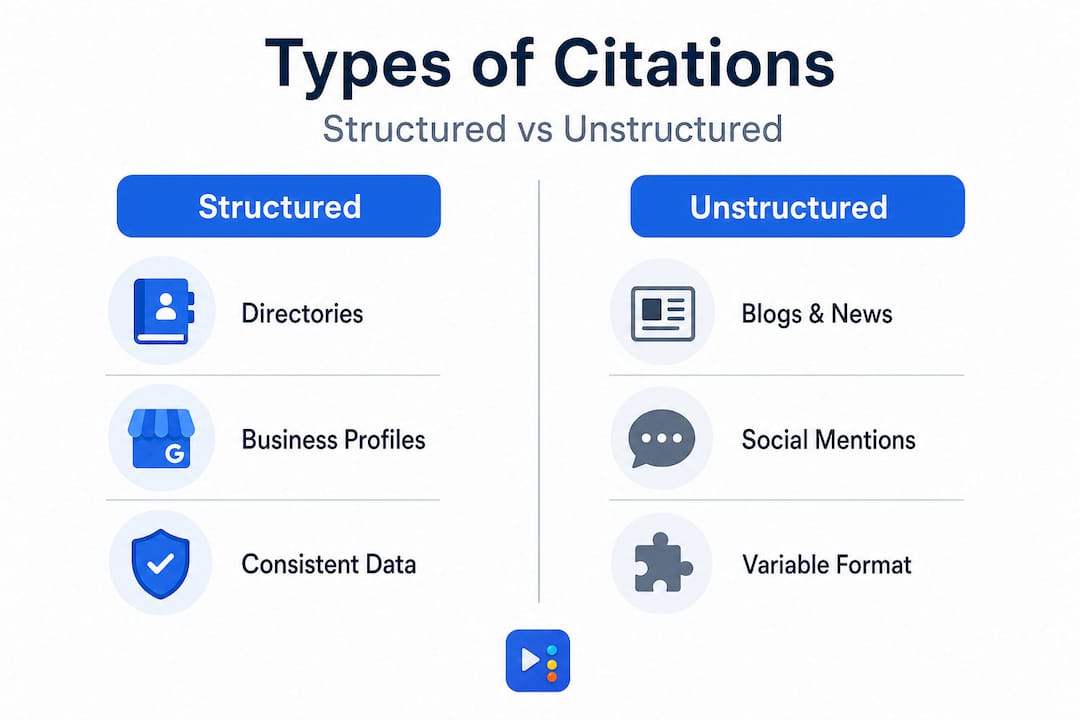
Structured citations are formal listings on directories and business databases. These include platforms like Google Business Profile, Yelp, Bing Places, Apple Maps, and industry-specific directories. You typically create or claim these listings yourself, which gives you direct control over the information displayed.

Unstructured citations are mentions of your business on blogs, local news articles, social media posts, event pages, or review websites, where you didn't necessarily submit your info yourself. A local food blogger mentioning your restaurant in a Georgetown dining roundup is an unstructured citation. A local news site covering your nail salon's grand opening is another example.
Here's a quick comparison to help you see the difference clearly:
| Feature | Structured citations | Unstructured citations |
|---|---|---|
| Where they appear | Directories, maps, apps | Blogs, news sites, social media |
| Your control | High (you submit info) | Low (third parties mention you) |
| Ease of updating | Easy (log in and edit) | Difficult (must contact publisher) |
| SEO impact | Consistent and predictable | Variable but can be very powerful |
| Best for | Building a citation base | Earning authority and trust |
| Examples for Texas businesses | Yelp, Google Business Profile, TripAdvisor | Austin Chronicle features, local blog mentions |
For beauty and hospitality businesses in Central Texas, a strong citation strategy combines both types. You build your structured foundation first, then earn unstructured mentions through local press, community events, and partnerships.
Citation building strategies consistently prove effective at improving Google ranking for local businesses, and structured citations give you the most direct control over that process.
Pro Tip: Don't overlook industry-specific directories. Beauty businesses should target platforms like StyleSeat, Vagaro, and Booksy. Restaurants and hospitality businesses should look at OpenTable, Zomato, and TripAdvisor. These niche directories carry extra weight with Google because they're highly relevant to your category. Pairing these with a solid keyword strategy for citations can amplify your results even further.
Consistency and accuracy: The secret to citation power
Here's where many small businesses stumble. You can have 100 citations, but if they list your business address differently across platforms, your phone number is outdated on some, or your business name has small variations from one site to another, you're actually working against yourself.
Google compares your citation data across all platforms. When it finds inconsistencies, it gets confused. Which version of your business is correct? Rather than guess, Google may simply rank you lower or leave you out of the local map pack entirely. This is one of the most common and costly mistakes we see with Central Texas businesses.
Here's a step-by-step process to audit and clean up your citation accuracy:
- Document your correct NAP information. Write down your exact business name, full address (including suite numbers), and primary phone number. This becomes your "master record."
- Search for your business on major directories. Google your business name and check the top results across platforms like Yelp, Yellow Pages, Bing Places, Facebook, and Apple Maps.
- Look for discrepancies. Common errors include abbreviations (St. vs. Street), old phone numbers, suite numbers left out, or business name variations (like using "LLC" in some places and not others).
- Claim and correct each listing. Log into each platform and update the information to match your master record exactly.
- Check for duplicate listings. Sometimes the same business appears multiple times on a single platform. Merge or remove duplicates, as they confuse both Google and customers.
- Set a quarterly review schedule. Citations can drift over time, especially if a directory pulls data from another source. Check your major listings at least every three months.
For multi-location businesses or franchise owners in Central Texas, this process is even more critical. Each location needs its own unique, accurate NAP, and mixing up location details can tank the visibility of all your locations at once. The good news is that solid homepage SEO for local business combined with accurate citations creates a strong, consistent signal Google can trust.
Key insight: Citation accuracy is a key factor in achieving higher local pack and map results. Even a minor mismatch, like "Suite 200" in one place and "Ste. 200" in another, can fragment your citation authority and hurt your rankings.
Building quality citations: Where and how to start
Once your current citations are accurate and consistent, it's time to grow your citation footprint. But building citations isn't about submitting your business to every directory you can find. It's about choosing the right platforms strategically.
Here are the highest-impact citation sources for Central Texas service businesses:
| Citation source | Type | Priority for beauty/hospitality | Notes |
|---|---|---|---|
| Google Business Profile | Structured | Essential | Directly influences Maps ranking |
| Yelp | Structured | High | Major platform for service discovery |
| Apple Maps | Structured | High | Significant mobile search volume |
| Bing Places | Structured | Medium | Covers Microsoft search users |
| Facebook Business Page | Structured | High | Social proof plus citation value |
| Greater Austin Chamber | Structured | High | Strong regional authority |
| Georgetown Chamber of Commerce | Structured | High | Excellent for Georgetown businesses |
| TripAdvisor | Structured | High for restaurants/hospitality | Major review and discovery platform |
| StyleSeat or Vagaro | Structured | High for beauty | Industry-specific, high relevance |
| Local news features | Unstructured | Medium to high | Builds authority and trust |
Now here are the simple steps to start building citations effectively:
- Claim your Google Business Profile first. This is the single most important citation for any local business.
- Move to major general directories. Yelp, Apple Maps, Bing Places, and Facebook should be your next stops.
- Target regional and local sources. Submit to your local chamber of commerce directory, local business associations, and regional websites covering your area.
- Add industry-specific listings. Beauty businesses should prioritize StyleSeat, Vagaro, Booksy, and similar platforms. Restaurants should target TripAdvisor and OpenTable.
- Monitor and update regularly. Use a spreadsheet or citation management tool to track where you're listed and when each was last verified.
Watch out for these common citation-building mistakes:
- Duplicate listings: Multiple listings for the same business on one platform weaken your authority rather than strengthen it.
- Unverified profiles: Claiming a listing but not verifying it can leave incorrect information in place.
- Incomplete profiles: Missing hours, descriptions, categories, or photos reduce the value of the citation significantly.
- Inconsistent business categories: Using different business categories across platforms sends mixed signals to search engines.
- Ignoring niche directories: Skipping industry-specific platforms means missing highly relevant visibility.
Proper citation building is a core part of any complete local SEO checklist, and treating it as a one-time task rather than an ongoing process is a mistake. Pair your citation efforts with a fully optimized Google Business Profile to maximize the impact of every listing you build.
A Central Texas expert's view: What most guides miss about local citations
Most citation guides tell you to get listed everywhere. We've seen what actually happens when businesses follow that advice. They end up with dozens of low-quality, irrelevant listings that do almost nothing for their rankings, while ignoring the few authoritative, regionally relevant platforms that could actually move the needle.
Here's the real lesson: ten citations from trusted, relevant sources outperform 100 citations from random, low-traffic directories. A mention in the Austin Chronicle, a listing in the Georgetown Chamber of Commerce directory, or a feature on a Central Texas lifestyle blog carries far more weight than 50 generic business directory submissions.
Central Texas businesses benefit most from citation strategies built around local competition, not generic national benchmarks. That means looking at what citations your top-ranking competitors have, and then matching and surpassing their coverage. If the top-ranked nail salon in Round Rock is listed in five industry directories you haven't touched yet, that gap is directly affecting your rankings.
Another overlooked strategy is pairing citation updates with active review management. When you update your Yelp listing, that's the perfect moment to also respond to recent reviews and post updated photos. When you claim a new directory listing, send a follow-up message to recent customers asking them to share their experience. This combination amplifies the unique local ranking factors that Google weighs when placing businesses in the map pack.
We've worked with beauty and hospitality businesses across Pflugerville, Cedar Park, and Manor who were convinced their citation profiles were fine. After a proper audit, they discovered outdated addresses from a move two years prior, phone numbers that no longer worked, and duplicate listings on three major platforms. Cleaning those up alone produced meaningful ranking improvements within 60 days. No new website, no new content, just accurate and authoritative citations.
Ready to get results? YourLocalSEO makes citation success simple
Citation work is one of those tasks that sounds simple but gets complicated fast, especially when you're running a busy salon, restaurant, or service business and don't have hours to spend auditing directories.

At ourLocalSEO, we handle citation building, auditing, and cleanup for Central Texas service businesses, so you can focus on serving your clients. From local SEO tricks that move the rankings needle to full citation management and Google Business Profile optimization, we build strategies around your specific location and competition. Whether you're in Georgetown TX or anywhere else in Central Texas, our local SEO guide is a great place to start. Reach out today and let's build a citation profile that actually drives customers through your door.
Frequently asked questions
What is the difference between a citation and a backlink?
A citation is a mention of your business NAP (name, address, phone number) on another website, while a backlink is a clickable link pointing directly to your website. Both help local SEO, but they serve different purposes and are evaluated differently by search engines.
How many citations does my business need for good local SEO?
Quality and accuracy matter more than volume, but having listings across major directories plus industry-specific and local sites gives your business a strong foundation. Citation accuracy and volume together contribute to better Google Maps rankings, so building dozens of accurate citations beats having hundreds of inconsistent ones.
How can I fix inconsistent citations online?
Start by auditing major directories and claiming your listings, then correct any mismatched business details to match your exact master NAP record. A local SEO checklist can help you work through each platform systematically without missing anything.
Do citations help with Google Maps ranking?
Yes, citation accuracy and volume significantly boost your Google Maps ranking potential. Consistent, accurate citations across trusted platforms tell Google exactly where you are and what you do, which directly influences your local map pack placement.
Which citations are most important for my beauty or hospitality business?
Prioritize Google Business Profile, Yelp, Apple Maps, and Facebook first, then add industry-specific platforms like StyleSeat or TripAdvisor. A complete local SEO checklist for Central Texas will point you toward the regional and niche directories that carry the most weight in your specific market.