

If you've ever wondered what is proximity in local SEO and why your business sometimes doesn't rank first even when you're the closest option, you're not alone. Proximity is one of three core local SEO factors Google uses to decide which businesses appear in the local map pack. But it works very differently than most people assume. This article breaks down exactly how proximity functions, why it doesn't guarantee top rankings, and what you can actually do to compete, even if a competitor has a more favorable address.
Table of Contents
- Key Takeaways
- What is proximity in local SEO and how it works
- Why proximity alone does not guarantee top rankings
- Advanced nuances: vicinity radius, semantic clusters, and proximity decay
- Practical strategies to maximize your proximity advantage
- My honest take on proximity after working with local businesses
- Let Yourlocalseo help you rank beyond your front door
- FAQ
Key Takeaways
| Point | Details |
|---|---|
| Proximity is dynamic, not static | Google recalculates your proximity signal in real time based on the searcher's current location. |
| Closest does not mean top-ranked | About 60% of top local pack spots go to businesses that are more prominent or relevant, not necessarily closest. |
| Prominence and relevance override proximity | Strong reviews, a complete Google Business Profile, and local backlinks regularly outrank businesses with a better address. |
| Proximity decay is steep in cities | Rankings drop 80 to 90% per kilometer in dense urban areas without compensating signals from reviews or content. |
| You can expand your ranking radius | Semantic content clusters, LocalBusiness Schema, and consistent NAP data extend your visibility beyond your physical location. |
What is proximity in local SEO and how it works
Proximity, in the context of local SEO, refers to how close a searcher is to a business when they perform a location-based query. Google measures this distance in real time using the searcher's IP address on desktop, or GPS coordinates on mobile, and compares it to the registered address of your Google Business Profile. The result influences whether and where your business appears in local search results.
Google ranks local businesses based on three pillars: relevance, prominence, and proximity. According to the breakdown of local SEO ranking factors in 2026, GBP signals account for 32%, on-page factors 19%, reviews 16%, links 15%, behavioral signals 8%, and citations 7%. Proximity doesn't hold a fixed percentage in this model because it functions differently from the others. Rather than being a ranking driver you can strengthen through effort, it acts more like an eligibility filter that shifts with every search.
Here's what makes proximity unique compared to other local SEO factors:
- It is real-time. Every time someone searches "nail salon near me" from a different block, the proximity calculation resets. This is why the same search can return different results from two locations two miles apart.
- It is uncontrollable. You cannot move your business to match every searcher's location. That's why focusing on the signals you can control matters so much.
- It is elastic, not a fixed radius. Google doesn't simply draw a circle around your address. The algorithm uses a weighted, elastic vicinity that expands or contracts based on competition density and prominence.
- It favors mobile search heavily. 70% of local searches are hyper-local, meaning under five kilometers. Proximity as an eligibility signal is strongest in these mobile searches where Google can detect your exact GPS location.
Understanding this distinction between proximity as a filter versus a ranking driver is the foundation of every smart local SEO strategy.
Why proximity alone does not guarantee top rankings
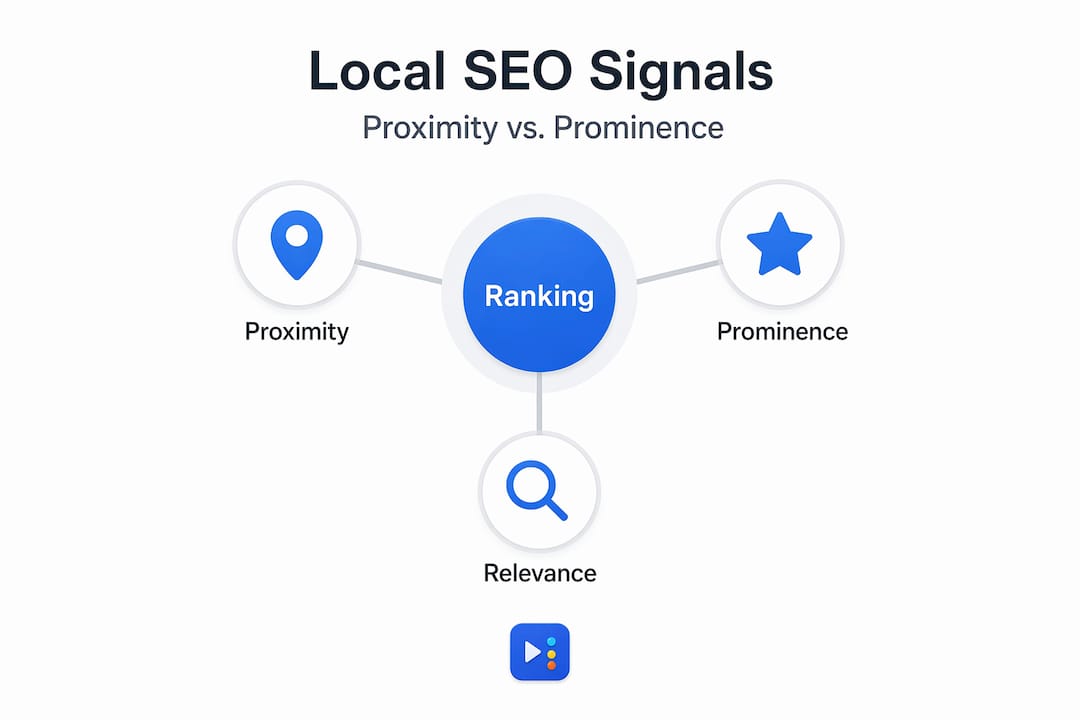
This is where most business owners get frustrated. You're right down the street. The competitor ranking above you is eight blocks farther away. It doesn't feel fair, and honestly, it's not about fairness. It's about how Google weighs competing signals.

About 60% of top local pack spots go to businesses that are more prominent or relevant, not the ones physically closest to the searcher. Google has made this trade-off deliberately. A searcher who gets the best result builds trust in Google. A searcher who gets the closest result but has a bad experience does not.
Here's a direct comparison that illustrates the gap:
| Signal | Business A (closer) | Business B (farther, higher-ranked) |
|---|---|---|
| Distance from searcher | 0.4 miles | 1.2 miles |
| Google reviews | 60 reviews, 3.8 stars | 190 reviews, 4.7 stars |
| GBP completeness | 60% complete | Fully optimized |
| Local backlinks | None | 12 local mentions |
| Category alignment | Generic | Precise, primary category |
A competitor 0.8 miles farther with 190 reviews and strong local mentions consistently outranked a closer clinic with 60 reviews and an incomplete GBP. This is the proximity paradox. The better-optimized business wins because Google trusts it more.
What drives prominence over proximity? Three things matter most: review signals, Google Business Profile completeness, and category precision. Learn more about how business category choices directly affect your map pack visibility.
Pro Tip: Review velocity matters more than total review count. Gaining 10 recent reviews per month consistently outperforms a competitor sitting on 200 stale reviews from two years ago.
The proximity paradox is common in competitive markets. Prioritizing review velocity, category precision, and local content strategy is how you solve it.
Advanced nuances: vicinity radius, semantic clusters, and proximity decay
Once you get past the basics, the algorithm's behavior becomes genuinely interesting. Google doesn't calculate proximity as a simple circle drawn from your front door. It applies a far more nuanced model.
Vicinity radius and why it stretches
Google's vicinity radius behaves like a highly elastic polygon, not a fixed boundary. It can stretch outward through semantic topic clusters and prominence signals. A business that publishes consistent, location-specific content and uses proper LocalBusiness Schema can rank for searches well outside its physical neighborhood. In less competitive areas, the radius expands naturally because Google has fewer strong options to show. In dense urban markets, the radius compresses, and you need stronger compensating signals just to maintain your current position.
The reality of proximity decay
Proximity decay is steep and nonlinear, especially in cities. Grid analysis across competitive markets shows rank drops of 80 to 90% per kilometer in dense urban areas without compensating signals. That means a business two kilometers from the searcher with no strong GBP signals is nearly invisible, even in a low-competition query. Rural or suburban businesses benefit here because the radius stretches farther before decaying.
Key factors that interact with proximity decay include:
- Population density. Higher density compresses the radius and steepens the decay curve.
- Competition volume. More businesses per category means Google has more options to rank, accelerating decay for weaker profiles.
- Neighborhood nodes. Google uses human geography such as named neighborhoods, business districts, and landmarks to inform spatial reasoning beyond GPS coordinates.
- Structured data. LocalBusiness Schema paired with local content silos forces the algorithm to recognize your entity's topical authority, effectively expanding your ranking footprint.
Understanding proximity decay tells you something practical. If you're in Austin or Round Rock and you're not ranking even for nearby searchers, the problem almost certainly isn't your address. It's your prominence signals.
Practical strategies to maximize your proximity advantage
You cannot move your business closer to every searcher. But you can absolutely strengthen every signal that allows you to rank despite distance. Here's how to approach it systematically.
-
Keep your NAP consistent everywhere. Name, address, and phone number must match exactly across Google Business Profile, your website, and every directory listing. Inconsistencies confuse the algorithm and dilute your proximity signal at the source.
-
Optimize your Google Business Profile service area carefully. Service area businesses must define their radius thoughtfully. Too broad and you dilute relevance. Too narrow and you exclude customers you could realistically serve. Match your service area to where your best customers actually come from.
-
Build review velocity, not just volume. Ask for reviews consistently after every service. A system that generates 10 new reviews per month is more powerful than a one-time push that produces 50 reviews and then goes quiet.
-
Create location-specific content silos. Write pages and blog posts targeting neighborhoods, cities, and landmarks near your location. Pairing this with smart keyword targeting for localized terms tells Google you are the authority in your area, not just a business that happens to be nearby.
-
Earn local backlinks. Sponsoring a local event, partnering with a neighborhood organization, or getting mentioned in a local news article each produce the kind of local authority signals that extend your ranking radius.
-
Run grid rank tracking. Tools that map your rankings across a geographic grid show you exactly where your proximity signal is strong and where it falls off. This data tells you which neighborhoods to target with additional content or citation building.
Pro Tip: Use Google Maps optimization tips to audit your GBP regularly. A profile with updated photos, accurate hours, and active Q&A responses signals to Google that your business is active, which strengthens behavioral signals alongside proximity.
Top rankings depend on a business's "center of gravity" built from strong technical SEO, entity clarity, and behavioral signals. Proximity is just one coordinate in that equation.
My honest take on proximity after working with local businesses
I've worked with enough local business owners to know the most common reaction when they find out a competitor across town is outranking them. They want to know if they should move or open a second location. Almost never is that the right answer.
What I've seen consistently is that businesses obsessing over their physical address are missing the 80% of the work that actually moves the needle. Proximity is real, and yes, it matters. But it's the baseline, not the ceiling. The businesses I've watched climb from page two of the map pack to the top three spots didn't move their front door. They got serious about their Google Business Profile, they built a review generation system that actually worked, and they started publishing content that matched how their neighborhood searches.
The grid audit is the tool I recommend most. It shows you your ranking across a visual map of your area, and it makes the proximity decay problem concrete instead of abstract. When a client sees they rank first within half a mile but drop to position nine at two miles, that's a solvable content and citation problem, not a location problem.
What I've found is that proximity gives you a fighting chance close to home. Prominence is what earns you the right to compete everywhere else.
— Tran
Let Yourlocalseo help you rank beyond your front door

At Yourlocalseo, we work with small businesses across Pflugerville, Austin, Round Rock, and surrounding Central Texas communities to turn proximity from a limitation into a foundation. We handle Google Business Profile optimization, citation building, review generation strategy, and location-specific content development — everything that builds the prominence signals that expand your ranking radius. We've seen how the right combination of these local SEO services transforms businesses that were invisible two miles from home into consistent top-three map pack performers. If you're ready to stop guessing and start ranking, we're ready to build the strategy with you. Reach out to our team at Yourlocalseo and let's get to work.
FAQ
What does proximity mean in local SEO?
Proximity in local SEO refers to how close a searcher is to a business at the time of a search query. Google uses this real-time distance measurement as one of three core factors, alongside relevance and prominence, to determine which businesses appear in local search results.
Does being closest guarantee ranking first in Google Maps?
No. About 60% of top local pack spots go to businesses that are more prominent or relevant rather than physically closest. A competitor farther away with stronger reviews, a complete GBP, and local backlinks will typically outrank a closer business with weaker signals.
How can a business rank in areas farther from its location?
Businesses can extend their ranking radius by building prominence through review velocity, earning local backlinks, publishing location-specific content, and implementing LocalBusiness Schema. Semantic topic clusters signal topical authority that expands the algorithm's vicinity radius beyond the physical address.
How does proximity affect service area businesses?
Service area businesses set their coverage zone directly in Google Business Profile, and that defined area acts as their proximity signal. Setting the area too broadly dilutes relevance, while setting it too narrowly limits visibility. Matching your service area to your actual customer geography produces the strongest results.
What is proximity decay in local SEO?
Proximity decay describes the drop in ranking visibility as distance from the searcher increases. In dense urban areas, rankings drop 80 to 90% per kilometer without compensating signals like strong reviews, citations, and local content. Businesses with high prominence experience a slower, shallower decay curve.