

Featured snippets are defined as the direct answer boxes Google displays above organic search results, pulling a concise response from a ranked page. Snippets appear for about 19% of all Google queries in 2026, making them one of the most visible positions on any results page. That visibility pays off: featured snippets yield a 42.9% CTR, outperforming every other element on the SERP. Knowing how to optimize for featured snippets is no longer optional for digital marketers and website owners who want to compete for organic traffic. This guide covers the exact formats, prerequisites, and content structures that win snippet positions.
What are featured snippets and why does format matter?
Featured snippets come in three primary formats: paragraph, list, and table. Each format serves a different query type, and Google's algorithm selects the format that best matches how users phrase their search.

Paragraph snippets dominate at 58% of all snippet types. They answer definitional or explanatory questions in 40–60 words of plain prose. List snippets handle step-by-step or ranked queries, appearing as ordered or unordered HTML lists. Table snippets surface comparison or data-heavy queries, pulling structured rows and columns directly from your page.
The critical point: Google favors structurally consistent content that mirrors the format already winning the snippet for a given query. If the current snippet holder uses a numbered list, and your page answers with a paragraph, Google will almost always keep the list format winner in place.
- Paragraph snippets: Best for "what is," "who is," and definitional queries
- Ordered list snippets: Best for "how to" and step-by-step processes
- Unordered list snippets: Best for "types of," "examples of," and category queries
- Table snippets: Best for comparisons, pricing tiers, and data sets
Pro Tip: Before writing a single word, search your target query on Google and study the current snippet. Note its format, word count, and heading structure. Then mirror those elements in your own content.
What are the prerequisites for winning featured snippets?
Snippet optimization fails without a solid ranking foundation. 71% of featured snippets come from pages already ranking in the top 10 organic results. That means earning a snippet starts with earning a page-one position.
Here are the non-negotiable prerequisites before you pursue any featured snippet strategy:
- Rank in the top 10 organically. Google almost never pulls a snippet from page two or beyond. Focus on improving your Google ranking before targeting snippets directly.
- Remove restrictive meta tags. A
max-snippetmeta tag set too low tells Google not to display extended text from your page. Check your robots meta tags and remove any character limits that block snippet extraction. - Use the exact query as a heading. Format your H2 or H3 as the literal question a user types. "What is local SEO?" works better than "Understanding Local SEO Basics."
- Place your answer immediately below the heading. Google's extraction algorithm skips preambles. The answer must start in the first sentence after the heading, with no introductory fluff.
- Implement FAQPage schema. FAQPage schema increases snippet likelihood by 2.6 times by sending a machine-readable signal that your content contains direct answers.
Pro Tip: Read your answer paragraph out loud immediately after the heading. If the first sentence does not directly answer the question, cut everything before it. Phrases like "Great question" or "As we discussed earlier" are automatic disqualifiers.
The ranking prerequisite is the one most marketers skip. They spend hours formatting content for snippets on pages sitting on page three. Fix the ranking problem first, then apply snippet formatting on top.
How to structure content for featured snippet capture
Content structure is the single biggest variable you control. Google's extraction logic looks for a specific pattern: question heading, immediate answer, supporting detail. Deviating from that pattern reduces your eligibility.
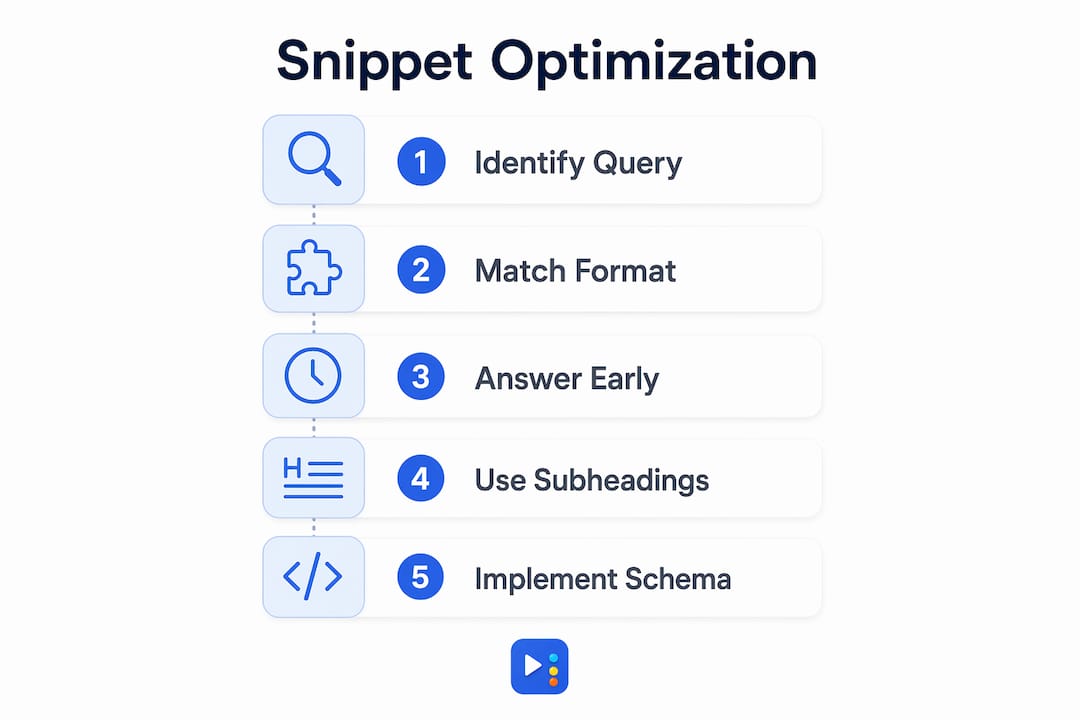
Follow these steps to build snippet-ready content:
- Write the heading as the exact user query. Use H2 for primary questions and H3 for supporting sub-questions. Keep headings under 10 words.
- Write a 40–60 word answer paragraph directly below the heading. This paragraph should be self-contained. A reader should understand the full answer without reading anything else on the page.
- For list snippets, use proper HTML list tags. Avoid formatting lists with dashes or asterisks in your CMS if the output is not true
<ul>or<ol>HTML. Google reads the markup, not just the visual appearance. - Include 8–12 list items for list-format content. Including 8–12 items increases click-through because Google displays only the first few and adds a "More items..." link. That curiosity gap drives users to click through to your page.
- For table snippets, place the most important data in the top-left cell. Use 3–5 rows and 2–4 columns. Keep cell text short and scannable.
- Add related FAQ sections below your main content. Each FAQ entry should follow the same pattern: question heading, 40-word answer. This expands the number of snippet opportunities a single page can win.
Pro Tip: Use multiple H3 subheadings formatted as list items, with a short clarifying paragraph under each. This structure works for both list snippets and paragraph snippets, giving Google two extraction options from the same page.
Here is an example of how a table snippet structure looks in practice:
| Query type | Best format | Ideal length |
|---|---|---|
| Definitional ("what is") | Paragraph | 40–60 words |
| Process ("how to") | Ordered list | 6–10 steps |
| Comparison ("X vs Y") | Table | 3–5 rows |
| Category ("types of") | Unordered list | 6–10 items |
The FAQ approach is particularly powerful for local businesses. A nail salon page that answers "How long does a gel manicure last?" with a clean 50-word paragraph directly below an H3 heading has a real shot at the snippet for that query.
How do you find the right keywords for snippet targeting?
Keyword selection determines whether your snippet efforts pay off. Not every query triggers a featured snippet, and not every snippet is worth chasing.
The most effective approach targets queries that already show a snippet in the SERP. If Google is already pulling a snippet for a term, it has confirmed that query type warrants one. Your job is to produce a better-structured answer than the current holder.
Use these criteria to build your snippet keyword list:
- Prioritize long-tail, factual queries. Questions with clear definitional or procedural intent are the highest-value targets. Long-tail keywords drive more qualified traffic and face less competition for snippet positions.
- Use Google Search Console to identify near-snippet opportunities. Pages ranking in positions 2–10 for question-based queries are your best candidates for snippet formatting upgrades.
- Analyze the current snippet holder's page structure. Visit the page, inspect the heading, count the words in the answer, and note the HTML format. That is your benchmark.
- Avoid branded or navigational queries. Google rarely shows featured snippets for brand-specific searches. Focus on neutral, information-based terms.
- Align your keyword targeting with your local SEO keyword strategy. Local queries like "how much does a med spa facial cost in Austin" can trigger snippets and drive high-intent local traffic.
Snippet opportunities have shifted with AI Overview expansions. Broad, generic queries increasingly show AI-generated summaries instead of traditional snippets. Concrete, specific, and factual queries remain the most reliable snippet targets in 2026.
What mistakes kill your chances of ranking for snippets?
Most snippet optimization failures come from the same handful of errors. Recognizing them early saves significant time.
- Burying the answer. Google's extraction algorithm rejects content with preambles. If your answer starts three sentences into a paragraph, Google skips it.
- Using vague or mismatched headings. A heading like "More Information About Local SEO" does not match any user query. It signals nothing to Google's extraction logic.
- Mismatching the snippet format. Answering a list-format query with a paragraph, or a paragraph query with a table, reduces your eligibility regardless of content quality.
- Ignoring FAQ schema. Omitting structured data leaves a measurable advantage on the table, given the 2.6x lift FAQPage schema provides.
- Neglecting page ranking. No amount of formatting fixes a page sitting on page two. Snippet formatting is a finishing step, not a substitute for ranking work.
- Failing to update content. Snippet holders rotate. A competitor can take your snippet by publishing a better-structured answer. Check your snippet positions monthly.
Pro Tip: Set a recurring monthly calendar reminder to search your top 10 target queries. Screenshot the current snippet holder each time. If you lose a position, compare the new winner's structure to yours and adjust within 48 hours.
Key Takeaways
Winning featured snippets requires matching the right format, placing your answer immediately after a question-formatted heading, and holding a top-10 organic ranking before any snippet strategy applies.
| Point | Details |
|---|---|
| Format match is non-negotiable | Mirror the snippet format already winning your target query: paragraph, list, or table. |
| Top-10 ranking comes first | 71% of snippets come from page-one results; fix your ranking before formatting for snippets. |
| Answer placement is critical | Place your 40–60 word answer in the first sentence directly below the question heading. |
| FAQ schema multiplies opportunities | FAQPage schema increases snippet likelihood by 2.6x and expands how many snippets one page can win. |
| Long-tail queries are the best targets | Specific, factual queries remain the most reliable snippet opportunities as AI Overviews expand. |
What I've learned after years of chasing snippets
Most marketers treat featured snippets as a formatting exercise. They add a question heading, write a short paragraph, and wait. That approach works occasionally, but it misses the deeper pattern.
The pages that consistently hold snippets are not just well-formatted. They are genuinely the clearest answer to the query on the entire web. Google's extraction logic rewards clarity and structure, but it also rewards completeness. A page that answers the main question and five related sub-questions in the same structured format will outperform a page that answers only the main question, even if both are formatted identically.
I have also seen marketers abandon snippet targeting the moment AI Overviews started appearing for their target queries. That is a mistake. AI Overviews and featured snippets coexist on many SERPs, and the content that feeds AI Overviews often comes from the same pages that hold snippets. Investing in snippet-ready content structure builds authority for both formats simultaneously.
Patience matters more than most guides admit. Snippet positions shift, and a page you optimize today may not show a snippet for four to six weeks. The marketers who win long-term are the ones who build a systematic review process, not the ones who optimize once and move on.
— Tran
Yourlocalseo can help you capture more snippet positions
Snippet optimization is one layer of a broader search visibility strategy. At Yourlocalseo, we work with small businesses across Pflugerville, Austin, Round Rock, and Central Texas to build content and technical SEO foundations that support both organic rankings and snippet capture.

We handle keyword research, content structuring, FAQPage schema implementation, and on-page SEO for clients who want real search visibility, not just traffic numbers. If your pages are ranking but not winning snippets, or if you are starting from scratch, our team can identify your best opportunities and build a plan around them. Visit Yourlocalseo's SEO services to see how we approach search visibility for local businesses.
FAQ
What are featured snippets in Google search?
Featured snippets are direct answer boxes that Google displays above organic results, pulling 40–60 words of text from a ranked page. They appear for about 19% of all queries in 2026.
How do I qualify my page for a featured snippet?
Your page must rank in Google's top 10 organic results. 71% of snippets come from page-one positions, so earning a first-page ranking is the required first step.
Does FAQ schema help with featured snippets?
Yes. FAQPage schema increases snippet likelihood by 2.6 times by giving Google a structured, machine-readable signal that your content contains direct answers.
How long should a featured snippet answer be?
A featured snippet answer should be 40–60 words for paragraph snippets. Place the answer immediately below a question-formatted H2 or H3 heading with no introductory sentences before it.
Are featured snippets still worth targeting in 2026?
Yes. Featured snippets yield a 42.9% CTR, and they persist on specific, factual queries even as AI Overviews expand. Long-tail, definitional queries remain the most reliable targets.