

Voice search optimization is the process of tailoring your website and content to be found and favored by voice assistants through conversational keywords, featured snippets, and local SEO techniques. With 8.4 billion voice-enabled devices in use globally and over 50% of U.S. consumers using voice search daily, the channel is too large to ignore. The question of why optimize for voice search has a clear answer: voice is where your customers already are, and most small businesses are not showing up. Google's mobile-first indexing and featured snippet dominance make voice optimization a direct path to higher visibility and real conversions.
Why optimize for voice search differently than traditional SEO?
Voice search and traditional SEO share the same foundation, but they diverge sharply in how queries are formed. A typed search looks like "nail salon Austin." A voice query sounds like "What's the best nail salon near me open right now?" That difference changes everything about keyword targeting, content structure, and ranking signals.
Voice queries are conversational, longer, and almost always phrased as questions. Traditional SEO targets short keyword fragments. Voice SEO targets full natural-language questions and phrases that match how people actually speak. The content that wins voice results is written to answer a specific question directly, not to rank for a broad topic.

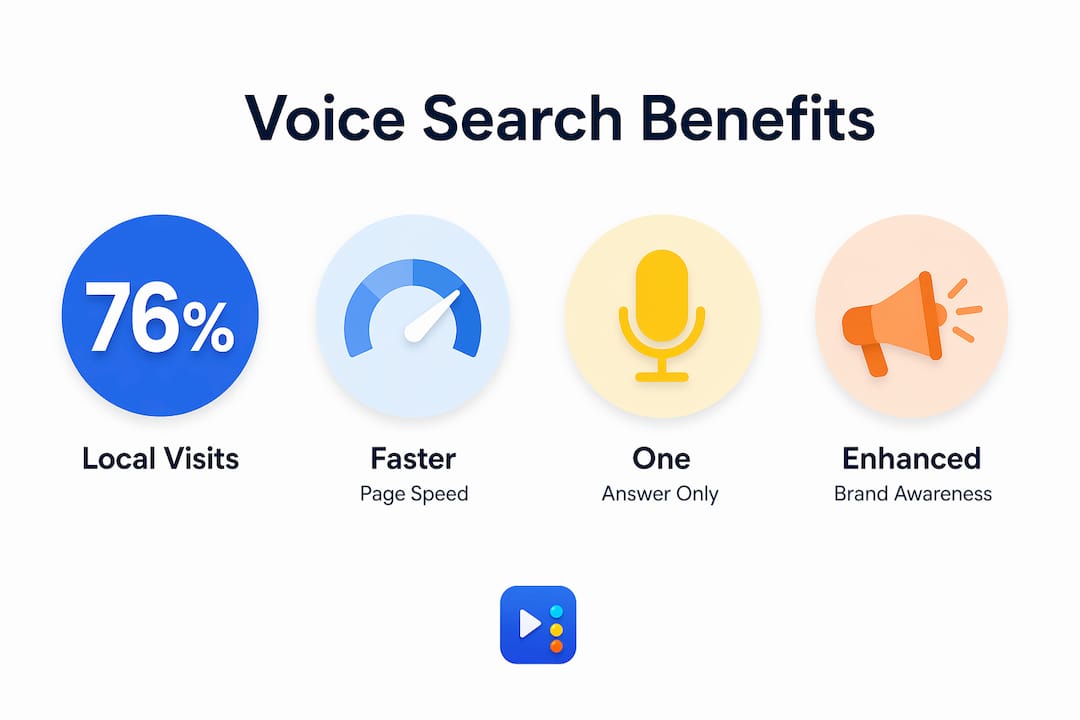
The other major difference is the result format. Voice assistants read only one answer per query. There is no page two. There is no second result. Position zero, the featured snippet, is the only position that matters in voice search. That makes the competition for featured snippets far more consequential than in traditional search.
The good news is that voice SEO and AI search optimization have converged into one unified discipline. Treating them as separate strategies wastes time and budget. The same conversational, structured, question-answering content that wins voice results also performs well in AI-generated answers from tools like Google's AI Overviews.
Key differences at a glance:
- Query format: Typed searches use fragments; voice searches use full questions
- Result format: Traditional search shows a list; voice search reads one answer aloud
- Content style: Traditional SEO favors topic breadth; voice SEO rewards direct, concise answers
- Local intent: Voice queries carry far more local and immediate intent than typed searches
Pro Tip: Structure your FAQ pages with exact question-and-answer pairs. Voice assistants pull directly from this format when selecting featured snippet answers.
How to optimize for voice search effectively
Winning voice results requires a specific set of techniques applied consistently across your site. These are not advanced tactics reserved for enterprise brands. Small businesses in Austin, Round Rock, and Pflugerville can implement every one of them.
-
Target conversational long-tail keywords. Write content that mirrors how your customers speak. Use tools like Google's "People Also Ask" section to find real question phrases. Build dedicated FAQ pages around those questions with clear, direct answers.
-
Win position zero with featured snippet optimization. Featured snippets win 40–60% of voice search answers. Structure your answers using a multi-tier format: a 20-word direct answer at the top, a 100-word expanded explanation below it, and a full 300-word section for depth. This layered approach gives voice assistants exactly what they need to cite your content.
-
Improve page speed to under 2 seconds. Voice search results load 52% faster than non-voice results on average. Google uses page speed as a ranking factor specifically for voice. Compress images, use browser caching, and minimize JavaScript to hit that threshold.
-
Optimize for mobile-first indexing. Most voice queries come from mobile devices, and Google indexes your mobile site first. A site that performs poorly on mobile will not rank in voice results regardless of content quality. Test your site with Google's Mobile-Friendly Test regularly.
-
Add structured data and schema markup. SpeakableSpecification schema tells voice assistants exactly which sections of your content to read aloud. LocalBusiness schema gives assistants your hours, address, and phone number in a machine-readable format. Both directly improve your chances of being cited in voice results.
-
Strengthen your Google Business Profile. An accurate, complete Google Business Profile is the single most important local signal for voice search. Include your service area, business categories, hours, and photos. Respond to reviews. Update your profile when anything changes.
Pro Tip: Use conversational keyword strategies to build content clusters around question phrases. One well-structured FAQ page can capture dozens of voice queries at once.
| Technique | What it targets | Difficulty |
|---|---|---|
| Conversational long-tail keywords | Query match and relevance | Low |
| Featured snippet optimization | Position zero ranking | Medium |
| Page speed under 2 seconds | Technical ranking factor | Medium |
| Schema markup and structured data | Machine readability | Medium |
| Google Business Profile optimization | Local voice results | Low |
Why is local SEO essential for voice search success?
Local intent drives voice search more than any other category. When someone asks "Where can I get a facial near me?" they are ready to act. They are not browsing. They are deciding. That behavioral difference makes local voice queries the highest-converting traffic a small business can capture.
Local voice queries convert 76% of the time into in-store visits within 24 hours. That conversion rate is extraordinary compared to standard organic traffic. A business that shows up in voice results for local queries is not just getting clicks. It is getting customers walking through the door.
Voice assistants use GPS data and query phrasing to determine location context automatically. Accurate business profile and schema data are critical because assistants pull from structured sources, not raw webpage text. If your Google Business Profile has outdated hours or a missing service area, voice assistants will skip your listing entirely.
The growth in "near me" voice queries has been exponential. Local SEO is the highest-impact category within voice search, and businesses that invest in local listings and profile optimization see the most direct return. For a nail salon in Cedar Park or a med spa in Georgetown, this is not optional. It is the difference between being found and being invisible.
Key local voice SEO priorities:
- Keep your Google Business Profile complete and updated at all times
- Add LocalBusiness schema to your homepage and contact page
- Build consistent citations across directories like Yelp, Apple Maps, and Bing Places
- Use location-specific language in your content ("serving Round Rock and Pflugerville")
- Collect and respond to Google reviews, which signal credibility to voice assistants
For a deeper look at how local listings drive real business growth, see the benefits of local listings for small businesses.
What business benefits result from optimizing for voice search?
The benefits of voice search SEO extend well beyond ranking in one more channel. Voice optimization strengthens your entire digital presence because the techniques required overlap directly with high-performing SEO fundamentals.
Voice SEO reinforces mobile-first design, fast load speeds, and clear FAQ content. Every improvement you make for voice search also improves your traditional search rankings. You are not building a separate strategy. You are building a better website.
Brand awareness is another direct benefit. When a voice assistant reads your business name aloud as the answer to a customer's question, that is a brand impression with zero competition. No ads. No other listings. Just your name. Voice search citations often result in zero-click experiences, meaning success shows up as branded search lifts and direct traffic rather than referral clicks. Tracking these signals gives you a more accurate picture of voice's real impact.
Voice optimization also future-proofs your SEO investment. AI-powered search tools and voice assistants are converging rapidly. Businesses that build conversational, structured, authoritative content now will be positioned to capture AI-generated answer placements as that technology matures. Waiting means starting from behind.
The competitive edge is real and available right now. Most small businesses in Central Texas have not invested in voice search at all. That gap is an opportunity. Businesses that optimize for near me searches today are capturing customers that competitors are missing entirely.
Voice search and AI are the same problem now
The conventional wisdom used to be that voice search was its own separate channel requiring its own separate strategy. I spent time building that way, and it was inefficient. The smarter frame is this: voice search, AI search, and traditional SEO are all the same discipline now.
Every piece of content I recommend to clients at Yourlocalseo is built to answer questions clearly, load fast, and carry structured data. That content performs in Google's traditional results, in AI Overviews, and in voice assistant answers simultaneously. Splitting your effort across three separate strategies is how you end up with three mediocre results instead of one strong one.
The businesses I see winning in voice search are not the ones who built a "voice SEO strategy." They are the ones who built genuinely helpful, well-structured content and kept their local presence accurate and active. Voice assistants reward clarity and authority. So does every other search format.
My honest advice: stop thinking about voice as a separate channel. Start thinking about whether your content answers real questions better than anyone else in your market. If it does, voice will follow. If it does not, no amount of voice-specific tactics will save you.
— Tran
How Yourlocalseo helps you show up in voice results
Voice search visibility starts with the same foundation as strong local SEO: an accurate Google Business Profile, fast mobile pages, structured content, and consistent citations. Yourlocalseo builds all of it for small businesses across Pflugerville, Austin, Round Rock, Georgetown, Cedar Park, and the surrounding Central Texas area.

We handle Google Business Profile optimization, schema markup, local citation building, and on-page SEO so your business shows up when customers ask their phones for recommendations. Every strategy we build is tied to your specific location and service area, not a generic template. If you are ready to capture more local voice traffic and drive real leads, visit Yourlocalseo to see how we can help your business get found.
FAQ
Why does voice search matter for small businesses?
Voice search drives high-intent local traffic. Local voice queries convert 76% of the time into in-store visits within 24 hours, making it one of the highest-converting traffic sources available to small businesses.
What is position zero and why does it matter for voice?
Position zero is the featured snippet that appears above all other search results. Voice assistants read only one answer per query, and that answer almost always comes from the featured snippet, making it the only position that delivers voice traffic.
How does page speed affect voice search rankings?
Google favors pages that load in under 2 seconds for voice results. Voice search results load 52% faster on average than non-voice results, so slow pages are effectively disqualified from voice rankings.
What schema markup helps with voice search?
SpeakableSpecification schema identifies which content segments voice assistants should read aloud. LocalBusiness schema provides your address, hours, and phone number in a machine-readable format that voice assistants pull directly.
Is voice search optimization different from AI search optimization?
The distinction between voice and AI search optimization has collapsed. A unified strategy built around conversational content, structured data, and local SEO performs across voice assistants, AI-generated answers, and traditional search results simultaneously.
Key takeaways
Voice search optimization and local SEO are now the same investment, and businesses that build conversational, structured, fast-loading content will capture voice, AI, and traditional search results at the same time.
| Point | Details |
|---|---|
| Voice is winner-take-all | Voice assistants read only one answer per query, making featured snippet ranking the only position that delivers results. |
| Local intent converts fast | Local voice queries convert 76% of the time into in-store visits within 24 hours. |
| Page speed is non-negotiable | Pages must load in under 2 seconds to qualify for voice search rankings. |
| Voice and AI strategies are unified | Treating voice SEO as a separate discipline wastes resources; one content strategy serves all answer engines. |
| Google Business Profile drives local voice | Accurate, complete business profiles are the top local signal voice assistants use to select answers. |