

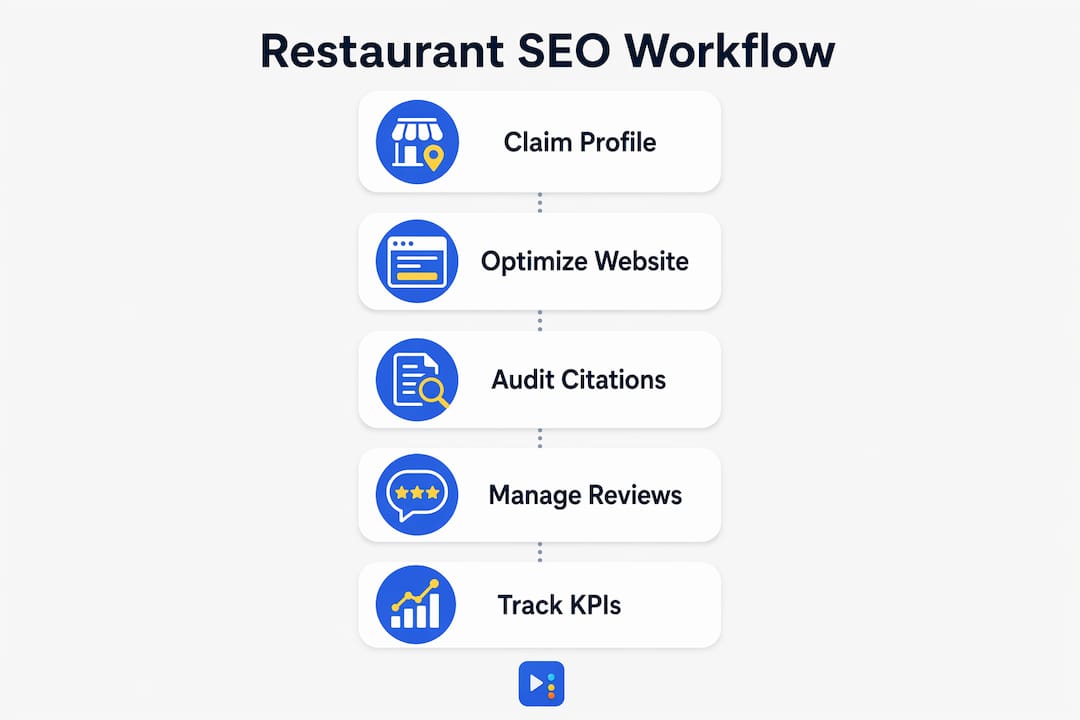
A restaurant SEO workflow is the systematic, multi-step process restaurateurs use to improve their digital presence, climb Google's local rankings, and convert online searchers into paying diners. 80% of diners research restaurants on Google before deciding where to eat, and 77% check the restaurant's own website before ordering. That means your Google Business Profile, website structure, review volume, and conversion buttons are not optional extras. They are the engine of your revenue. This guide walks you through a phased restaurant SEO workflow built to deliver measurable results, from foundational data setup through reputation management and guest retention automation.
What does a restaurant SEO workflow actually require?
A restaurant SEO workflow, known in the industry as a local search optimization process, starts with one non-negotiable: consistent, verified data everywhere your restaurant appears online. Google cross-references your name, address, and phone number across 20 or more directories including Yelp, TripAdvisor, Apple Maps, and Foursquare. Any mismatch signals distrust and suppresses your local pack ranking. Audit every listing before you touch anything else.
Google Business Profile is the single most important asset in your local SEO toolkit. Claim and verify your profile, then complete every field: primary and secondary categories, business description with location-specific keywords, hours, menu link, and at least 10 high-resolution photos. Add your menu directly inside the profile using Google's menu editor, not just a PDF link.
Technical SEO on your website is the second pillar. Implement schema markup using the Restaurant, LocalBusiness, Menu, and FAQPage types. Schema markup with detailed, keyword-rich menu descriptions that include accurate allergens and pricing directly boosts local visibility and eligibility for Google rich results. Use Google's Rich Results Test to verify your markup is error-free before publishing.
Pro Tip: Connect your point-of-sale system, reservation platform (OpenTable, Resy), and online ordering system to your website so all guest data flows into one place. Disjointed systems waste traffic that could become direct orders and repeat customers.
Here is a quick reference for the foundational workflow phase:
| Task | Tool or Method |
|---|---|
| NAP consistency audit | BrightLocal, Moz Local, or manual directory check |
| Google Business Profile setup | Google Business Profile Manager |
| Schema markup implementation | Google's Rich Results Test, Schema.org |
| Website speed and mobile audit | Google PageSpeed Insights |
| Reservation and ordering integration | OpenTable, Toast, or first-party ordering system |
How do you build data authority and dominate local search?
Data authority is what separates restaurants that appear in the Google Map Pack from those buried on page two. The Map Pack is the key battleground: visibility in the top three local results, combined with strong photos, active reviews, and conversion buttons, finalizes diner decisions in under 8 seconds. Getting there requires a deliberate reputation and content strategy, not luck.
Start with review velocity. Servers remember to ask for reviews only 5% of the time, which makes manual review requests functionally useless at scale. Automated post-visit review requests sent via SMS or email within two hours of a meal consistently outperform manual asks. Set up automation through your CRM or a tool like Podium or Birdeye, and configure it to trigger based on table turnover data from your POS system.
Review content itself carries SEO weight. When guests mention specific dishes, neighborhoods, or occasions in their reviews, Google indexes that language as local relevance signals. Encourage specificity in your review request message. Something as simple as "Tell us what you ordered and what brought you in" produces richer, more citation-worthy responses.
AI engines like ChatGPT and Perplexity are now a real discovery channel for restaurants. Review velocity, structured data completeness, and cross-platform consistency accelerate AI citations more than traditional backlink profiles. This reshapes your SEO priorities: freshness and verification matter more than link building.
Here is the four-step process for building data authority:
- Activate automated review requests tied to your POS or reservation system within two hours of each visit.
- Respond to every review within four hours using AI reputation management tools configured to your brand voice, targeting a 100% response rate.
- Add FAQPage schema to your website targeting voice search queries like "Does [Restaurant Name] have gluten-free options?" and "Is [Restaurant Name] open on Sundays?"
- Publish review excerpts and guest sentiment language directly onto your website's location and menu pages to feed AI citation engines with verified, multi-source content.
"AI citation frequency is more influenced by data freshness and multi-source verification than traditional backlink profiles, reshaping SEO priorities for restaurant operators." — Bloom Intelligence
Pro Tip: Use Google's Search Console to monitor which queries trigger your restaurant's appearance in AI-generated answers. If you see impressions without clicks, your structured data is working but your conversion copy needs sharpening.
Which workflow steps convert search visibility into bookings?
Ranking well means nothing if your profile does not push the visitor toward action. Your Google Business Profile must display three conversion buttons prominently: "Reserve a Table," "Order Online," and "Call Now." These are not decorative. Direction requests, calls, and booking button taps are the key intent signals Google uses to measure your profile's performance, and they directly influence your local pack ranking.
Walk-in guests present a specific challenge. They visit, enjoy their meal, and leave without entering your data ecosystem. NFC and QR code technology placed on table cards or receipts solves this. When a guest scans the code, they enroll in your CRM, trigger an automated review request, and become trackable for retention marketing. Walk-ins are invisible to Google's ranking algorithms unless reviews are received, so capturing this data is a direct SEO action, not just a marketing nicety.
Retention automation is the final phase of a complete workflow. Once a guest is in your CRM, automated sequences can send a thank-you message after their first visit, a return offer after 30 days of inactivity, and a birthday reward in their birth month. The metric to track here is new-guest-to-regular conversion rate, meaning the percentage of first-time visitors who return within 90 days.
Pro Tip: Set up a Google Business Profile post every week featuring a current special, seasonal menu item, or event. Fresh posts signal an active, relevant business to Google and give returning searchers a reason to click.
Here is a conversion workflow summary:
| Conversion Step | Method | KPI to Track |
|---|---|---|
| Profile action buttons | GBP settings: Reserve, Order, Call | Button tap rate in GBP Insights |
| Walk-in data capture | NFC/QR table cards linked to CRM | Scan rate per table turn |
| Post-visit review request | Automated SMS or email via Podium or Birdeye | Review volume per week |
| Retention sequence | CRM automation (30-day and 60-day triggers) | New-guest-to-regular conversion rate |
What mistakes should restaurant owners avoid in their SEO workflow?
Most restaurant SEO failures trace back to the same short list of avoidable errors. Recognizing them early saves months of wasted effort. For a deeper look at pitfalls that affect local rankings broadly, the common local SEO mistakes guide covers patterns we see repeatedly across restaurant clients in Central Texas.
The five most damaging mistakes are:
- Skipping Google Business Profile verification. An unverified profile cannot rank in the local pack. Verification via postcard, phone, or video is mandatory before any other optimization step.
- Inconsistent NAP data across directories. A phone number formatted differently on Yelp versus your website creates conflicting signals. Google resolves conflicts by lowering your trust score.
- Ignoring review velocity. A restaurant with 40 reviews from three years ago ranks below a competitor with 15 reviews from the past 60 days. Recency matters as much as volume.
- Missing online ordering and reservation integrations. Sending guests to a third-party ordering platform without a first-party option costs you data and margin. Integrating first-party ordering can increase orders by up to 40%.
- Ignoring AI and voice search signals. Restaurants without FAQPage schema and Speakable markup are invisible to voice assistants and AI recommendation engines, a channel growing faster than traditional search.
Pro Tip: Run a monthly audit of your top five directory listings (Google, Yelp, TripAdvisor, Apple Maps, Bing Places) to catch any auto-generated edits or user-suggested changes that may have corrupted your NAP data without your knowledge.
Key takeaways
A restaurant SEO workflow delivers compounding results only when foundational data accuracy, active reputation management, and conversion-focused profile optimization work together as a single system.
| Point | Details |
|---|---|
| Start with data consistency | Audit NAP data across 20 or more directories before optimizing anything else. |
| Google Business Profile is the priority asset | Complete every field, add photos, and activate Reserve and Order buttons from day one. |
| Automate review collection | Manual review asks succeed only 5% of the time; automation delivers consistent volume and velocity. |
| Capture walk-in guest data | NFC and QR table codes feed offline visitors into your CRM and review workflow. |
| Track intent signals, not impressions | Direction requests, calls, and booking taps are the KPIs that reflect real SEO performance. |
What I've learned running restaurant SEO workflows in the real world
Most restaurant owners I work with come in thinking SEO is about keywords and blog posts. The reality is that for local restaurants, the biggest wins come from data plumbing: fixing NAP inconsistencies, completing the Google Business Profile, and getting review automation running. Those three steps alone move the needle faster than any content strategy.
The part that consistently surprises people is how much AI-powered reputation management changes the game. Responding to every review within four hours sounds like a full-time job. With the right tool configured to your brand voice, it takes minutes per week. And that response rate directly feeds your local ranking. It is one of the highest-return activities in the entire workflow.
I also want to push back on the idea that you need to do everything at once. The phased 90-day approach works because each phase builds on the last. Month one is data infrastructure. Month two is reputation and content authority. Month three is conversion and retention. Trying to run all three simultaneously usually means none of them get done properly.
Finally, measure what matters. Impressions are vanity. The number that tells you whether your workflow is working is how many people clicked "Get Directions" or tapped "Reserve a Table" this month compared to last month. If that number is growing, your SEO is working. If it is flat, something in the workflow needs attention. For restaurant owners in the Austin and Central Texas area, check out our practical SEO tips for location-specific guidance.
— Tran
Let Yourlocalseo handle your restaurant's local SEO
Running a restaurant is already a full-time job. Building and maintaining a local SEO workflow on top of that is where most owners stall out. Yourlocalseo specializes in exactly this work for restaurants and service businesses across Pflugerville, Austin, Round Rock, and surrounding Central Texas communities.

We handle Google Business Profile optimization, NAP citation building, schema markup, review automation setup, and monthly performance reporting. Every strategy is built around your specific location and competitive market, not a generic template. If you want to see what a properly executed workflow looks like for your restaurant, explore our local SEO services and reach out for a no-pressure conversation about where you stand today.
FAQ
What is a restaurant SEO workflow?
A restaurant SEO workflow is a structured, multi-phase process that covers Google Business Profile optimization, website technical SEO, review management, and conversion setup to improve local search rankings and drive more diners through the door.
How long does it take to see results from restaurant SEO?
Most restaurants see measurable movement in direction requests and profile views within 60 to 90 days of implementing a complete workflow, with stronger ranking gains compounding through months three to six.
Why does review velocity matter more than total review count?
Google's local ranking algorithm weights recency heavily. A restaurant with 15 reviews in the past 60 days ranks above one with 200 reviews from three years ago because fresh reviews signal an active, relevant business.
How do I capture data from walk-in guests for SEO purposes?
Place NFC-enabled cards or QR codes on tables and receipts that link to a CRM enrollment page. Once a guest scans, they enter your review automation and retention sequence, turning an anonymous visit into a trackable SEO signal.
What KPIs should I track to measure my restaurant SEO performance?
Track direction requests, phone calls, and booking button taps inside Google Business Profile Insights. These intent-based signals reflect actual customer behavior and are far more meaningful than impressions or search ranking position alone.