

Most digital marketers assume that voice search SEO is simply a matter of targeting longer keywords. That assumption is costing businesses real visibility. The proper definition of voice search SEO is the practice of optimizing your website and content so that voice assistants like Google Assistant, Siri, and Alexa select your pages as the spoken answer to a user's query. It operates on completely different rules from traditional text-based SEO, and over 1 billion voice searches happen every month. If your content isn't built for spoken answers, you're invisible to a massive and growing audience.
Table of Contents
- Key takeaways
- How voice search differs from text search
- Core voice search optimization strategies
- Local SEO's role in voice search success
- Measuring your voice search SEO performance
- My honest take on voice search SEO
- Ready to win more voice searches?
- FAQ
Key takeaways
| Point | Details |
|---|---|
| Voice search SEO defined | It means optimizing content to be chosen as the spoken answer by a voice assistant, not just ranking in text results. |
| Conversational queries win | Voice queries are longer and phrased as natural questions, requiring content written in a matching conversational tone. |
| Featured snippets are critical | Voice assistants pull answers directly from featured snippets, making position zero a primary goal. |
| Local intent drives voice traffic | "Near me" and location-based queries dominate voice search, making Google Business Profile accuracy non-negotiable. |
| Proxy metrics replace rankings | Traditional rank tracking doesn't capture voice visibility. Monitor featured snippets, local pack presence, and People Also Ask instead. |
How voice search differs from text search
Text search and voice search feel similar on the surface. Both start with a question and end with results. But the mechanics underneath are fundamentally different, and understanding that gap is where good voice SEO begins.
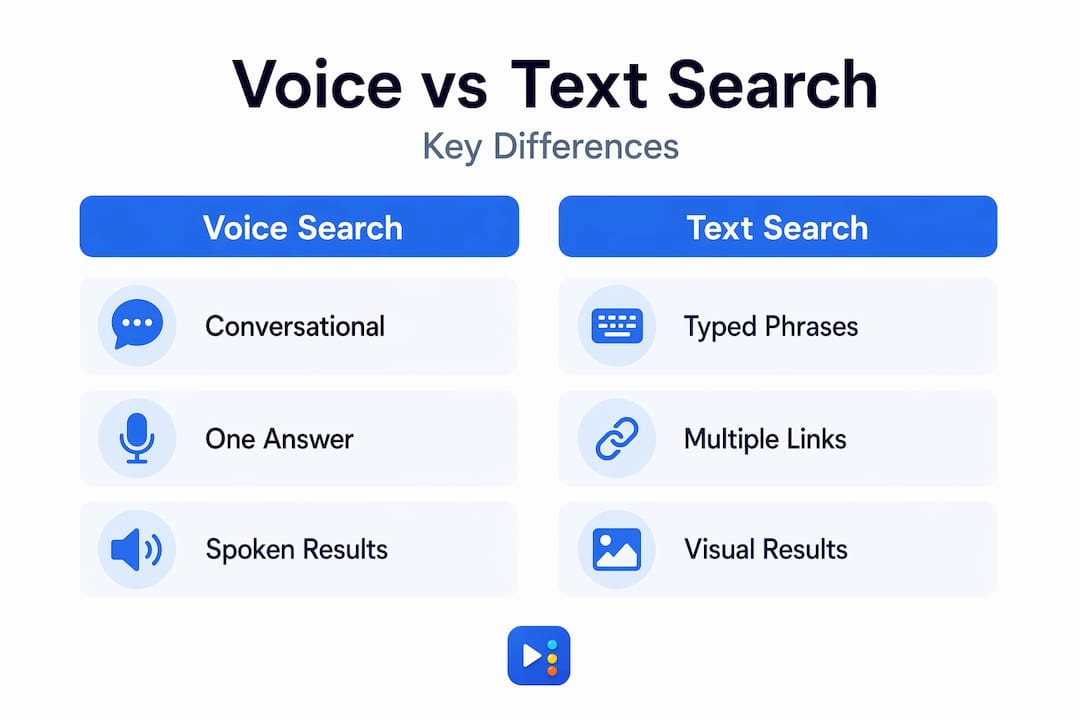

When someone types a search, they tend to write shorthand. "best pizza Austin" or "nail salon near me" are classic examples. When someone speaks to a device, they use full sentences and natural phrasing. That same person might ask, "Where's the best pizza place open right now near downtown Austin?" Voice queries are conversational, specific, and often include location or time context.
Here's what makes voice queries distinctly different from their typed equivalents:
- Length and phrasing: Voice queries average five or more words compared to two or three for typed searches.
- Question format: People use words like who, what, where, when, how, and why far more often when speaking.
- Intent: Voice search is loaded with immediate intent. Users want directions, hours, quick facts, or a product recommendation right now.
- Location dependency: A large portion of voice queries include a local element, either explicitly ("near me") or implied by context.
- Expected answer format: Typed search returns a list of links. Voice search returns one spoken answer, often pulled directly from a featured snippet or local pack.
That last point is the biggest strategic implication. Voice assistants don't read ten blue links out loud. They pick one source and speak it. Voice assistants frequently source answers from featured snippets and local packs to read aloud, which means winning position zero or local pack placement is the real prize in voice SEO. Ranking fifth or sixth means nothing if a user never hears your name mentioned.
Core voice search optimization strategies
Understanding the definition is only half the battle. Applying it through specific tactics is what creates results. Voice search optimization requires a deliberate restructuring of how you create and format content. Here's a practical breakdown of what that looks like.
-
Lead with question-based headings. Structure your pages so that a relevant question appears as a heading, followed immediately by a concise, self-contained answer. This mirrors how voice assistants extract content. If someone asks, "What are the hours for X business?" your page should have that exact question format with a clear answer below it.
-
Write answers under 60 words. Concise answers under 50 to 60 words placed near the top of a page using question-based headings significantly improve your chances of being selected for a voice response. Keep answers tight and complete. Think of it as writing the answer you'd want read aloud to you in a car.
-
Use natural, conversational language. Formal, keyword-stuffed prose sounds robotic when read by a voice assistant. Write the way your customers actually speak. If you run a med spa in Round Rock, your content should sound like a helpful staff member explaining services, not a press release.
-
Target featured snippets and People Also Ask. Both of these SERP features are prime sources for voice assistant answers. Use structured content, bullet lists, numbered steps, and clear definitions to give Google something easy to pull. Check your current rankings for People Also Ask opportunities using tools like Google Search Console or third-party rank trackers.
-
Add structured data markup. Schema markup tells search engines exactly what your content means. For local businesses, that includes business name, address, phone number, hours, and service types. Structured data increases your odds of appearing in the local pack, which is a direct voice search gateway.
-
Prioritize mobile speed. Updating Google Business Profile and optimizing for mobile speed are both critical for voice SEO success. Most voice searches happen on mobile devices. A slow-loading page won't just hurt your traditional SEO. It will disqualify you from voice results entirely. Check mobile SEO performance as a baseline before anything else.
-
Build FAQ sections. A dedicated FAQ section on your key pages gives you multiple chances to match exact voice query phrasing. Each question and answer pair is a potential voice result. Focus on the questions your customers actually ask, not the ones you wish they'd ask.
Pro Tip: When writing a content segment you want voice assistants to read, draft the answer first, then work backward to write the rest of the page. If your answer can't stand alone in two to three sentences, rewrite it until it can. Voice assistants quote verbatim, so designing pages for verbatim quoting is the real skill.
Local SEO's role in voice search success
Local businesses have a genuine structural advantage in voice search, and most don't fully use it. The majority of voice queries carry strong local intent, often asking about businesses, services, or places within a specific area. That means your Google Business Profile isn't just a nice-to-have listing. It's a primary source voice assistants draw from when answering local queries.
Voice search optimization for local businesses centers on consistent business details across all listings, "near me" phrasing, and well-structured location and service pages. Here's what that looks like in practice:
- Google Business Profile accuracy: Your name, address, phone number, hours, and categories must be correct and consistent everywhere. Discrepancies between your GBP and your website confuse search engines and reduce voice assistant confidence in citing your information.
- Local pack visibility: Ranking in the local map pack and capturing voice search attention go hand in hand. Google Maps optimization directly supports your voice search presence.
- Location and service page optimization: Each city or service area you target should have a dedicated page with conversational language, structured answers, and locally relevant details. Don't rely on a single homepage to cover all your geographic ground.
- Review management: Reviews signal trustworthiness to both users and search algorithms. A business with 200 four-star reviews is far more likely to be cited by a voice assistant than one with five reviews and no recent activity.
Here's a quick comparison of what separates businesses that capture voice search traffic from those that don't:
| Factor | Optimized for voice | Not optimized |
|---|---|---|
| Google Business Profile | Complete, accurate, regularly updated | Incomplete or outdated |
| Content format | Question headings with concise answers | Long paragraphs without structure |
| Schema markup | Applied to key pages | Missing or incomplete |
| Mobile page speed | Under 3 seconds | 5+ seconds load time |
| Review count and recency | 50+ reviews, recent activity | Few reviews, no recent updates |
Local voice search is effectively a hybrid of local SEO hygiene with conversational query optimization. Both have to work together for results to follow. Check out this guide on optimizing your Google Business Profile for a detailed breakdown of every field that matters.
Measuring your voice search SEO performance
One of the most frustrating aspects of voice search is that you can't track it directly. There's no "voice search impressions" column in Google Search Console. That absence leads many marketers to assume it's not measurable. It is, just differently.
Voice SEO metrics differ from traditional SEO tracking. The right approach is to monitor proxy indicators that reflect how visible your content is across the channels voice assistants use to pull answers. Those indicators include:
- Featured snippet acquisitions: How many queries does your site currently own position zero for? Track this consistently.
- People Also Ask appearances: These question boxes are rich sources for voice assistant answers. Gaining visibility here signals relevance for spoken queries.
- Local pack rankings: For service-based businesses, local pack placement directly correlates with voice search visibility for "near me" queries.
- Organic traffic for question-based queries: Filter your Search Console data for queries starting with who, what, where, when, how, and why. Growth in these query types is a strong proxy signal.
Pro Tip: Set up a filtered segment in Google Search Console for question-based queries. Sort by clicks and impressions and look for pages that rank but don't earn clicks. Those are your best candidates for voice optimization rewrites. A page that shows up in text results but earns no engagement is often one restructured answer away from becoming a featured snippet.
Track these metrics monthly, not weekly. Voice SEO is a slow-building channel. Expect gradual improvement over two to three months as Google recrawls and reindexes your updated content. Pair that monitoring with consistent GBP management for the strongest combined signal.
My honest take on voice search SEO
I've worked with enough local businesses to know that voice SEO is one of the most misunderstood areas in digital marketing. When the topic comes up, the conversation almost always drifts toward keywords. "We need more long-tail keywords." That's not wrong, but it misses the real point.
Voice search SEO isn't just about longer keywords. It's about being the one source that gets read aloud. That's a fundamentally different goal. Ranking third for a conversational keyword still means the user never hears your name. You're either the answer or you're not.
What I've found actually works is treating every key page like a spoken FAQ. Ask yourself: if someone asked a voice assistant about my business or my service, what would I want it to say? Then build the exact content structure that makes that answer possible.
Local businesses have a real edge here, and I think most of them squander it. A nail salon in Pflugerville that keeps its GBP spotless, earns regular reviews, and builds a few well-structured service pages can realistically out-voice-search a competitor ten times its size. The playing field isn't determined by budget. It's determined by structure and consistency.
The future of voice search will likely push toward even more conversational AI interfaces. The groundwork you lay now, clean local data, question-based content, featured snippet ownership, will compound in value. Don't wait until voice search feels unavoidable to start.
— Tran
Ready to win more voice searches?
Voice search visibility is built on the same foundation as strong local SEO: accurate business data, well-structured content, and consistent optimization over time.

At Yourlocalseo, we help small businesses across Pflugerville, Austin, Round Rock, and Central Texas build that foundation the right way. From Google Business Profile optimization to fully structured local service pages, we handle the technical work so you can focus on running your business. Explore our local SEO services to see exactly how we approach rankings that drive real leads. Ready to get specific? Our local SEO guide walks you through every step your business needs to take.
FAQ
What is the definition of voice search SEO?
Voice search SEO is the practice of optimizing website content so that voice assistants like Google Assistant, Siri, or Alexa select it as the spoken answer to a user's query. It focuses on conversational, question-based content and direct answers rather than traditional keyword-ranked link lists.
How does voice search work differently from text search?
Voice search uses natural, spoken language that tends to be longer and more conversational than typed queries. Voice assistants return a single spoken answer rather than a list of links, so ranking in featured snippets or the local pack is the primary goal.
Why does local SEO matter so much for voice search?
A large portion of voice queries include local intent, such as "near me" searches or questions about business hours and locations. Keeping your Google Business Profile accurate and complete directly improves your chances of being cited as the answer to those queries.
What metrics should I track for voice search SEO?
Since there are no direct voice search ranking reports, track featured snippet acquisitions, local pack rankings, People Also Ask visibility, and organic traffic from question-based queries in Google Search Console as proxy indicators of your voice search performance.
How long does it take to see results from voice search optimization?
Most businesses see measurable improvement in featured snippet and local pack visibility within two to three months of restructuring content and updating their Google Business Profile, though results vary based on competition and how consistently updates are maintained.