

The Google Map Pack is defined as the set of three local business listings Google displays at the top of search results for queries with local intent. Also called the local 3-pack, it pulls data directly from Google Business Profiles and shows reviews, star ratings, hours, addresses, and photos to help searchers make fast decisions. Businesses that appear in the local pack see a 126% increase in website traffic compared to those that do not. That number alone explains why the Map Pack is the most valuable piece of real estate in local search. With 88% of consumers using Google Maps to find local businesses, showing up in those three spots is not optional for any business that depends on foot traffic.
What is the Google Map Pack and how does it work?
The Google Map Pack appears at the top of search results when Google detects local intent in a query. Searches like "nail salon near me," "best pizza in Austin," or "plumber Pflugerville" all trigger the local pack. Google determines local intent algorithmically, not just from explicit location words. A search for "coffee shop" from a phone in Round Rock will still produce a Map Pack result.
The three slots in the pack are not random. Google limits the Map Pack to three listings specifically to fit the mobile screen without requiring the user to scroll. About 60% of local searches come from mobile devices, so Google built the feature around that experience. Each listing shows the business name, category, address, phone number, hours, star rating, and a link to directions.

The Map Pack sits above all organic website results. That placement matters because most searchers click before they ever reach the organic links below. Organic SEO still has value, but for local businesses, the Map Pack delivers faster visibility and more direct action from searchers.
Pro Tip: Search your own business category from your phone while walking around your neighborhood. You will see exactly what your potential customers see, and you may be surprised how quickly the results change by location.
What factors influence ranking in the Google Map Pack?
Google uses three primary signals to rank businesses in the local pack: relevance, distance, and prominence. Understanding each one helps you focus your effort where it counts.
-
Relevance refers to how well your Google Business Profile matches what the searcher is looking for. A nail salon that lists gel manicures, acrylics, and pedicures as services is more relevant to those specific searches than one with a vague description.
-
Distance is the proximity of your business to the searcher's location. Google factors in the searcher's physical location, not just the city they typed. A business two blocks away will often outrank a more prominent business across town.
-
Prominence reflects how well known and trusted your business appears online. This includes the number and quality of Google reviews, your overall star rating, and how often your business is mentioned across the web.
-
Local citations are listings of your business name, address, and phone number (NAP) on directories like Yelp, the Better Business Bureau, and local chamber of commerce sites. Consistent NAP data across citations signals to Google that your business information is accurate and trustworthy.
-
Google Business Profile completeness is the single most direct factor you control. Map Pack listings come from Google Business Profile data, not from your website. A fully completed profile with accurate categories, photos, and descriptions outperforms an incomplete one every time.
Pro Tip: Choose your primary business category carefully. Google weighs it heavily for relevance. A med spa that lists "Medical Spa" as its primary category will rank better for med spa searches than one listed only as "Beauty Salon."
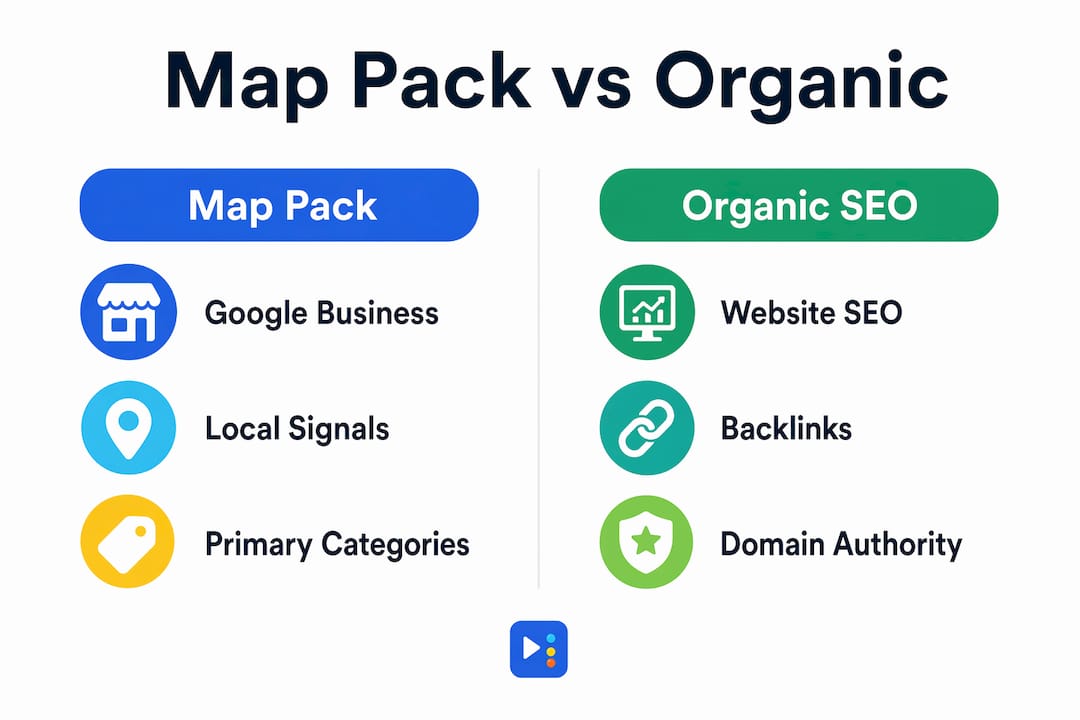
Map Pack ranking is distinct from traditional organic SEO. Your website's domain authority and backlink profile matter far less here. Local signals from your Google Business Profile carry the most weight. This is why a newer business with a well-managed profile can outrank an older competitor with a stronger website.
How can business owners improve their Google Map Pack visibility?
Improving your position in the local pack starts with your Google Business Profile. The steps below are ordered by impact, not complexity.
- Claim and verify your profile. Go to Google Business Profile and complete the verification process. An unverified profile cannot rank in the Map Pack.
- Complete every field. Add your business hours, phone number, website, service area, and a detailed business description. Use local keywords in your description naturally, such as your city name and the services you offer.
- Select accurate categories. Your primary category is the most important. Add secondary categories for every relevant service you provide.
- Upload photos regularly. Businesses with photos receive more clicks and direction requests. Add interior shots, exterior shots, team photos, and product images.
- Collect and respond to reviews. Ask every satisfied customer to leave a Google review. Respond to every review, positive or negative. Review volume and recency both influence your prominence score.
- Build local citations. List your business on Google, Yelp, Facebook, Apple Maps, and relevant local directories. Keep your NAP data identical across every listing. Even small inconsistencies, like "St." vs. "Street," can weaken your citation signals.
- Post updates to your profile. Google Business Profile posts keep your listing active and signal to Google that your business is current. Share promotions, events, or new services at least twice a month.
- Monitor your ranking from multiple locations. Your Map Pack position changes based on where the searcher is standing. Use a rank tracking tool for local search that checks rankings from different geographic points around your area.
Avoiding common local SEO mistakes like duplicate listings, incorrect hours, and missing categories can also protect the ranking you have already earned.
What are common misconceptions about the Google Map Pack?
Several widely held beliefs about the local pack are simply wrong. Clearing them up saves you time and misdirected effort.
The Map Pack is not static. Map Pack results shift significantly based on the searcher's physical location. A business that ranks first for someone standing on Main Street may not appear at all for someone searching from a neighborhood two miles away. Checking your ranking from one location gives you an incomplete picture.
Ranking first is not the only goal. Appearing anywhere in the Map Pack delivers dramatically more visibility than ranking first in organic results. The goal is to get into the three slots, not necessarily to be the top listing within them.
The Map Pack only triggers with local intent. Google activates the local pack only when a search query shows clear local intent. Broad informational searches do not produce a Map Pack. This means your profile optimization needs to align with the specific local queries your customers actually use.
Map Pack and organic SEO are separate systems. Map Pack rankings derive from Google Business Profile data and local signals, not from your website's SEO performance. You can rank in the Map Pack with a basic website, and you can have a highly ranked website that never appears in the local pack.
The table below shows the key differences between Map Pack and organic search results.
| Factor | Map Pack | Organic search results |
|---|---|---|
| Primary data source | Google Business Profile | Website content and backlinks |
| Key ranking signals | Proximity, reviews, profile completeness | Domain authority, on-page SEO, backlinks |
| Number of results shown | 3 listings | 10 or more per page |
| Triggered by | Local intent queries | All query types |
| Paid placement option | Local Service Ads (separate) | Google Ads (separate) |
One more distinction worth knowing: Local Service Ads appear above the Map Pack in some categories. These are paid placements and are separate from the organic Map Pack listings. Winning a spot in the organic Map Pack costs nothing beyond the time you invest in your profile.
Key takeaways
The Google Map Pack is the highest-value local search placement available to small businesses, and it is won through Google Business Profile optimization, not website SEO.
| Point | Details |
|---|---|
| Map Pack definition | Three local business listings shown at the top of Google results for local intent searches. |
| Primary ranking source | Google Business Profile data drives Map Pack rankings, not website authority or backlinks. |
| Mobile-first design | Google limits the pack to three slots because 60% of local searches come from mobile devices. |
| Dynamic results | Map Pack listings shift based on the searcher's physical location, so check rankings from multiple spots. |
| Top action to take | Complete and verify your Google Business Profile with accurate categories, photos, and consistent NAP data. |
Why the Map Pack is the one thing I tell every local business owner to prioritize
I have worked with nail salons, med spas, restaurants, and service businesses across Central Texas. The pattern I see repeatedly is that business owners spend money on website redesigns while their Google Business Profile sits incomplete and unverified. That is the wrong order of operations.
The Map Pack is where your customers are making decisions. When someone searches for a restaurant in Georgetown or a plumber in Cedar Park, they are not reading blog posts. They are looking at those three listings, checking your star rating, and clicking directions. If you are not in those three slots, you are invisible at the exact moment someone is ready to spend money.
What surprises most business owners is how achievable Map Pack visibility actually is. You do not need a massive advertising budget. You need a complete, accurate, and active Google Business Profile. You need reviews coming in consistently. You need your NAP data to match across every directory where your business is listed.
The other thing I stress is monitoring. Checking your Map Pack ranking from a single location tells you almost nothing. Your ranking in the neighborhood two miles from your shop may be completely different from your ranking right outside your front door. Understanding that dynamic nature is what separates businesses that maintain their Map Pack position from those that lose it without knowing why.
Pairing your Google Business Profile work with proven local ranking strategies creates a compounding effect. Each improvement reinforces the others. That is the approach we take at Yourlocalseo, and it is the one that produces real, measurable results for local businesses.
— Tran
How Yourlocalseo helps local businesses win the Map Pack
Getting into the local 3-pack requires consistent, detailed work on your Google Business Profile, citations, and local search signals. Yourlocalseo specializes in exactly that for small businesses across Pflugerville, Austin, Round Rock, Georgetown, Cedar Park, and the surrounding Central Texas area.

We handle Google Business Profile setup, verification, and ongoing optimization so your listing stays complete, accurate, and competitive. We build local citations, manage review generation, and track your Map Pack rankings from multiple locations around your service area. Every strategy we apply is built around driving real foot traffic to your business, not vanity metrics. If you are ready to get found on Google and turn local searches into paying customers, Yourlocalseo is the partner built for that work.
FAQ
What is the Google Map Pack?
The Google Map Pack is the group of three local business listings Google shows at the top of search results for location-based queries. Each listing displays the business name, address, phone number, hours, star rating, and a link to directions.
How do I get my business into the local 3-pack?
Claim and fully complete your Google Business Profile with accurate categories, photos, hours, and a detailed description. Build consistent local citations and collect Google reviews regularly to improve your prominence score.
Does my website affect my Map Pack ranking?
Map Pack rankings come primarily from Google Business Profile data and local signals, not from your website's SEO performance. A well-optimized profile can outrank businesses with stronger websites.
Why does my Map Pack ranking change by location?
Map Pack results are hyper-local and shift based on the physical location of the person searching. A business that ranks in the top three for someone nearby may not appear at all for someone searching from a few miles away.
Are Map Pack listings free?
Organic Map Pack listings are free. Google does offer paid Local Service Ads that appear above the Map Pack in certain categories, but those are separate from the organic three-pack results.