

Search engine optimization (SEO) is the practice of earning organic visibility in Google Search without paying per click, and it is the most cost-effective path to sustainable traffic for small businesses. The reason to choose SEO over ads comes down to one economic reality: paid advertising stops delivering the moment your budget runs out, while SEO compounds in value the longer you invest. Organic search drives 17.1% of global web traffic as of Q1 2026, dwarfing every other channel. For small businesses in Pflugerville, Austin, or Round Rock competing against larger brands with bigger ad budgets, SEO builds the kind of durable visibility that paid clicks simply cannot replicate.
Why choose SEO over ads for long-term ROI
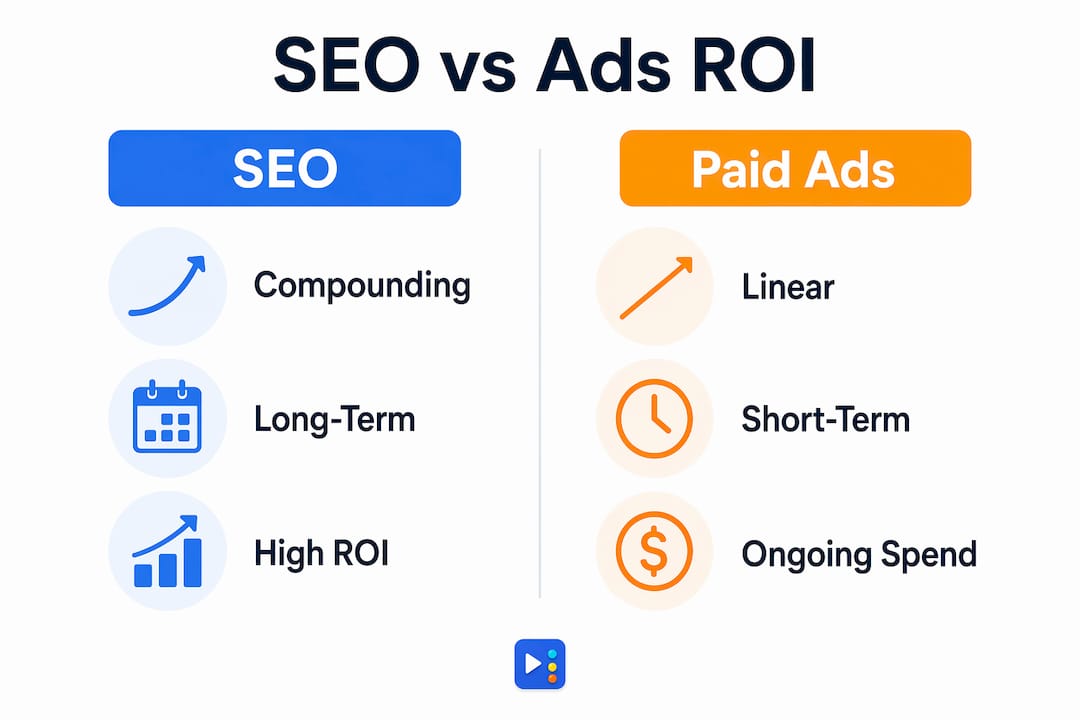
Paid advertising follows a linear model: spend a dollar, get a click. Stop spending, get nothing. SEO follows a compounding model, where the authority and content you build today continues generating traffic months and years from now. That structural difference is the core reason SEO wins over a long enough time horizon.
The numbers from Previsible's tracked programs make this concrete. ROI at month 24 averages 384% and climbs to 946% by month 36. No paid campaign sustains those returns without continuous spend. This is not a theoretical projection. It reflects what happens when organic authority accumulates and content ages into higher rankings.
SEO content behaves like a capital asset. The average useful lifespan of SEO content is 3.7 years of traffic generation without further investment. Compare that to a Google Ads campaign where cost per click ranges from $3 to $12 for the same traffic volume, versus an estimated $0.08 per session for mature SEO content. For a local nail salon or med spa running on a tight marketing budget, that cost difference is the margin between growth and stagnation.

| Metric | SEO (month 36) | Paid Ads (ongoing) |
|---|---|---|
| Average ROI | 946% | Resets to zero when spend stops |
| Cost per session | ~$0.08 | $3 to $12 per click |
| Content lifespan | ~3.7 years | Active only while funded |
| Traffic trend | Compounds upward | Flat or dependent on budget |
A tracked blog post in Previsible's data rose from position 17 to position 2 between month 2 and month 14, with session volume growing over 10x. No additional spend was required after the initial content investment. That is the compounding effect in practice.
Pro Tip: Do not evaluate SEO performance at month 3 or even month 6. Previsible's data shows month 6 may still precede the break-even point. Set your measurement window at 12, 24, and 36 months to see the real picture.
How does generative AI in search affect the SEO vs. paid ads decision?
Google's integration of generative AI into search results has prompted a lot of concern among small business owners. The worry is that AI-generated answers will replace organic results and make SEO irrelevant. That concern is not supported by current data or by Google's own guidance.
Google Search Central confirmed in 2026 that optimizing for generative AI features depends on the same high-quality content and anti-spam standards as core ranking systems. Generative AI draws from Google's organic index. If your site ranks well organically, it is already positioned to appear in AI-enhanced results. Paid ads do not feed into that system.
Here is what this means practically for small businesses:
- Generative AI currently accounts for only 0.7% of global web traffic, while organic search holds 17.1%. The shift is real but gradual.
- Google's 2026 guidance explicitly states that trying to "game" AI with inauthentic mentions is futile. Content must be valuable, unique, and technically accessible.
- Technical SEO standards, including page speed, structured data, and crawlability, determine visibility in both classic and AI-enhanced search formats.
- Businesses that invest in SEO now are building the content authority that generative AI will draw from as its traffic share grows.
"SEO fundamentals remain the durable foundation for both traditional and AI-enhanced search visibility." — Google Search Central, 2026
The practical takeaway is direct: the SEO work you do today protects your visibility across every format Google deploys tomorrow. Paid ads offer no such carry-forward value.
How does incrementality testing change how you measure SEO vs. paid ads?
Most small businesses measure marketing through last-click attribution. A customer clicks a Google Ad and converts, so the ad gets full credit. The problem is that the customer may have found you through organic search first, read your blog, and then clicked the ad on a return visit. Last-click attribution systematically undervalues SEO's contribution to your pipeline.
Incrementality testing solves this by measuring the lift that a specific channel actually causes, not just the last touchpoint it touched. The process works like this:
- Establish a baseline. Measure organic traffic, leads, and conversions during a period without paid ads running.
- Run a controlled experiment. Activate paid ads for a defined period while holding other variables constant.
- Measure the lift. Calculate how much additional conversion volume the ads generated beyond what organic would have produced alone.
- Calculate true cost per acquisition. Divide ad spend by the incremental conversions only, not total conversions that would have happened anyway.
Google Ads reduced incrementality experiment costs to $5,000 in 2025, making this methodology accessible to small and mid-size businesses for the first time. Previously, only enterprise brands could afford to run these tests. This matters because many SMBs discover through incrementality testing that their paid ads are capturing conversions that organic search was already generating, meaning the ads added little true lift at significant cost.
Pro Tip: Run an incrementality test before scaling your ad budget. If your organic traffic is already converting well, you may find that tracking local SEO results delivers better returns than doubling down on paid spend.
Multi-touch attribution models, such as data-driven attribution in Google Analytics 4, show SEO influencing the pipeline at the awareness and consideration stages, not just the final click. When you account for that full-funnel contribution, the SEO benefits versus ads comparison shifts decisively toward organic.
What digital marketing strategies work best for small businesses choosing SEO?
Small businesses face a real constraint: limited budget means every dollar must work harder. The right strategy depends on where you are in your business cycle, but the framework below applies to most local service businesses.
| Situation | Recommended approach |
|---|---|
| New business, limited budget | Prioritize technical SEO and Google Business Profile optimization first |
| Established business, slow lead flow | Add content strategy and local citations to build authority |
| Product launch or seasonal push | Use paid ads short-term while maintaining SEO execution |
| Competing in a saturated local market | Combine on-page SEO, review generation, and local link building |
The businesses that get the most from SEO share three practices. First, they treat content as a long-term asset, not a one-time task. A service page optimized for "med spa Austin TX" does not need to be rewritten every month. It needs to be technically sound, genuinely useful, and supported by citations and backlinks over time. Second, they prioritize local search visibility through Google Business Profile optimization, consistent NAP citations, and review generation. Third, they measure at the right intervals. Checking rankings at week four is like checking a retirement account after one contribution.
When combining SEO and paid ads, the most effective approach is to use paid ads for immediate lead needs during the first 6 to 12 months while SEO builds momentum. Once organic traffic reaches a self-sustaining level, reduce paid spend and reinvest in content and technical improvements. Home services businesses like HVAC companies and cleaning services follow this model successfully because their local search intent is high and local SEO strategies convert that intent into booked jobs.
Smart keyword targeting is the foundation of this approach. Targeting high-intent, location-specific phrases like "nail salon Pflugerville" or "HVAC repair Round Rock" costs nothing per click once you rank organically, compared to $6 to $12 per click in Google Ads for the same terms.
Key takeaways
SEO outperforms paid advertising over a 24 to 36 month horizon because organic traffic compounds in value while paid traffic resets to zero the moment spending stops.
| Point | Details |
|---|---|
| Compounding ROI | SEO averages 946% ROI at month 36, compared to zero return when ad spend stops. |
| Cost per session | Mature SEO content costs approximately $0.08 per session versus $3 to $12 for paid clicks. |
| AI search alignment | Google's 2026 guidance confirms SEO best practices drive visibility in both classic and AI-enhanced results. |
| Measurement timing | Evaluate SEO at 12, 24, and 36 months. Early measurement underestimates real impact. |
| Incrementality testing | Run controlled experiments to find true ad lift before scaling paid budgets. |
Why I tell every small business owner to commit to SEO early
I have worked with enough local businesses to see the same pattern repeat. A restaurant or med spa launches, runs Google Ads to get initial traction, and then keeps running ads indefinitely because stopping feels too risky. Two years later, they have spent $40,000 on clicks and own nothing. No rankings, no domain authority, no organic presence. The moment the budget tightens, the leads disappear.
SEO requires patience. The first three to six months feel slow, and that is genuinely uncomfortable when you need leads now. But the businesses that commit early, build their Google Business Profile correctly, publish consistent content, and earn local citations, are the ones that stop worrying about ad costs by year two. They own their visibility instead of renting it.
The other thing paid ads cannot replicate is trust. When a potential customer in Pflugerville searches for a nail salon and sees your business ranking organically in the local map pack with 80 reviews, that signal carries weight that a sponsored listing simply does not. Organic rankings communicate that Google has validated your relevance. That credibility compounds just like the traffic does.
My advice is straightforward. Start SEO on day one. Use paid ads tactically for launches or slow seasons. Measure at the right intervals. And do not let a slow month 4 convince you to abandon a strategy that pays off at month 24.
— Tran
Start building organic visibility that lasts
If you are ready to stop paying for every click and start building traffic that compounds over time, Yourlocalseo helps small businesses across Pflugerville, Austin, Round Rock, and Central Texas do exactly that.

We specialize in Google Business Profile optimization, local citation building, on-page SEO, and review generation. Every strategy is built around your specific location and business type, whether you run a nail salon, a med spa, a restaurant, or a home services company. Our local SEO services are designed to reduce your dependency on paid ads and build the kind of organic presence that keeps generating leads month after month. If you want to see what sustainable search visibility looks like for your business, visit Yourlocalseo and let's build something that lasts.
FAQ
Why does SEO outperform paid ads over time?
SEO builds cumulative authority and organic rankings that continue delivering traffic without ongoing spend. ROI at month 36 averages 946%, while paid ad traffic stops the moment your budget does.
How long does SEO take to show results?
Most SEO programs begin showing meaningful traffic gains between months 6 and 12, with the strongest returns appearing at months 24 and 36. Evaluating SEO before month 6 consistently underestimates its real impact.
Does generative AI make SEO less valuable?
No. Google Search Central confirmed in 2026 that generative AI features rely on the same quality and technical standards as core organic rankings. Strong SEO positions your content for both classic and AI-enhanced search results.
Should small businesses use SEO or paid ads?
Small businesses with limited budgets should prioritize SEO for long-term visibility and use paid ads only for short-term needs like product launches or seasonal promotions. Once organic traffic is established, paid spend can be reduced significantly.
What is incrementality testing and why does it matter?
Incrementality testing measures the actual lift that paid ads generate beyond what organic search would have produced on its own. Google Ads lowered experiment costs to $5,000 in 2025, making this approach accessible to small businesses evaluating their true ad ROI.