

Most small business owners treat SEO like a single switch to flip. Either you're doing it or you're not. But that thinking leaves a massive opportunity on the table, especially if you run a nail salon in Pflugerville, a med spa in Georgetown, or a restaurant in Round Rock. Local SEO adds unique factors like Google Business Profile rankings, map pack placement, and "near me" searches on top of what traditional SEO already covers. These are two different strategies built for two different goals, and knowing which one to prioritize could be the clearest competitive advantage you act on this year.
Table of Contents
- What is local SEO and how does it work?
- How does traditional SEO compare?
- Local SEO vs. traditional SEO: a side-by-side comparison
- Special considerations for Central Texas businesses
- Our take: why smart Central Texas businesses layer local and traditional SEO
- Get local SEO results fast
- Frequently asked questions
Key Takeaways
| Point | Details |
|---|---|
| Local SEO brings fast results | Most Texas small businesses can drive leads and revenue within months using targeted local SEO tactics. |
| Traditional SEO boosts long-term growth | Broad, authority-building SEO is valuable for online reach but is slower and more competitive for small local businesses. |
| Hybrid strategies win | The best results come from combining local foundation with traditional SEO for maximum search visibility. |
| Regional tactics matter | Unique factors in Central Texas mean your local SEO must be regionally tailored to outpace competitors. |
| Start with your Google Business Profile | Optimize your Google Business Profile and local info for the quickest path to better rankings and more customers. |
What is local SEO and how does it work?
Now that we've previewed how local search stands apart from general SEO, let's break down exactly what local SEO means for your business.
Local SEO is the practice of optimizing your online presence to attract customers in a specific geographic area. When someone in Austin searches "best nail salon near me" or "HVAC repair Pflugerville," Google uses a set of local signals to decide which businesses appear in the map pack and local listings. That's local SEO at work.
According to Search Engine Land's guide, local SEO targets geographically specific audiences using location-based keywords, Google Business Profile (GBP) optimization, local citations (NAP consistency), reviews, and proximity signals. Each of these elements works together to tell Google exactly who you are, where you are, and why you're the best fit for a nearby searcher.
Here's what local SEO actually involves:
- Google Business Profile (GBP): Your listing on Google Maps and local search. It includes your hours, photos, reviews, services, and more. Optimizing your Google Business Profile is usually the single highest-impact action a local business can take.
- NAP consistency: NAP stands for Name, Address, and Phone number. These details must match exactly across every directory, website, and listing where your business appears. Inconsistencies confuse Google and lower your rankings.
- Local citations: These are mentions of your business across the web on platforms like Yelp, the Better Business Bureau, and local directories. More accurate citations signal legitimacy to Google.
- Reviews: The number of reviews, their rating, and how recent they are all influence your placement in local results.
- Location-based keywords: Phrases like "Georgetown TX chiropractor" or "Cedar Park coffee shop" tell Google your content is relevant to local searchers.
The results you earn from local SEO show up in the local map pack (the three business listings with a map that appear at the top of search results) and in local organic listings. These are prime positions. Searchers clicking on these results are ready to call, visit, or buy. For brick-and-mortar businesses and service-area businesses across Central Texas, that kind of traffic converts far better than generic website visits.
Pro Tip: Use our local SEO checklist for Central Texas to audit your current presence and find the fastest areas for improvement before investing in anything else.
How does traditional SEO compare?
With a clear baseline for local SEO, it helps to contrast this with the traditional approach most people associate with search marketing.

Traditional SEO focuses on ranking for broad, non-location-specific search terms. Think "best running shoes" or "how to manage small business finances." As Search Engine Land notes, traditional SEO relies on broad keywords, content marketing, backlink building, and technical site structure to earn national or global visibility.
This is the SEO that most large brands and e-commerce companies use. The goal is to rank on page one for high-volume terms that pull in massive amounts of traffic from all over the country or the world.
Here's how traditional SEO typically works:
- Keyword research for broad topics: Focus on high-volume, intent-based terms that aren't tied to a location.
- Content marketing: Long-form blog posts, guides, and pillar pages that attract links and establish authority.
- Link building: Earning backlinks from reputable websites to boost your domain authority, the overall trust score Google assigns to your site.
- Technical SEO: Site speed, mobile usability, proper indexing, and structured data all fall under this category.
Traditional SEO takes time. It can take 6 to 12 months to see meaningful movement on competitive national keywords, and even then, ranking doesn't guarantee conversions if the traffic isn't local.
For a single-location restaurant in Manor or a service-area plumber in Round Rock, competing nationally rarely makes sense. You don't need visitors from New York. You need customers five miles away. That's where traditional SEO falls short for most Central Texas small businesses.
Research also shows that local SEO drives faster ROI for small businesses, with lower competition and higher conversion rates because local search intent is so specific. Someone searching "emergency plumber Georgetown TX" is ready to call right now. Someone searching "plumbing tips" is probably just browsing.
| Feature | Traditional SEO | Local SEO |
|---|---|---|
| Keyword focus | Broad, non-location | Location-based, service-specific |
| Target audience | National or global | City, neighborhood, or region |
| Primary results | Organic blue links | Map pack, local listings |
| Time to results | 6-12+ months | 3-6 months for measurable gains |
| Best for | E-commerce, large brands | Brick-and-mortar, service-area businesses |
| Cost for small business | High (competitive) | Lower (less competition) |
| Conversion rate | Variable | High (high-intent searchers) |
Many small business owners invest in improving Google rankings using traditional tactics and wonder why the results feel slow. Often, it's because the strategy wasn't built for their audience from the start.
Local SEO vs. traditional SEO: a side-by-side comparison
The strengths of each approach make even more sense when compared directly. Here's how local SEO stacks up to the traditional route.
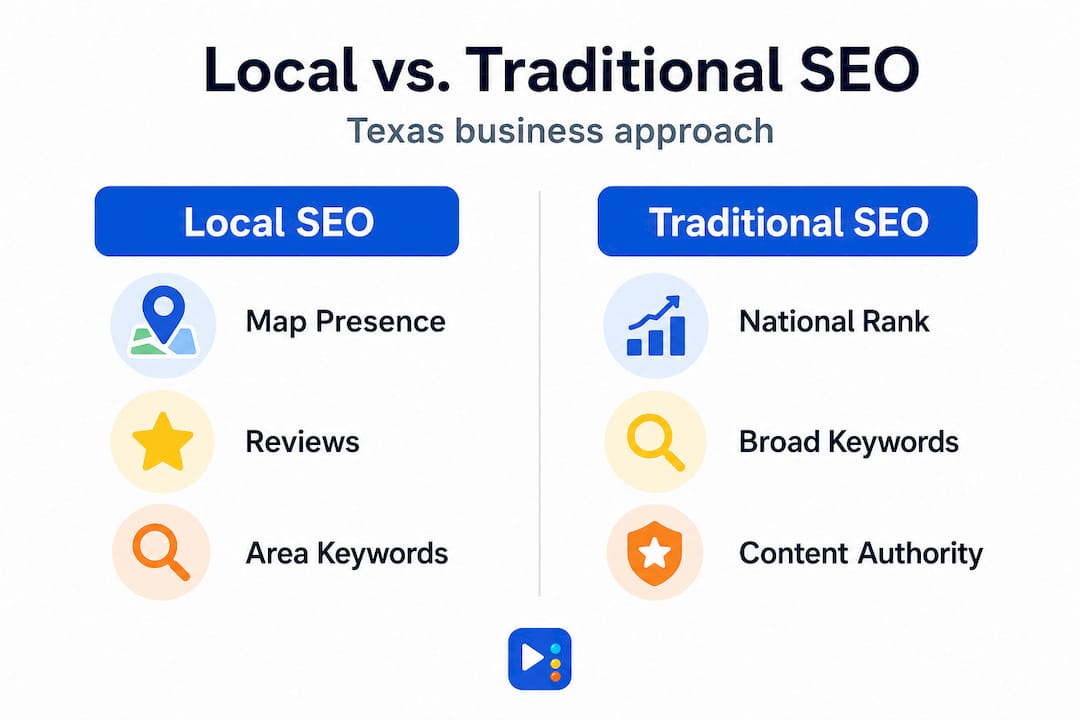
The most telling data point: the local map pack captures about 44% of all clicks in local searches. That's nearly half of the available traffic going to just three map listings. If your business isn't in that pack, you're likely invisible to the majority of nearby, ready-to-buy customers.
Here's a breakdown of how the two approaches differ on core elements:
| Element | Local SEO | Traditional SEO |
|---|---|---|
| Google Business Profile | Essential | Not a factor |
| Reviews and ratings | Critical ranking signal | No direct impact |
| NAP citations | High priority | Not applicable |
| Link building | Locally focused | Broad authority building |
| Content strategy | Local landing pages, location content | Broad topic authority, pillar pages |
| Maps visibility | Yes (map pack) | No |
| Typical ROI timeline | 3-6 months | 6-18 months |
| Conversion quality | Very high (local intent) | Moderate (mixed intent) |
The real-world numbers back this up. Case studies from businesses using local SEO show a 150% increase in leads within six months, a 347% revenue boost generating $127,000 in just 90 days, a 300% increase in website traffic, and review counts jumping from 3 to 78 while ratings climbed from 3.1 to 4.9 stars. These are not outliers. These are the results small businesses earn when the strategy matches their actual audience.
When does a hybrid approach make sense? Once your local SEO foundation is solid, traditional SEO content can layer on top to build longer-term authority. For example, a med spa in Austin might rank locally for "lip filler Austin TX" while also building a content strategy around broader terms like "how to choose a med spa." The local SEO brings in immediate leads. The traditional content builds credibility over time.
Pro Tip: Start with homepage SEO strategies built for local intent, then expand into supporting blog content. And pair that with smart local keyword strategies to target the right terms in the right neighborhoods.
Special considerations for Central Texas businesses
While the basic rules apply everywhere, business owners in Central Texas face a few unique opportunities and challenges worth calling out.
Central Texas is one of the fastest-growing regions in the country. Cities like Austin, Pflugerville, Round Rock, Georgetown, Cedar Park, and Manor are all competing in the same metro area but have distinct local signals. Google treats each city as a separate geographic market, which means a business in Pflugerville needs to optimize for Pflugerville specifically, not just the Austin metro.
Here's what local businesses in this region need to prioritize:
- Use city-specific keywords: Don't just target "nail salon" or "HVAC repair." Target "nail salon Pflugerville TX" and "HVAC repair Georgetown TX." The more specific your location signals, the better you'll rank in that specific city's map pack.
- Build reviews from local customers: Google weighs the recency and relevance of reviews heavily. A business with 40 fresh reviews from Georgetown customers will outrank one with 200 old reviews from random cities.
- Set up location-specific pages if you serve multiple cities: A single-page website that just says "serving Central Texas" won't rank in any specific city. You need dedicated location pages for each market you serve.
- Claim and categorize your GBP correctly: The business categories you choose for local SEO directly affect which searches trigger your listing. Choosing the wrong primary category is one of the most common and costly mistakes we see.
- Optimize for AI-driven and zero-click searches: Google increasingly answers questions directly in search results without users clicking any link. To stay visible, your business information needs to be structured clearly through your GBP, schema markup, and consistent entity signals across the web.
Multi-location businesses face additional complexity. Managing local SEO at scale requires separate GBP listings, unique location pages, and location-specific review strategies for each market. Proximity still matters, but authority and relevance can override it in some searches.
The pitfalls here are real. Businesses that use generic, city-agnostic SEO tactics in a market like Central Texas often stall out entirely. Proximity, relevance, and prominence are the three pillars Google uses for local rankings. Ignoring even one of them puts you at a disadvantage against competitors who have all three dialed in.
Pro Tip: If you serve multiple cities in Central Texas, create a separate location page for each one. These pages should include unique content, local customer reviews, and a locally optimized GBP link. Generic pages pulled from a template rarely rank.
Our take: why smart Central Texas businesses layer local and traditional SEO
Here's where we land after working with hundreds of local businesses across Pflugerville, Austin, Georgetown, and the surrounding communities.
The "either/or" framing is outdated. Asking whether you need local SEO or traditional SEO is like asking whether your business needs Instagram or a website. They serve different functions, and the best outcomes happen when they work together.
That said, sequencing matters. Most small businesses in Central Texas should prioritize local SEO first. Full stop. The reason is simple: local SEO targets people who are actively searching for what you sell, right now, in your area. That means faster results, better conversion rates, and lower cost per lead compared to broader SEO campaigns.
We've seen nail salons triple their weekly bookings within four months of a proper GBP overhaul and review strategy. We've watched a Georgetown service business go from zero visibility to the top three map positions in under six months by fixing NAP consistency and building local citations. These aren't theoretical outcomes. They're what happens when the strategy fits the business.
Where traditional SEO earns its place is in building the credibility that makes you harder to knock off your local rankings over time. A business with strong local SEO and a solid content library is far more durable than one that relies on GBP optimization alone.
What most businesses miss is that review generation and content authority don't happen automatically. You have to actively ask for reviews. You have to publish content that earns trust. Start with a solid local SEO checklist to identify your gaps, then layer in content strategy once the foundation is tight.
The clearest path forward: audit your current local presence, fix your GBP, build your citations and reviews, then scale with content. Don't let perfect be the enemy of progress.
Get local SEO results fast
If this article helped clarify the difference between local and traditional SEO, the next step is putting that understanding to work for your business.

At ourLocalSEO, we work specifically with small businesses in Central Texas. Whether you want to tackle this yourself or hand it off entirely, we've built the systems to help. Our expert strategies for local SEO cover everything from GBP setup and review generation to citation building and local content. If you're in Georgetown, check out our local SEO services in Georgetown page for location-specific support. Ready to start from the beginning? Our step-by-step local SEO guide walks you through every stage of the process at your own pace.
Frequently asked questions
Does my business need both local and traditional SEO?
Most small businesses see faster results with local SEO first, but blending in traditional SEO content over time builds the long-term visibility and authority that protects your rankings. As Search Engine Land explains, a hybrid approach wins for most businesses.
How quickly can local SEO deliver results for a small business?
Many businesses report measurable results within 3 to 6 months. Case studies back this up with documented examples of 150% lead growth in six months and a $127,000 revenue boost in just 90 days.
What is the "local pack" on Google?
The local pack is the set of three map-based business listings Google displays at the top of location-based search results. It captures about 44% of local search clicks, making it the most valuable real estate in local search.
Are there risks in focusing only on traditional SEO for my shop or local service?
Yes. Relying only on traditional SEO means you miss out on high-intent, nearby searches where customers are ready to act. Local SEO drives higher conversion specifically because it captures searchers at the moment of decision, not just during research.
What is the best first step to improve my local SEO?
Claim and fully optimize your Google Business Profile, then audit your NAP consistency across every directory and platform. As Search Engine Land outlines, GBP optimization and citation consistency are the foundation of every effective local SEO strategy.