

A business website is the single most important digital asset a small business owner can own. 97% of consumers research online before making a purchase, which means your potential customers are already searching for what you sell. If your business does not appear in those results, a competitor's does. Understanding why have a business website goes beyond just having an online presence. It is about owning the infrastructure that generates leads, builds credibility, and drives revenue every single day, whether you are open or not.
What are the primary benefits of a business website?
A business website works as your 24/7 virtual salesperson, answering questions, capturing leads, and presenting your brand to new customers at any hour. Unlike a storefront that closes at 6 p.m., your website never clocks out. That constant availability is one of the most underrated advantages a small business can have.
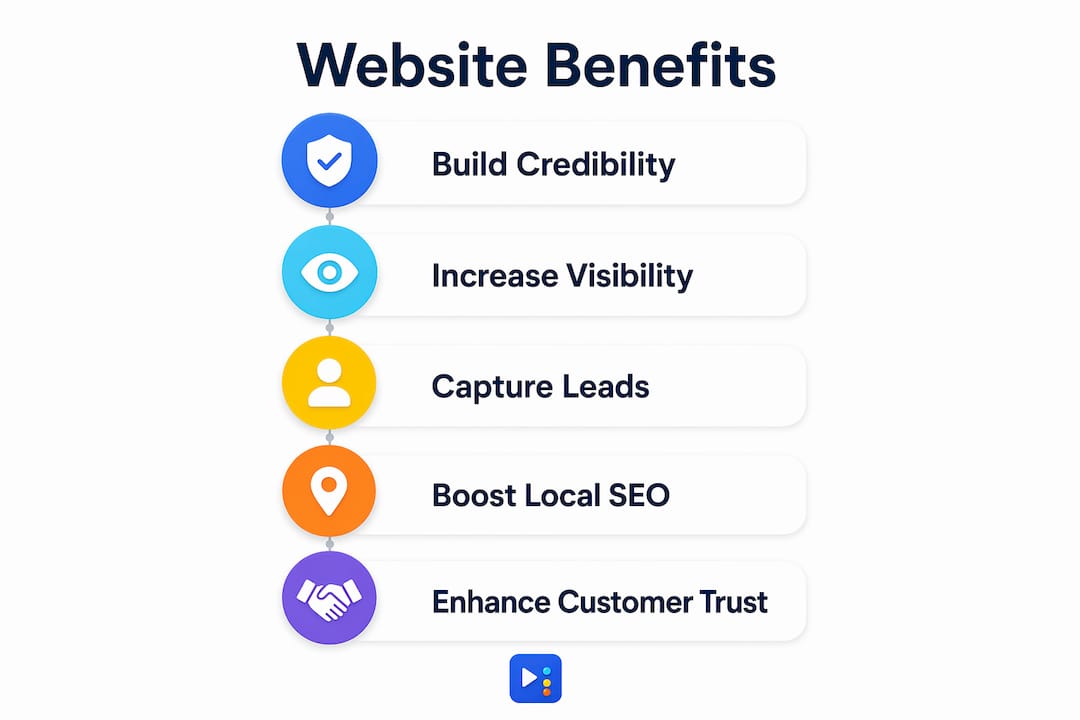
The benefits of a business website go well beyond availability. Here is what a professional site delivers:
- Credibility on demand. Over 75% of consumers judge a business's legitimacy based on website design quality. A polished site signals that you are serious and trustworthy.
- Full control over your brand. You decide the messaging, the visuals, and the customer experience. No algorithm changes that for you.
- Lead generation on autopilot. Contact forms, booking tools, and inquiry pages collect customer information while you focus on running your business.
- Cost-effective marketing. A professional website costs between $2,000 and $5,000 to build, and gaining just two or three new clients monthly covers that investment within weeks.
- Ownership of customer data. Every visitor, form submission, and inquiry belongs to you, not a third-party platform.
Pro Tip: Add a lead capture form above the fold on your homepage. Visitors who see a clear call to action in the first few seconds convert at a significantly higher rate than those who have to scroll to find contact information.
The return on investment for a well-built site compounds over time. A nail salon in Round Rock that ranks on page one of Google for "nail salon near me" does not pay per click for that visibility. The website earns it through consistent SEO and content, month after month.

How does a website boost online visibility and local SEO?
Google prioritizes websites over social media profiles in search results. That is not an opinion. It is how Google Search rewards crawlable content, clear navigation, and mobile usability with better rankings. If your business only exists on Instagram or Facebook, Google has very little to index and rank for you.
Local SEO is the practice of making your business visible to nearby customers searching on Google. A website is the foundation of that practice. Here is how to set it up correctly:
- Optimize your homepage for local keywords. Use phrases like "plumber in Austin" or "med spa in Pflugerville" naturally in your page title, headings, and first paragraph. Homepage SEO strategies for local businesses are well-documented and directly affect your ranking position.
- Make your site mobile-friendly. Most local searches happen on a phone. A site that loads slowly or displays poorly on mobile loses those visitors immediately.
- Use structured, crawlable content. Google's bots read your site the way a person skims a page. Clear headings, short paragraphs, and descriptive image alt text all help Google understand what your business does.
- Target the right local keywords. Smart keyword strategies help you identify exactly what your local customers are typing into Google, so your pages answer those queries directly.
- Connect your website to your Google Business Profile. Your website URL in your Google Business Profile creates a direct signal that ties your physical location to your online content.
Pro Tip: Create a dedicated service page for each city or neighborhood you serve. A restaurant in Cedar Park and Georgetown should have separate location pages, not one generic "about us" page. This gives Google specific content to rank for each area.
The importance of a business website for local visibility cannot be overstated. Businesses without websites or with poorly optimized ones lose local customers to competitors who show up in search results and look professional online.
Why is social media alone not enough for your business?
Social media platforms are powerful tools for reaching audiences, but they are not substitutes for a website. The core problem is ownership. When you build your brand entirely on Instagram, TikTok, or Facebook, you are building on rented land. The platform owns the relationship with your audience, not you.
The risks of a social-media-only presence are real and recurring:
- Algorithm changes cut your reach without warning. A platform update can reduce your organic visibility overnight, and you have no recourse.
- You do not own your customer data. Follower lists, engagement metrics, and contact information belong to the platform. If your account is suspended or the platform shuts down, that data disappears.
- No guaranteed search visibility. Social profiles rarely rank for specific service searches on Google. A Facebook page for "Austin HVAC company" will almost never outrank a well-optimized website for that same query.
- Limited conversion tools. Social platforms are designed for engagement, not for capturing leads, scheduling appointments, or processing payments in a way you control.
Social media should amplify traffic to your owned website, not replace it. Think of your website as home base and social platforms as the channels that drive people there. A restaurant that posts daily on Instagram but has no website loses every customer who searches "best tacos in Georgetown" on Google and clicks the first result with a menu and hours.
The brands that grow consistently treat their website as critical digital infrastructure, not an optional extra. Social media is a megaphone. Your website is the foundation.
What practical steps should small business owners take to build a website?
Building a website does not require a computer science degree, but it does require clear priorities. The goal is a site that looks professional, loads fast, and converts visitors into customers. Here is what that looks like in practice:
Design and budget. A professional small business website typically costs between $2,000 and $5,000. That range covers custom design, mobile optimization, and basic SEO setup. DIY website builders cost less upfront but often produce sites that lack the technical structure Google rewards. For most small businesses, investing in web design with a professional pays off faster than the savings from going it alone.
Must-have features. Every small business website needs these elements to function as a lead generator:
- A clear homepage headline that states what you do and who you serve
- A contact form or booking tool on every key page
- Customer testimonials or Google review highlights
- A mobile-responsive design that loads in under three seconds
- A service or menu page with specific, keyword-rich descriptions
- Your business name, address, and phone number on every page (this is called NAP consistency and it matters for local SEO)
Ongoing maintenance. A website is not a one-time project. Regular SEO updates, content refreshes, and mobile usability improvements keep your site competitive. Google rewards sites that stay current and penalizes those that go stale.
| Website element | Why it matters |
|---|---|
| Mobile-responsive design | Most local searches happen on phones |
| Contact or booking form | Captures leads automatically, around the clock |
| Customer testimonials | Builds trust and supports purchase decisions |
| Local keyword content | Helps Google match your site to nearby searches |
| NAP consistency | Strengthens local SEO signals across the web |
A professional website with lead forms and scheduling tools can capture inquiries automatically and increase conversion rates significantly. That is the difference between a website that sits idle and one that actively grows your business.
Key takeaways
A business website is not optional. It is the owned digital infrastructure that generates leads, builds credibility, and compounds value over time through SEO and consistent customer engagement.
| Point | Details |
|---|---|
| Credibility drives decisions | Over 75% of consumers judge business legitimacy by website design quality. |
| Websites outrank social profiles | Google prioritizes crawlable websites over social media pages in local search results. |
| Social media amplifies, not replaces | Use social platforms to drive traffic to your website, not as a substitute for it. |
| ROI arrives quickly | A $2,000–$5,000 website investment pays off with just two or three new clients per month. |
| Maintenance keeps rankings | Regular SEO updates and content refreshes are required to stay visible and competitive. |
The website mistake I see small businesses make most often
After working with nail salons, restaurants, and service businesses across Central Texas, the pattern I see most often is this: a business owner builds a beautiful Instagram following, gets comfortable with the engagement, and then wonders why new customer calls have plateaued. The answer is almost always the same. Their website is either nonexistent, outdated, or invisible on Google.
The misconception I hear most is that a website is a one-time expense with a one-time payoff. That thinking leads to sites that get built and then ignored. A website that has not been updated in two years is not just stale. It is actively losing ground to competitors who are publishing new content, earning backlinks, and improving their local SEO month after month.
The other mistake is treating budget as the primary constraint. A $500 DIY site that ranks nowhere costs more in lost business than a $3,500 professionally built site that generates five new leads a week. The math is not complicated once you frame it correctly.
My honest advice: build the site before you feel ready, and then commit to treating it like a living part of your business. Update your service pages when your offerings change. Add new testimonials when clients leave great reviews. Write one blog post a month about a question your customers ask repeatedly. That consistency is what separates businesses that dominate local search from those that stay invisible.
— Tran
How Yourlocalseo helps small businesses get found online
Small business owners in Pflugerville, Austin, Round Rock, and across Central Texas come to Yourlocalseo because they are tired of being invisible on Google. We build websites designed to rank, convert, and grow with your business, not just look good on a screen.

Our team handles everything from site design and on-page SEO to Google Business Profile optimization and local citation building. Every website we build is structured for search visibility from day one. If you are ready to stop losing customers to competitors who show up in search results and you do not, visit Yourlocalseo and let's build something that works for your business.
FAQ
Why have a business website if I already have social media?
Social media platforms restrict your reach and own your audience data. A website gives you full control over your brand, customer data, and search visibility on Google.
How much does a small business website cost?
A professional small business website typically costs between $2,000 and $5,000. That investment pays for itself quickly when the site generates consistent new leads each month.
Does a website really help with local Google searches?
Google prioritizes websites with crawlable content, clear structure, and mobile usability in local search results. A well-optimized site is the most reliable way to appear when nearby customers search for your services.
What happens if I don't have a website?
Businesses without websites lose potential customers to competitors who appear in search results and look professional online. Invisibility in Google search directly translates to lost revenue.
How often should I update my business website?
Regular updates including new content, SEO improvements, and mobile usability checks are required to maintain rankings. A website that goes without updates for extended periods loses ground to competitors who stay active.