

Professional web design is the single most direct investment a small business can make to turn website visitors into paying customers. For small business owners in competitive local markets, a well-built site does more than look good. It builds trust, ranks higher on Google, and converts browsers into buyers. Understanding why invest in web design matters means looking at real data: conversion rates can increase by 200%–400% when a site is professionally designed versus poorly built. That gap is the difference between a website that pays for itself and one that quietly costs you customers every day.
Why invest in web design as a small business owner?
Web design, in the professional sense, refers to the planned combination of visual layout, site structure, content hierarchy, and technical performance that shapes how visitors experience your site. Most small business owners think of it as making a site "look nice." The real definition is broader. Good design controls what a visitor sees first, how fast they find what they need, and whether they trust you enough to call or buy.
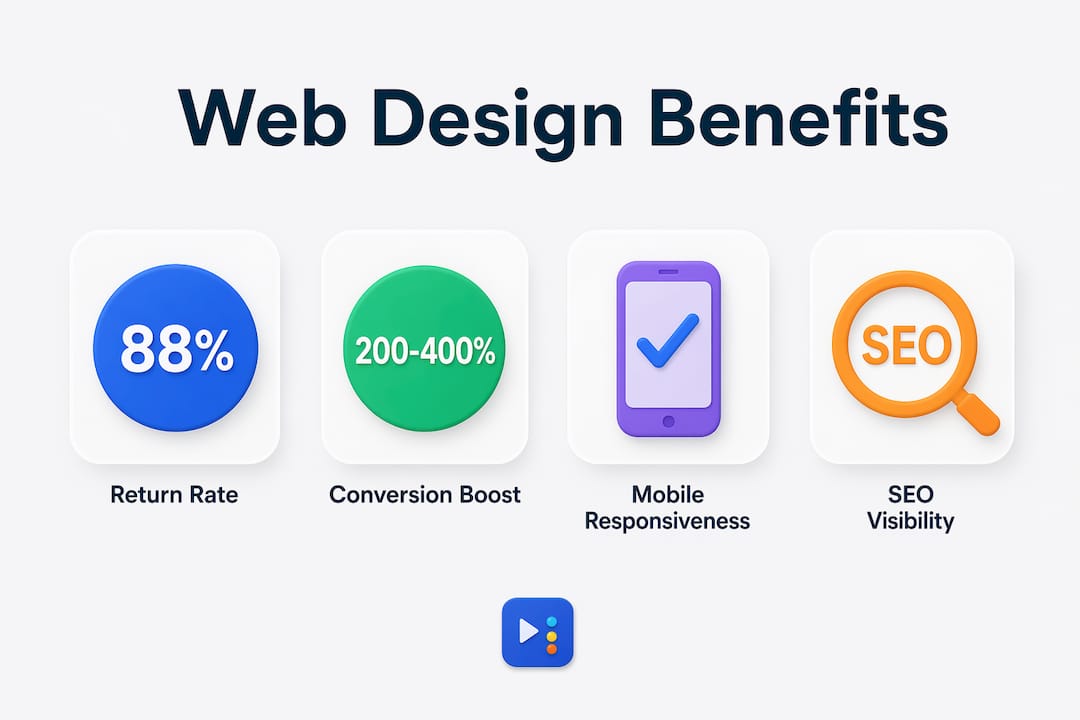
The importance of web design shows up immediately in customer behavior. 88% of online consumers are less likely to return to a site after a poor experience. That means one bad visit can permanently lose a customer. For a nail salon in Pflugerville or a med spa in Round Rock, that lost customer likely goes straight to a competitor with a cleaner, faster site.

Good web design strengthens brand credibility and engagement, which leads to more sales and customer loyalty. These are not soft benefits. They show up in your booking rate, your call volume, and your repeat customer numbers.
How does web design affect customer trust and perception?
Visual quality signals professionalism before a single word is read. A visitor lands on your homepage and forms an opinion in under a second. That judgment is based almost entirely on design: color choices, font clarity, image quality, and layout spacing. A cluttered or outdated site tells the visitor you may not be reliable. A clean, consistent site tells them you take your business seriously.
Consistent branding across your website reinforces recognition. When your logo, colors, and tone match across every page, customers feel they are dealing with a real, established business. That consistency is especially critical for service businesses like restaurants, contractors, and med spas where trust is the primary purchase driver.
Several design elements directly shape perception:
- Clear navigation menus that let visitors find services, pricing, and contact info in two clicks or fewer
- High-quality photos of your actual location, team, or products rather than generic stock images
- Readable typography with enough contrast and spacing to reduce eye strain
- Consistent color palette that matches your brand across every page
- Visible contact information in the header or a sticky bar so customers never have to hunt for it
Pro Tip: Place your phone number and a "Book Now" or "Get a Quote" button in the top right corner of every page. Visitors who are ready to buy should never have to scroll to find how to reach you.
How does user experience design impact sales and retention?
User experience (UX) design is the practice of organizing a website so visitors move naturally from interest to action. A strategic layout removes friction. Friction is anything that slows a visitor down or confuses them: buried menus, slow load times, forms with too many fields, or pages that do not work on a phone.
The sales impact of strong UX is measurable. Professional design can increase conversion rates by 200%–400% compared to poorly built sites. That means a site getting 500 visitors a month could go from 5 leads to 15 or 20 leads with no increase in ad spend. The traffic stays the same. The design does the work.
Four UX factors that directly affect your revenue:
- Mobile responsiveness. More than half of local searches happen on a phone. A site that breaks on mobile loses those visitors immediately.
- Page load speed. Slow sites frustrate visitors and hurt your Google ranking. Improving website speed is one of the fastest ways to recover lost traffic.
- Clear calls to action. Every page needs one obvious next step: call, book, buy, or contact.
- Accessible structure. Logical headings, alt text on images, and readable font sizes serve both visitors and search engines.
| UX Factor | DIY Builder Result | Professional Design Result |
|---|---|---|
| Mobile responsiveness | Often inconsistent | Fully tested across devices |
| Page load speed | Frequently slow due to bloated templates | Optimized for fast delivery |
| Navigation clarity | Generic template layouts | Custom flow built for your customer |
| Conversion elements | Basic buttons, limited placement | Strategic CTAs placed by behavior data |
Pro Tip: Run your current site through Google PageSpeed Insights. A score below 70 on mobile is costing you customers. That single fix often produces a measurable lift in leads within 30 days.
How does investing in web development support SEO?
Web design and SEO are not separate disciplines. They are the same investment viewed from two angles. Google uses user experience as a ranking factor that directly impacts where your site appears in search results. A site that loads slowly, breaks on mobile, or confuses visitors will rank lower, regardless of how good your content is.
The technical side of web design shapes your SEO in three specific ways:
- Site architecture. A well-organized site structure helps Google crawl and index your pages effectively, which improves rankings. Logical page hierarchies and internal linking tell Google what your site is about and which pages matter most.
- Mobile and speed optimization. Mobile responsiveness and fast load times improve both SEO rankings and visitor satisfaction. Google's mobile-first indexing means your phone version of the site is the one being evaluated.
- Clean code. Bloated or broken code slows crawling and can cause indexing errors that hide your pages from search results entirely.
The results of combining good design with SEO strategy are concrete. One documented case saw organic traffic grow from 800 to 4,300 visitors in five months after a targeted SEO and content strategy was paired with supporting design improvements. That is a 437% traffic increase without paid advertising.
For local businesses in Central Texas, the connection between design and local search visibility is direct. Homepage SEO strategies built into a well-designed site help you appear in the Google local map pack, where most local buying decisions are made. Local landing pages designed with proper structure and content further extend your reach across neighborhoods and service areas.
| Design Element | SEO Benefit |
|---|---|
| Fast load time | Lower bounce rate, higher Google ranking |
| Mobile-responsive layout | Passes Google's mobile-first index check |
| Logical page structure | Easier crawling, better indexing |
| Clean, minimal code | Faster rendering, fewer technical errors |
DIY vs. professional web design: which one actually grows your business?
DIY website builders like Wix, Squarespace, and GoDaddy Website Builder lower the barrier to getting online. That is their value. DIY builders are often cheaper upfront but come with limitations that affect branding and scalability over time. Those limitations are not always visible at launch. They show up six months later when you cannot add a booking system, your site slows down as you add pages, or your template looks identical to three competitors in your area.
Professional web design solves problems that templates cannot:
- Custom branding. A professional designer builds your site around your specific business identity, not a generic template shared by thousands of other sites.
- Scalability. Small businesses that invest in scalable web architecture handle higher traffic without expensive redesigns when they grow.
- Sales cycle efficiency. Professional design creates websites that convert visitors into leads around the clock, shortening the sales cycle and pre-qualifying visitors before they ever contact you.
- Technical SEO from day one. A professionally built site is structured for search engines from the start, not retrofitted later.
The cost comparison changes when you factor in lost leads. A DIY site that converts at 1% versus a professional site that converts at 3% means you are leaving two out of every three potential customers on the table. Over a year, that gap in web design ROI is almost always larger than the cost of professional design.
Key Takeaways
Investing in professional web design pays off through higher conversions, stronger SEO, and lasting brand credibility that DIY templates cannot replicate.
| Point | Details |
|---|---|
| Design drives conversions | Professional sites convert visitors at rates 200%–400% higher than poorly built ones. |
| First impressions are permanent | 88% of users will not return after a bad experience, making design a retention tool. |
| UX and SEO are linked | Google ranks sites partly on user experience, so good design directly improves search visibility. |
| DIY has a hidden cost | Template limitations hurt branding, scalability, and conversion rates over time. |
| Local businesses benefit most | Properly designed local sites rank in the map pack and attract nearby customers ready to buy. |
What I've learned from building sites for local businesses
Most small business owners I work with come to us after a DIY site has failed them quietly. They built something on Wix or Squarespace, it looked fine to them, and then nothing happened. No calls. No bookings. No growth. The site existed, but it was not working.
The pattern I see consistently is this: template sites are built for the owner, not the customer. The owner picks colors they like, writes content they feel proud of, and arranges pages in a way that makes sense to them. But the customer does not care about any of that. The customer wants to know, in under five seconds, whether you solve their problem and how to reach you.
Custom design forces that discipline. When we build a site for a nail salon in Pflugerville or a contractor in Cedar Park, we start with the customer's decision process, not the owner's preferences. What does someone searching "nail salon near me" need to see to book an appointment? That question shapes every layout choice.
The other thing I tell every client: tracking ROI for every design decision is what separates a website that grows with your business from one that just sits there. Set up Google Analytics. Track form submissions and calls. Know your conversion rate. When you treat your site as a measurable asset, you make better decisions about where to invest next.
Web design is not an expense. It is the foundation every other marketing investment sits on. Paid ads, Google Business Profile optimization, review generation. All of it performs better when the site it points to is built to convert.
— Tran
Ready to get a site that actually brings in customers?
At Yourlocalseo, we build websites for small businesses across Pflugerville, Austin, Round Rock, Georgetown, and the surrounding Central Texas area. Every site we design is built with local SEO baked in from the start, so you rank in local search and convert the visitors who find you.

We work with nail salons, med spas, restaurants, and service businesses that need a real online presence, not just a placeholder page. If your current site is not generating leads, we can show you exactly why and fix it. Visit Yourlocalseo to see how we approach web design for local businesses and get a clear picture of what a properly built site can do for your revenue.
FAQ
How much can web design improve my conversion rate?
Professional web design increases conversion rates by 200%–400% compared to poorly built sites. That means significantly more leads from the same amount of traffic.
Does web design really affect my Google ranking?
Yes. Google uses user experience as a ranking factor, so a slow, hard-to-navigate, or mobile-unfriendly site will rank lower than a well-designed competitor.
Is a DIY website good enough for a small business?
DIY builders work for getting online quickly, but they carry limitations in branding, speed, and scalability that hurt growth over time. Professional design delivers better long-term results for businesses focused on lead generation.
How does web design help local SEO?
A properly structured site with fast load times, mobile responsiveness, and local landing pages helps your business appear in Google's local map pack, where most nearby customers search and decide.
How do I know if my website is costing me customers?
Check your bounce rate in Google Analytics and run your site through Google PageSpeed Insights. A high bounce rate or a low speed score are clear signs your design is losing visitors before they convert.