

FAQ pages are defined as structured Q&A content that directly answers user queries, and they are one of the most underused assets in a small business SEO strategy. When you implement FAQ schema markup alongside well-researched questions, you give Google, Perplexity, and AI Overviews exactly what they need to surface your content in rich results, People Also Ask boxes, and AI-generated answers. The role of FAQs in SEO extends beyond simple keyword targeting. They signal topical authority, improve click-through rates, and increasingly determine whether your business gets cited by AI-driven search engines. For digital marketers and local business owners, that combination is hard to ignore.
How do FAQs improve search engine visibility and organic traffic?
FAQs improve search engine visibility by targeting long-tail question keywords that match exactly how real users type queries into Google. A nail salon in Pflugerville asking "how long does gel polish last" on its service page is competing for a specific, high-intent search that a generic paragraph about gel manicures would never capture. That precision is the core SEO advantage of FAQ sections.
The technical side matters just as much. FAQ schema markup in JSON-LD format signals directly to search engines that your content contains structured answers, increasing your eligibility for People Also Ask boxes and featured snippets. These rich results expand your presence on the search results page without requiring you to climb from position 5 to position 1. More screen space means more clicks, regardless of where you technically rank.

FAQ pages improve SERP real estate, increasing click-through rates even when traditional rankings stay flat. That means a well-structured FAQ section can drive measurably more traffic to a page that has not moved a single position in organic results. For small businesses working with limited SEO budgets, that is a significant return on a relatively small content investment.
The benefits of FAQs in SEO also extend into AI-driven search. LLM-driven engines prefer structured Q&A content, and by 2026, FAQ optimization has become foundational for visibility in Google AI Overviews and tools like Perplexity. If your answers are clear, concise, and directly extractable, AI systems will pull them as citations, which builds brand authority with high-intent visitors.
- FAQ content captures long-tail queries that standard page copy misses
- JSON-LD schema increases eligibility for People Also Ask and featured snippets
- Rich results expand SERP real estate and lift click-through rates without ranking changes
- Structured Q&A format aligns with how AI search engines extract and cite answers
Pro Tip: Use Google Search Console's "Queries" report to find questions your pages already rank for but do not explicitly answer. Those are your highest-priority FAQ candidates.
What are the best practices for creating effective FAQs for SEO?
Effective FAQ content starts with real data, not guesswork. Pulling questions from authentic customer data, such as support tickets, live chat logs, and Google Search Console queries, produces FAQs that address genuine user intent rather than what you assume customers are asking. A med spa in Austin that mines its booking inquiry emails will find questions like "do you offer payment plans for laser treatments" that no keyword tool would surface.
Follow this process to build FAQs that rank and convert:
- Gather real questions. Export your top queries from Google Search Console, review your support inbox, and check the "People Also Ask" boxes for your main service pages. These three sources alone will give you more material than you can use.
- Write concise answers. Optimal FAQ answer length is 40 to 60 words, starting with a direct response to the question. Do not bury the answer in context or background. Lead with the fact, then add one sentence of supporting detail.
- Group questions under clear subheadings. Grouping FAQs by topic with descriptive subheadings helps search engines interpret the content structure and improves snippet eligibility. A restaurant FAQ page might separate "Reservations," "Menu," and "Dietary Options" into distinct clusters.
- Implement FAQ schema in JSON-LD. Google recommends JSON-LD format, and implementing FAQ schema takes under 30 minutes using plugins like Yoast SEO or RankMath. The schema must exactly match the visible text on the page. Any mismatch risks a manual penalty.
- Update FAQs regularly. Search behavior shifts. A question that drove traffic in 2024 may no longer reflect how users phrase their queries in 2026. Schedule a quarterly review of FAQ performance in Google Search Console and retire or rewrite answers that have stopped generating impressions.
- Measure and iterate. Track FAQ-specific performance by monitoring impressions, clicks, and average position for question-format queries in Search Console. If a question generates impressions but few clicks, rewrite the answer to be more compelling in the snippet preview.
Pro Tip: Write each FAQ answer as if it will be read aloud by a voice assistant. If it sounds natural and complete as a standalone response, it is ready for both featured snippets and voice search.
FAQ placement and format: standalone page vs. integrated sections
Where you place your FAQs determines how much SEO value they generate. A standalone FAQ page consolidates all your Q&A content in one place, which makes it easy to manage and link to. However, it often lacks the topical context that search engines use to determine relevance. A generic FAQ page covering every aspect of your business tends to rank for nothing specific.
Integrated FAQ sections, placed directly on service pages, product pages, or blog posts, perform better for targeted SEO because they reinforce the topical authority of that specific page. A roofing company that adds a FAQ section to its "roof replacement cost" page answers the follow-up questions users have after reading the main content. That keeps users on the page longer and signals to Google that the page comprehensively covers the topic. FAQs used across landing pages, product pages, and blogs strengthen internal linking and user engagement across the entire site.
The table below compares both formats across the dimensions that matter most for SEO and user experience.
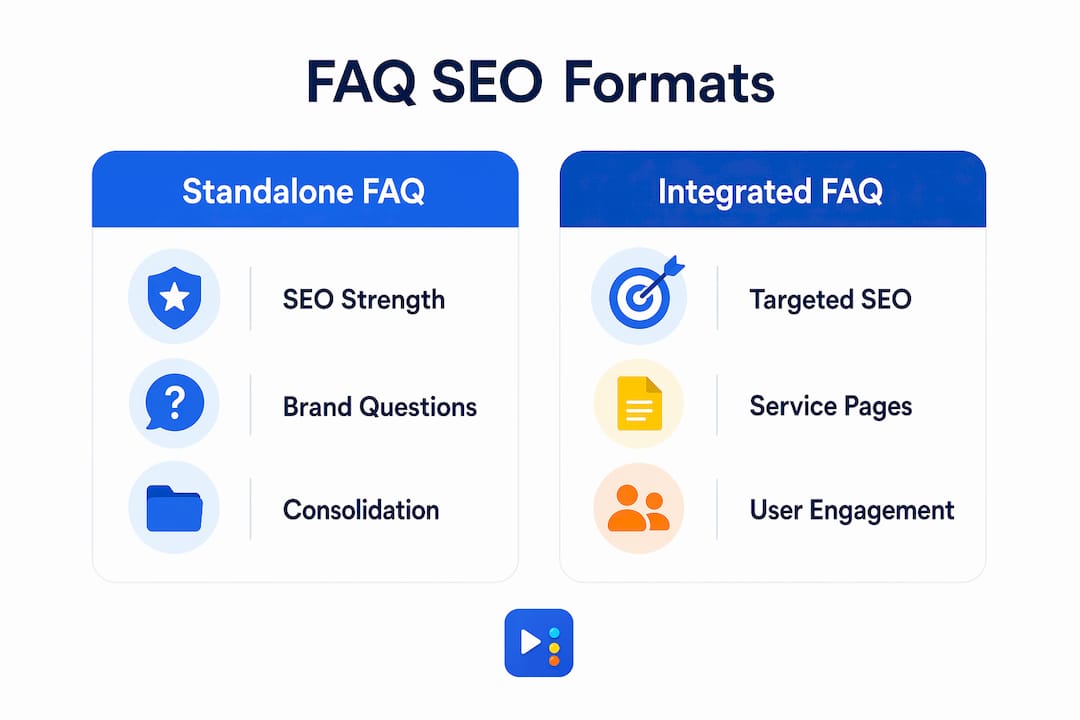
| Format | SEO strength | Best use case | Key limitation |
|---|---|---|---|
| Standalone FAQ page | Consolidates schema, easy to link | Brand-level or general service questions | Low topical relevance for specific queries |
| Integrated FAQ section | Reinforces page authority, targets micro-intents | Service pages, product pages, blog posts | Requires more content planning per page |
| Hybrid approach | Covers both general and specific intents | Larger sites with multiple service categories | Higher maintenance overhead |
The hybrid approach works best for most small businesses. Keep a lean standalone FAQ page for brand-level questions like pricing, hours, and service areas. Then add topic-specific FAQ sections to your highest-traffic service pages. This structure supports local landing page SEO by giving each page its own layer of question-based content that matches local search queries.
Common pitfalls to avoid when using FAQs for SEO
The most damaging FAQ mistake is writing questions based on assumptions rather than data. When you guess what customers are asking, you produce content that answers questions nobody is searching for. That content generates zero impressions, zero clicks, and zero leads. The fix is straightforward: use Search Console, customer emails, and tools like Automateed to validate every question before you write the answer.
Keyword stuffing is the second most common error. Separating FAQ content to cover secondary micro-intents keeps your main page copy focused and authoritative. When you force primary keywords into every FAQ answer, you dilute both the user experience and the page's topical signal. Each FAQ answer should use natural language that mirrors how a customer would actually ask the question, not how an SEO checklist would phrase it.
Watch for these specific mistakes that undermine FAQ SEO value:
- Schema mismatch. Your JSON-LD markup must exactly match the visible text on the page. If the schema says one thing and the page displays another, Google treats it as deceptive markup and may apply a manual action.
- Thin answers. A one-sentence answer that says "Yes, we offer that service" provides no value to users or search engines. Every answer needs enough substance to stand alone as a useful response.
- Overloading a single page. Adding 40 FAQs to one page creates a wall of content that confuses both users and crawlers. Keep FAQ sections to 5 to 10 questions per page, focused on that page's specific topic.
- Treating FAQs as a replacement for core content. FAQs support your main content by covering secondary questions. They do not replace well-written service descriptions, case studies, or location pages. A FAQ section on a page with thin primary content will not rescue that page's rankings.
Avoiding these errors is part of local SEO best practices that separate businesses that grow their search presence from those that spin their wheels.
Key takeaways
FAQs improve SEO rankings and organic traffic by combining targeted question content, structured schema markup, and AI-ready answer formatting that search engines can extract and cite directly.
| Point | Details |
|---|---|
| FAQ schema drives rich results | JSON-LD markup increases eligibility for People Also Ask boxes and featured snippets. |
| Answer length matters | Keep FAQ answers between 40 and 60 words, leading with a direct response. |
| Data beats guesswork | Source questions from Search Console, support tickets, and live chat logs. |
| Placement shapes SEO value | Integrated FAQ sections on service pages outperform standalone pages for topical authority. |
| Schema must match visible content | Any mismatch between JSON-LD markup and on-page text risks a Google manual penalty. |
FAQs are a long-term content asset, not a quick fix
I have worked with enough small businesses to know that most of them treat FAQs as an afterthought. They add a generic Q&A block at the bottom of a page, never update it, and wonder why it does not move the needle. That approach misses the point entirely.
What I have found is that FAQs work best when they are treated as a living content layer, one that evolves with your customers' actual questions. The businesses that see real results from FAQ SEO are the ones reviewing their Search Console data every quarter and rewriting answers that have gone stale. They are also the ones adding FAQ sections to every new service page from day one, not retrofitting them six months later.
The AI search angle is not hype. AI-driven search engines increasingly cite FAQ content as authoritative sources, and being cited in a Google AI Overview or a Perplexity answer puts your brand in front of high-intent users who are close to making a decision. That kind of visibility does not come from ranking number one for a broad keyword. It comes from having the clearest, most direct answer to a specific question.
My recommendation: start with your five most common customer questions, write tight 50-word answers, add JSON-LD schema, and measure the impact over 60 days. You will see the data before you commit to a larger FAQ strategy. That is how we approach it at Yourlocalseo, and it is how we recommend our clients approach it too.
— Tran
Let Yourlocalseo build your FAQ SEO strategy
At Yourlocalseo, we handle FAQ schema implementation, on-page SEO, and local search rankings for small businesses across Pflugerville, Austin, Round Rock, and the surrounding Central Texas area. We know what questions your customers are actually asking because we research your market before we write a single word.

Whether you run a nail salon, a med spa, or a service-based business, we build FAQ content that targets real search queries and gets your pages into rich results. From JSON-LD schema setup to improving your Google ranking with structured content, every tactic we use is tied to leads, not vanity metrics. Contact us today to find out what a targeted FAQ strategy can do for your visibility.
FAQ
Why use FAQs for SEO on service pages?
FAQs on service pages target the follow-up questions users have after reading your main content, capturing long-tail queries and increasing time on page. They also qualify for People Also Ask boxes and featured snippets, expanding your SERP presence without requiring a ranking change.
Does FAQ schema markup actually help rankings?
FAQ schema in JSON-LD format does not directly improve your ranking position, but it significantly increases your eligibility for rich results that drive more clicks. The schema tells Google and AI search engines exactly where your structured answers are, making your content easier to extract and cite.
How long should FAQ answers be for SEO?
The optimal FAQ answer length for SEO and featured snippets is 40 to 60 words. Start with a direct response to the question, then add one sentence of supporting context. Answers shorter than 40 words often lack enough substance for Google to use as a snippet.
Where is the best place to put FAQs on a website?
Integrated FAQ sections on individual service or product pages generate more targeted SEO value than a single standalone FAQ page. For maximum coverage, use both: a lean standalone page for general brand questions and topic-specific FAQ sections on your highest-traffic service pages.
Can FAQs help with AI search visibility?
Yes. LLM-driven search engines like Google AI Overviews and Perplexity prefer structured Q&A content because it is easy to extract and cite. Writing clear, concise FAQ answers with proper schema markup gives your content the best chance of appearing in AI-generated search responses.