

Keyword mapping for SEO is the process of assigning specific target keywords to individual pages on your website so each page targets a distinct search intent and competes for rankings without internal conflict. Think of it as the organizational backbone of your entire SEO keyword strategy. According to Semrush and HubSpot, keyword mapping assigns target keywords grouped by intent to the most relevant existing or planned URLs, recorded in a keyword map document. Without this structure, your pages end up competing against each other, diluting your rankings and confusing search engines about which page deserves to rank. Tools like SEMrush, Ahrefs, and even a simple Google Sheets spreadsheet are the most common aids for building and maintaining a keyword map.
What is keyword mapping for SEO and how does it work?
Keyword mapping starts with keyword research, but it does not stop there. Keyword research is distinct from keyword mapping; research surfaces opportunities, while mapping applies strategy by assigning those keywords to specific pages and prioritizing them. The two processes work together, but confusing them is one of the most common mistakes small business owners make when starting out with SEO.
The practical process follows a clear sequence:
- Gather your keyword list. Pull keywords from Google Keyword Planner, Ahrefs, or SEMrush. Focus on terms relevant to your services, locations, and customer questions.
- Cluster by intent and topic. Group keywords that share the same dominant search intent, whether informational, commercial, or transactional. Keywords in the same cluster belong on the same page.
- Assign one primary keyword per page. Each page gets one primary keyword that defines its core purpose. Assign one primary keyword and 2-5 secondary keywords per page to fully cover the page's intent without overloading it.
- Document in a spreadsheet or template. A spreadsheet-based keyword map lists each page URL alongside its primary keyword, secondary keywords, search intent type, search volume, and notes. This document becomes your single source of truth.
- Validate against search intent. Check the actual Google search results for your primary keyword. The pages ranking on page one tell you what content format and intent Google expects. Match that pattern.
Pro Tip: Before assigning keywords to new pages, check whether an existing page already targets that keyword. Merging or redirecting a weaker duplicate page is almost always more effective than creating a third competing page.
Mapping keywords by intent stages such as informational, transactional, and commercial reduces overlap by matching page type to the dominant query intent. A blog post answering "how to choose a nail salon" serves informational intent. A service page for "nail salon in Pflugerville TX" serves transactional intent. Both can live on the same site without conflict because they target different intent stages.

Why is keyword mapping important for your SEO results?
Keyword mapping solves problems that quietly destroy SEO performance for small businesses and digital marketers alike. The most damaging of these is keyword cannibalization. Keyword mapping prevents cannibalization by ensuring no two pages target the same keyword and intent combination, which would otherwise dilute ranking signals and confuse search engines about which page to surface.
Here is what keyword mapping directly improves:
- Ranking clarity. Search engines receive a clear signal about which page owns which keyword, reducing ranking volatility across your site.
- Content gap identification. When you map your existing pages, you quickly see which customer questions or service terms have no page assigned to them. Those gaps are your next content opportunities.
- Site architecture and internal linking. Keyword maps feed directly into internal linking strategy, helping define pillar pages and cluster pages and clarifying where links should flow to reinforce page ownership.
- User experience. Each page satisfies a specific search intent, so visitors land on content that directly answers their query rather than a generic page that sort of covers everything.
- Local SEO precision. Local businesses benefit from keyword mapping by clarifying ownership for local service and location combinations, preventing internal competition between, say, a "Round Rock plumber" page and an "Austin plumber" page that both try to rank for the same terms.
"Cannibalization is best treated as a page ownership problem. Consolidate or differentiate pages so each has a unique keyword and intent. Ranking two pages for the same query does not double your traffic. It splits it." — Search Engine Land
The importance of keyword mapping becomes most visible when you audit a site that has grown without one. You typically find three or four blog posts all targeting the same keyword, none of them ranking well, and a service page buried under the weight of competing signals. A keyword map prevents that from happening in the first place.
Common keyword mapping techniques and best practices
The most reliable keyword mapping techniques share one principle: one page, one primary intent. Everything else flows from that rule.
Cluster by semantic similarity first
Group keywords that share meaning and intent before assigning them to pages. "Nail salon near me," "nail salon Pflugerville," and "best nail salon in Pflugerville TX" all belong to the same cluster because a single page can satisfy all three. Assign that cluster to one page, designate the highest-volume term as the primary keyword, and treat the others as secondary supporting terms.
Use a comparison table to assign cluster ownership
When keyword clusters overlap, assign cluster ownership based on priority metrics like search volume, then treat remaining cluster keywords as secondary terms. The table below shows how this works in practice:
| Keyword cluster | Primary keyword (highest volume) | Secondary keywords | Assigned page |
|---|---|---|---|
| Nail salon local intent | nail salon Pflugerville TX | nail salon near me, best nail salon Pflugerville | /services/nail-salon-pflugerville |
| Med spa services | med spa Austin TX | med spa treatments Austin, facial spa Austin | /services/med-spa-austin |
| Restaurant local search | restaurants in Round Rock TX | best restaurants Round Rock, dinner Round Rock | /locations/round-rock |
Enforce ownership through internal linking
Your keyword map should also serve as the rule book for internal linking. Use your keyword map as the authoritative source for target keywords and internal link rules. When you write a new blog post, link back to the page that owns the relevant primary keyword using that keyword as anchor text. This consistently reinforces page ownership to search engines.
Fix existing cannibalization with redirects or consolidation
If you already have multiple pages competing for the same keyword, consolidate the weaker pages into the strongest one and apply 301 redirects. This transfers ranking signals to a single page and eliminates the internal competition. Do not simply delete the weaker pages without redirecting them, or you lose whatever authority those URLs had accumulated.
Pro Tip: Audit your keyword map every three to six months. Search intent shifts, new competitors enter your market, and your own service offerings change. A keyword map that was accurate in January may be outdated by July.
How to implement keyword mapping in your SEO workflow
Building your first keyword map does not require expensive software. Here is a step-by-step process that works for small businesses and digital marketers at any level.
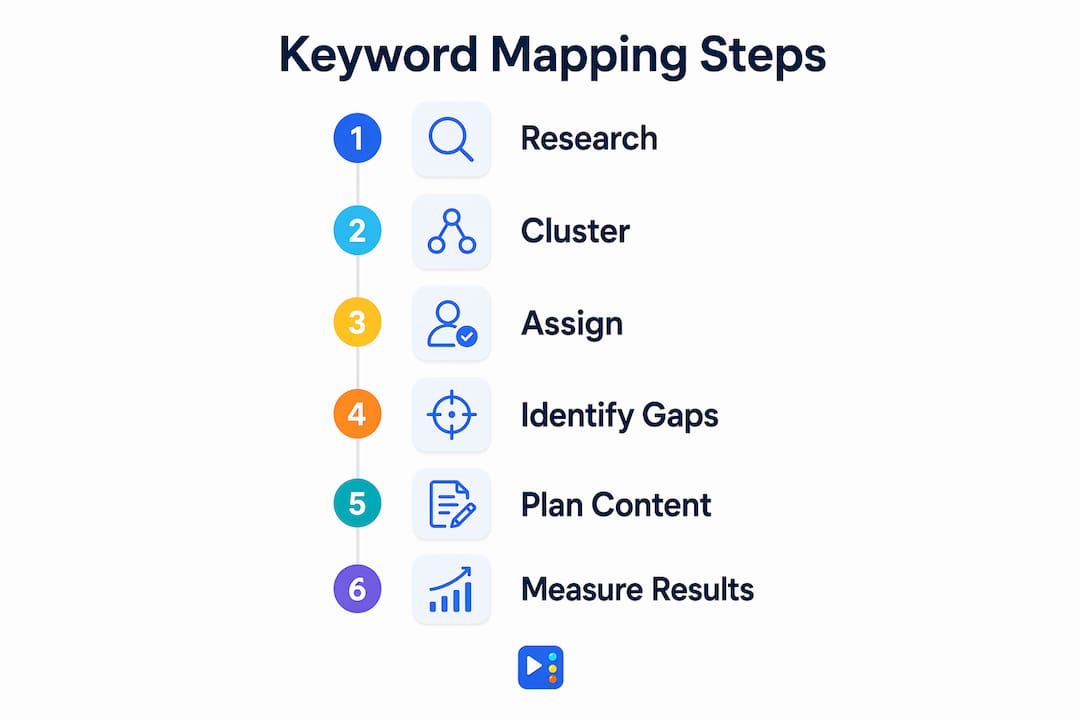
Step 1: Run keyword research. Use Google Keyword Planner for free volume data, or use Ahrefs and SEMrush for deeper competitive analysis. Pull at least 50 to 100 keywords relevant to your services and locations.
Step 2: Build your spreadsheet template. Create columns for the following data points:
| Column | What to include |
|---|---|
| Page URL | The existing or planned URL for this page |
| Primary keyword | One main keyword that defines the page's purpose |
| Secondary keywords | Two to five related terms that support the primary |
| Search intent | Informational, commercial, transactional, or navigational |
| Monthly search volume | Estimated monthly searches for the primary keyword |
| Notes | Cannibalization flags, content gaps, redirect needs |
Step 3: Assign keywords to existing pages first. Map your current pages before planning new content. This surfaces cannibalization issues and content gaps immediately.
Step 4: Identify gaps and plan new pages. Any keyword cluster with no assigned page is a content gap. Prioritize gaps by search volume and commercial relevance. A local landing page for each service and location combination is often the highest-priority gap for local businesses.
Step 5: Integrate with content planning and on-page SEO. Every new page you create should start from the keyword map. The primary keyword goes in the title tag, H1, meta description, and first paragraph. Secondary keywords appear naturally in subheadings and body copy.
Step 6: Measure results. Measuring keyword mapping results over 3-6 months shows improvements in organic traffic, rankings, and reduction of cannibalization problems. Track which URL ranks for each primary keyword in Google Search Console and watch for ranking stabilization on a single page per cluster.
Key takeaways
Keyword mapping is the single most effective way to organize your SEO strategy so every page on your site works toward a distinct ranking goal rather than competing against itself.
| Point | Details |
|---|---|
| One page, one primary intent | Assign one primary keyword per page to eliminate internal competition and ranking confusion. |
| Cannibalization prevention | Map keywords before creating new pages to avoid multiple pages splitting ranking signals for the same query. |
| Spreadsheet as source of truth | Document every URL, primary keyword, secondary keywords, intent, and volume in one shared file. |
| Internal linking alignment | Use your keyword map to direct internal links toward the page that owns each primary keyword. |
| Review every 3-6 months | Keyword maps become outdated as your business grows and search intent evolves. Schedule regular audits. |
Why keyword mapping changed how I approach every SEO project
I have worked on local SEO for businesses across Pflugerville, Austin, and Round Rock, and the single most consistent finding is this: sites that struggle to rank almost always have a keyword structure problem, not a content quality problem. They have good pages. Those pages just happen to be fighting each other.
The shift that changed my approach was treating keyword mapping as a living document rather than a one-time setup task. Early on, I would build a map at the start of a project and consider it done. Then six months later, a client would add three new service pages without consulting the map, and suddenly we had cannibalization problems all over again. Now the map is the first thing we open in any content meeting.
The other thing most guides do not tell you is that keyword mapping is where your local SEO workflow either holds together or falls apart. You can have perfect Google Business Profile optimization and strong citations, but if your website pages are competing for the same local keywords, you are leaving rankings on the table. The map is what connects keyword research to actual on-page execution.
Start simple. A ten-row spreadsheet covering your core service pages is more valuable than a complex system you never maintain. Scale the complexity only when the simple version stops being enough.
— Tran
Let Yourlocalseo build your keyword map and local SEO strategy

Yourlocalseo works with small businesses across Pflugerville, Austin, Round Rock, and Central Texas to build SEO strategies that drive real leads. We handle keyword research, keyword mapping, on-page optimization, and Google Business Profile management so your pages rank for the right terms in the right locations. If you are spending time on content without a clear keyword structure behind it, you are working harder than you need to. Our team builds custom keyword maps as part of every local SEO services engagement, giving your site a clear, organized foundation from day one. Reach out to Yourlocalseo and let us show you exactly which keywords your pages should own.
FAQ
What is keyword mapping in SEO?
Keyword mapping is the process of assigning target keywords to specific pages on your website based on search intent, recorded in a keyword map document. Each page receives one primary keyword and two to five secondary keywords to guide on-page optimization.
How does keyword mapping prevent cannibalization?
Keyword cannibalization occurs when two or more pages on the same site target the same keyword and intent, splitting ranking signals. Keyword mapping prevents this by assigning clear ownership of each keyword to a single page.
What tools do I need to create a keyword map?
Google Keyword Planner, Ahrefs, and SEMrush provide the keyword data you need. A Google Sheets or Excel spreadsheet is sufficient to build and maintain the actual map, though SEMrush also offers a dedicated keyword mapping template.
How often should I update my keyword map?
Reviewing your keyword map every 3-6 months is the recommended practice. Updates should also happen whenever you add new service pages, enter new markets, or notice ranking drops that suggest intent shifts.
Is keyword mapping only for large websites?
Keyword mapping benefits sites of any size. Small business websites with as few as ten pages gain immediate value from mapping because it prevents cannibalization and clarifies which pages to prioritize for local keyword research and optimization.