

Your Pflugerville business could be doing everything right, offering great services, collecting solid reviews, and maintaining a clean website, yet still not showing up when local customers search on Google. The problem is often not your business itself. It's that your online presence isn't speaking the language your customers are actually using. Local keyword research is the process of identifying the exact words and phrases people type when searching for nearby services, including geo-intent modifiers like "near me," city names, and ZIP codes. This guide walks Texas small business owners through every step of doing it right.
Table of Contents
- What is local keyword research?
- Essential tools and requirements for effective research
- Step-by-step workflow: Finding the best local keywords
- Mistakes to avoid and advanced strategies
- Why conversion-focused keyword research wins for Texas local SEO
- Unlock your local SEO potential with expert help
- Frequently asked questions
Key Takeaways
| Point | Details |
|---|---|
| Local intent matters | Focus on keywords reflecting your specific city, neighborhood, or area for higher-quality leads. |
| Tools guide your process | Leverage dedicated SEO tools and filters to find exactly what locals search for in your region. |
| SERP features guide strategy | Always check the actual Google results for a keyword to see what page type ranks—maps, directories, or regular website listings. |
| Conversion trumps volume | Prioritize keywords that signal buyer intent over those with just high search counts. |
| Regular updates are critical | Revisit and refine your keyword list monthly to keep up with shifting local trends and competition. |
What is local keyword research?
Local keyword research means finding the specific search phrases your nearby customers use when they need what you offer. It's not just about identifying popular industry terms. It's about understanding the where and why behind each search.
Think about the difference between someone searching "nail salon" versus "nail salon in Pflugerville TX." The second person is ready to book. They know what they want and where they want it. That's the searcher your business needs to connect with.
Local keyword research for local SEO centers on geo-intent modifiers. These are location signals attached to search queries, things like:
- City names: "Round Rock med spa," "Austin HVAC repair"
- Neighborhood references: "Pflugerville nail salon near Blackhawk"
- "Near me" phrases: "best plumber near me"
- ZIP code targeting: "restaurants 78660"
This approach differs significantly from national keyword research. A national strategy focuses on high search volume terms that attract visitors from across the country. A local strategy targets much smaller search volumes, but those searches carry strong purchase intent from people within your actual service area. For a small business in Pflugerville or Georgetown, ranking for a phrase that gets 200 local searches per month is far more valuable than ranking nationally for something with 20,000 searches.
Google SERP behavior matters for local keywords because Google actively adjusts what it shows based on user intent. A search with strong local intent will trigger the local map pack, those three prominent business listings at the top of results. A more informational query might show blog posts or directories instead. Understanding which type of result appears for your target keywords shapes your entire strategy.
"The goal isn't to rank for the most searches. It's to rank for the right searches, the ones your best customers are actually making."
Good homepage SEO for visibility starts with understanding exactly which local terms drive qualified traffic. And improving Google rankings becomes far more achievable when you're targeting keywords that actually match what local searchers type.
Essential tools and requirements for effective research
Understanding the goal is one thing. Having the right tools and preparation is another. Let's walk through what you need before you dive in.
You don't need to spend a fortune on tools to do solid local keyword research. Some of the most useful options are free or low cost. Here's a quick overview:
| Tool | Key feature | Best for | Cost |
|---|---|---|---|
| Google Keyword Planner | Location-based volume estimates | Budgeting and initial research | Free |
| Google Autocomplete | Real-time search suggestions | Finding natural language phrases | Free |
| Google Search Console | Tracks what queries bring traffic to your site | Monitoring and refining | Free |
| Semrush Keyword Magic Tool | Deep keyword expansion with filters | Keyword research at scale | Paid (free tier available) |
| Moz Keyword Explorer | Keyword difficulty and opportunity scoring | Competitive benchmarking | Paid (free tier available) |
| BrightLocal | Hyper-local rank tracking | Tracking by city and ZIP | Paid |
Before you open any tool, gather this information about your business:
- Your primary service area: List every city, neighborhood, or ZIP code you serve. For most Pflugerville businesses, this includes Pflugerville itself, Austin, Round Rock, Cedar Park, Manor, and potentially Georgetown or Hutto.
- Your core services: Break down exactly what you offer. A med spa might list lip filler, Botox, chemical peels, and laser hair removal as separate services rather than just "med spa treatments."
- Your ideal customer profile: Are they homeowners? Young professionals? Families? This helps you match tone and intent.
Pro Tip: Build a separate keyword tracking list for each city you serve. A keyword that performs well in Pflugerville may not behave the same in Austin due to different competition levels and search volumes. Semrush's position tracking feature lets you monitor rankings per city, which is invaluable for multi-location or multi-city strategies.
Explore the local SEO tools available specifically for Central Texas businesses to find what fits your budget and goals.

Step-by-step workflow: Finding the best local keywords
With your tools and prep in place, you're ready to dig in. Here's exactly how to uncover and vet the best keywords for your business.
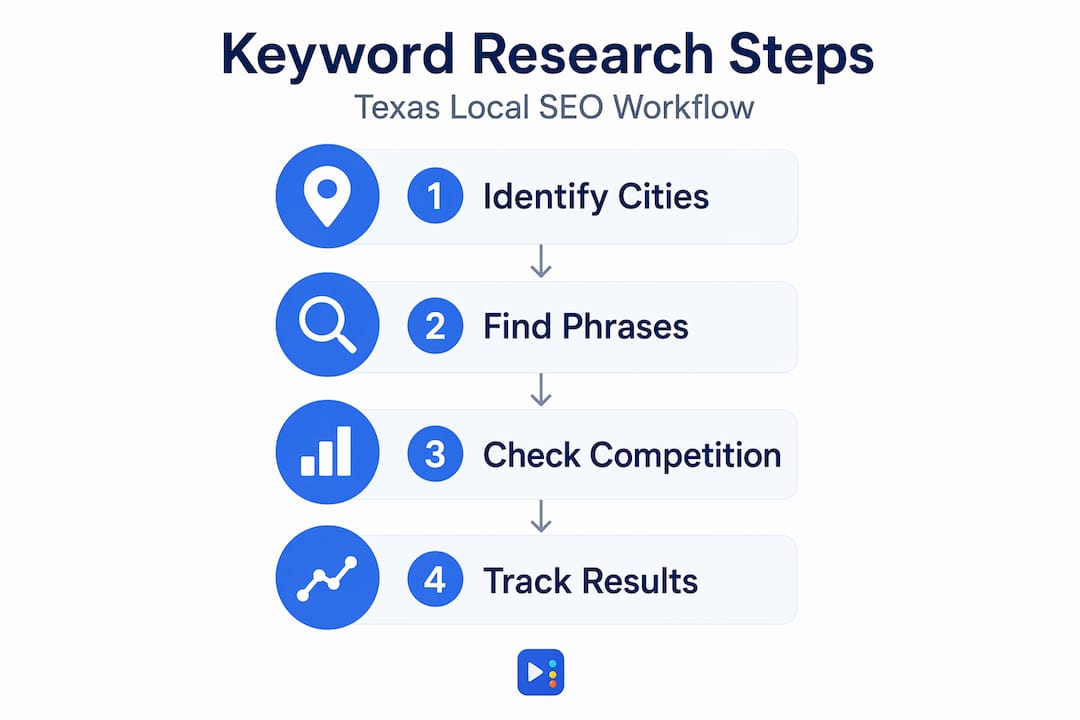
A repeatable local SEO keyword workflow follows a clear progression from broad ideas to targeted, actionable phrases mapped to specific pages on your website.
-
Define your realistic service area. Be honest about where you actually serve customers. Listing 30 cities when you primarily serve three dilutes your focus and credibility.
-
Generate seed keywords. Start with the simplest possible description of each service. "Roof repair," "dog grooming," "tax prep," "eyebrow threading." These are your starting points, not your final targets.
-
Expand with tools and autocomplete. Type each seed keyword into Google and note the autocomplete suggestions. These reflect real search behavior. Then run each seed through your keyword tool of choice to surface related terms, questions, and long-tail variations.
-
Add geo-modifiers. Attach location signals to your expanded list: city names, "near me," neighborhood names, and ZIP codes. "Tax prep Pflugerville," "tax accountant near me Round Rock," "small business CPA 78660."
-
Map each keyword to a page type. Semrush's location-specific research helps you understand which keywords should live on service pages versus your Google Business Profile versus location landing pages.
-
Analyze SERP features. Search each keyword manually in an incognito window set to your target city. Note whether the results show a map pack, organic listings, or a mix. Keywords that trigger the map pack need a strong Google Business Profile strategy. Keywords showing organic blog results need content-driven pages.
Here's how this workflow compares to the approach many businesses take without a strategy:
| Approach | Traditional (unfocused) | Conversion-driven (local) |
|---|---|---|
| Keyword targeting | High-volume generic terms | Low-volume, high-intent local phrases |
| Geographic precision | Statewide or national | City, neighborhood, or ZIP level |
| Page mapping | Guess and check | SERP-informed page strategy |
| Measurement | Rankings alone | Calls, bookings, and form fills |
| Modifier use | Limited to "near me" | City names, ZIP codes, landmarks, neighborhoods |
| Content focus | Broad industry topics | Service plus location combinations |
Pro Tip: Build a modifier library that goes beyond "near me." For Pflugerville businesses, useful modifiers include "Pflugerville," "near Stone Hill Town Center," "78660," "north Austin area," and "near Typhoon Texas." These hyper-local phrases have lower competition and attract searchers with very specific intent.
Follow a proven local SEO workflow to put this keyword research into a system that delivers consistent results over time.
Mistakes to avoid and advanced strategies
Following the basics is great, but avoiding common missteps and leveling up with advanced strategies sets your business apart.
Many Texas small businesses put real effort into keyword research but still underperform because of avoidable errors. Here are the most common ones we see:
- Using national data without location filters. A keyword tool showing 10,000 monthly searches means nothing if those searches happen in New York. Always filter to your city or state.
- Targeting only high-volume phrases. "Best restaurant in Texas" might get searched 5,000 times per month, but a small Pflugerville bistro has zero chance of ranking for it. Target phrases where you can realistically compete.
- Ignoring search intent. A page optimized for "how to fix a leaky faucet" will attract DIYers, not people ready to hire a plumber. Separate informational keywords from commercial intent keywords and build pages accordingly.
- Poor mapping between keywords and page types. If a keyword triggers map pack results, no amount of on-page SEO for a blog post will get you to position one. You need a strong Google Business Profile and local citations instead.
- Neglecting to refresh your keyword list. Search behavior changes. New neighborhoods develop, new competitors arrive, and seasonal patterns shift demand. A keyword list that was accurate six months ago may be outdated today.
For advanced strategy, competitor analysis is one of the most effective and underused tactics. Analyzing competitor keyword overlaps with tools like Moz's Keyword Gap feature reveals which search phrases your competitors rank for that you don't. These gaps represent direct opportunities to capture traffic and leads your competitors are currently taking from you.
"Don't just look at search volume. Look at what the SERP actually shows for each keyword. That tells you exactly what Google thinks the user wants, and that's what you need to deliver."
Running a thorough competitive analysis for local SEO also helps you spot patterns in how your market positions itself, revealing angles you can own. And once your keywords are in place, monitoring search rankings consistently tells you which strategies are working and which need adjustment.
One advanced consideration specific to the Texas market: city versus ZIP code targeting can produce very different results. Pflugerville spans multiple ZIP codes, and so does the greater Austin area. Searchers in Manor may use very different language than those in Cedar Park, even if they're both within your service range. Testing both city-name and ZIP-based keywords for each service area gives you a more complete picture of local demand.
Why conversion-focused keyword research wins for Texas local SEO
Now that you understand both the techniques and the traps, here's a perspective most SEO guides miss.
The conventional wisdom in most keyword research articles is straightforward: find keywords with high search volume, low competition, and target those. It sounds logical. But for small businesses in Pflugerville, Round Rock, or Cedar Park, chasing volume is the wrong game.
We've worked with businesses that ranked on page one for terms getting hundreds of monthly searches and barely saw a phone call. We've also helped businesses rank for phrases with fewer than 50 local monthly searches and watched those rankings generate consistent weekly bookings. The difference wasn't volume. It was conversion intent.
When someone types "nail salon Pflugerville open now," they're not browsing. They have their phone in hand, they're probably in their car, and they're ready to walk through a door. That query might get 30 searches a month. But if you capture 20 of those searchers, and 15 of them become customers, that single phrase drives real revenue.
Broad informational queries work differently. "How to prepare for a facial" might attract curiosity-driven readers who bookmark your article and never return. That's not worthless, but it shouldn't be your primary focus if you're trying to grow a local med spa in Cedar Park.
We also push back against over-indexing on map pack optimization at the expense of organic strategy, or vice versa. The truth is, some of your best target keywords will trigger map results, and some will favor organic listings. A smart keyword strategy accounts for both and builds content and profiles to match what each SERP demands.
Every Texas market behaves a little differently too. Pflugerville is growing fast, which means new competitors enter the market frequently and search demand for local services increases. Round Rock has a more established competitive landscape. Austin is hyper-competitive across almost every category. Your keyword strategy needs to reflect the specific competitive reality of your service area, not a generic statewide template.
Test, measure, and adapt. The businesses that win in local search aren't the ones who found a perfect keyword list once. They're the ones who review their rankings monthly, watch for new opportunities, and adjust their content and Google Business Profile to match what's actually working in their market.
Unlock your local SEO potential with expert help
Keyword research is the foundation of everything that follows in local SEO, from the pages you build to how you optimize your Google Business Profile. But knowing the process is different from having the time, tools, and experience to execute it consistently.

At ourLocalSEO, we specialize in helping Texas small businesses, nail salons, med spas, restaurants, and service providers across Pflugerville, Austin, Round Rock, and surrounding communities, get found by the customers who are ready to buy. We bring hands-on local market knowledge to every keyword strategy we build. If you want to put this guide into action faster, explore our Pflugerville local SEO services or get a full picture of how local search works with our local SEO guide. We'd love to help your business show up where it matters most.
Frequently asked questions
What are geo-modifiers and why do they matter in local keyword research?
Geo-modifiers are location-based words like city names, "near me," or ZIP codes that connect your business to searches happening in your area. Including these signals helps Google match your business to local demand and filters out irrelevant national traffic.
How often should I update my local keyword list?
Review and update your keyword list monthly to catch shifts in demand, new competitors, and changes in SERP features. A repeatable research workflow makes this faster and more consistent over time.
Can I use national keyword tools for local research?
Yes, but always apply city or ZIP code filters and prioritize keywords based on local volume and intent. Semrush's location filters let you view search data specific to your market rather than relying on national averages.
How do I know if a keyword will get my business in the local map pack?
Search your target keyword manually in an incognito browser window. If map results dominate the top of the page, it's a strong candidate for Google Business Profile optimization rather than purely on-page SEO.
Why should I analyze my competitors for keyword opportunities?
Competitor keyword analysis reveals search phrases your rivals rank for that you currently miss, creating direct opportunities for more traffic and leads. Identifying keyword gaps using tools like Moz puts you in a position to capture demand your competitors are currently monopolizing.