

Updating website content is defined as the practice of revising, expanding, or replacing existing pages to keep information accurate, relevant, and aligned with current search intent. This is the single most consistent driver of long-term SEO performance. Content updated within the last 30 days receives 3.2x more AI citations than older content. That gap matters because AI-powered search tools like ChatGPT, Perplexity, and Google's AI Overviews now shape how millions of people find businesses. If your pages are stale, they get skipped. At Yourlocalseo, we see this play out every week with small business clients across Pflugerville, Austin, and Round Rock who wonder why their traffic dropped without any obvious cause.
Why update website content for SEO and AI visibility?
Fresh content sends a direct signal to Google that your site is active and worth crawling. Google's crawl budget works like attention: pages that change frequently get visited more often. More crawls mean faster indexing of improvements, which translates to faster ranking gains.
The mechanism goes deeper than timestamps. AI evaluates semantic freshness by comparing your terminology and examples against current web data. A page written in 2022 that still references outdated tools, old statistics, or obsolete industry terms will lose AI citations even if every fact remains technically accurate. This is called semantic drift, and it is one of the most overlooked reasons pages quietly slide down the rankings.

Engagement signals compound the effect. When visitors find current, relevant content, they stay longer and click deeper. Those behavioral signals feed back into Google's ranking algorithm. The result is a self-reinforcing cycle: fresh content earns better rankings, which drives more traffic, which produces stronger engagement signals.
Key SEO benefits of refreshing web pages include:
- Crawl frequency. Google revisits updated pages more often, speeding up rank improvements.
- CTR recovery. Fresh publish dates and updated metadata can reverse ranking losses within 2–4 weeks.
- AI citation volume. Refreshing key pages every 30–60 days maintains prominence in AI-generated answers.
- Semantic relevance. Updating examples, statistics, and industry terms prevents citation loss from semantic drift.
- Internal link equity. New content creates natural opportunities to add internal links, spreading authority across your site.
Pro Tip: Never update a publish date without making substantive changes to the content. Google's quality systems detect cosmetic date changes and can penalize pages that fake freshness.
What risks does neglecting website updates pose to business performance?
Outdated content costs money in three distinct ways: lost rankings, lost conversions, and security breaches. Each compounds the others.
A 1-second delay in page load can reduce conversions by 7%. Slow sites are often the result of unmaintained code, bloated plugins, and unoptimized images that accumulate over months of neglect. The conversion loss is immediate and measurable.
Security risk is the less visible but more expensive problem. Unmaintained WordPress plugins cause most security breaches, with remediation costs running $500–$3,000 per incident. A managed monthly maintenance plan typically costs far less than a single emergency fix. Understanding how site security drives SEO success is critical for any business owner who relies on organic traffic.
Credibility loss is the third risk, and it is harder to quantify but just as damaging. Outdated pricing, contact info, and service descriptions signal to visitors that a business is inactive or unreliable. Users abandon sites with stale details and choose competitors instead.
"Poor maintenance leads to substantial security costs and damage to business reputations. Proactive plans minimize both risks and expenses before they become emergencies."
The combined effect of slow performance, security gaps, and credibility erosion creates a compounding drag on revenue. Businesses that treat website maintenance as optional discover the cost of neglect only after the damage is done.
How often should different types of website content be updated?
Update frequency is not a single number. The right cadence depends on content type, traffic trends, and business goals.
| Content type | Recommended update frequency | Priority trigger |
|---|---|---|
| Blog posts | Every 30–60 days for top performers | Traffic or ranking decline |
| Product and service pages | Monthly review, update as needed | Pricing or offering changes |
| Evergreen guides | Every 3–6 months | Semantic drift or stat aging |
| Seasonal content | Before each relevant season | Calendar-driven |
| Security and plugins | Weekly | Vendor patch releases |
| Site design | Every 2–3 years | UX or brand refresh |
Sites that publish fresh content two to four times per month gain 55% more traffic than those that publish less consistently. That figure applies to new content, but the same principle holds for refreshed content: consistent activity signals an active, authoritative site.
The smartest approach is data-driven prioritization. Focus refresh efforts on the top 10–20% of high-impact pages rather than updating everything at once. Updating every page too frequently produces diminishing returns and wastes resources.
Pro Tip: Audit your Google Search Console data monthly. Pages with falling click-through rates or rising bounce rates are your highest-priority refresh candidates. Fix those before touching pages that are already performing well.
For local businesses, keeping business listings current is part of the same discipline. Stale hours, wrong phone numbers, or outdated service areas erode trust just as quickly as outdated blog content.
What practical strategies keep website content fresh and effective?
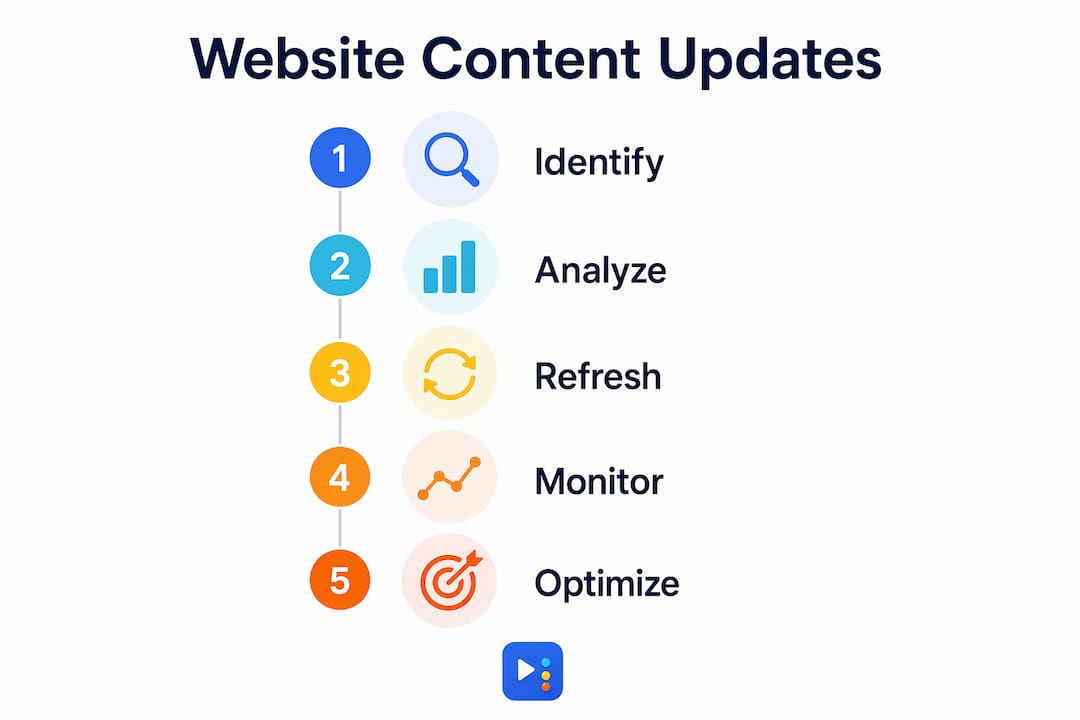
A repeatable refresh workflow produces better results than sporadic updates. The six-stage process below applies to any business, from a single-location nail salon to a multi-service home services company.
- Audit. Pull performance data from Google Search Console and Google Analytics. Flag pages with declining impressions, falling CTR, or bounce rate spikes. These are your update targets.
- Prioritize. Rank flagged pages by traffic volume and conversion value. Work from highest impact to lowest. Skip pages that are already performing well.
- Update. Revise outdated statistics, replace obsolete examples, add new sections that address current search intent, and fix broken links. Substantive changes only.
- Link. Add or refresh internal links on updated pages. Connecting updated content to related pages spreads authority and improves crawl efficiency. Following local content best practices includes keeping these connections current.
- Signal. Update the page's metadata, including the title tag, meta description, and schema markup, to reflect the new content. A refreshed publish date combined with updated metadata dramatically improves CTR and rankings.
- Measure. Track ranking changes, CTR, and engagement metrics for 4–6 weeks after each update. Use that data to refine your next audit cycle.
This workflow mirrors what property managers do with physical assets. Just as scheduled maintenance boosts property value by preventing costly deterioration, scheduled content maintenance prevents ranking decay before it becomes expensive to reverse.
Pro Tip: Use a simple spreadsheet to track every page you update: the date, what changed, and the pre-update metrics. After 90 days, you will have clear evidence of what types of updates produce the biggest ranking gains for your specific site.
A website maintenance checklist built around this workflow keeps the process consistent without requiring you to reinvent it each month. Consistency is the variable that separates sites that compound their SEO gains from those that plateau.
Key Takeaways
Regular content updates are the most reliable way to maintain search visibility, earn AI citations, and protect your site from security and credibility risks.
| Point | Details |
|---|---|
| Freshness drives AI citations | Content updated within 30 days earns 3.2x more AI citations than older pages. |
| Semantic drift is a hidden threat | Outdated language and examples cause citation loss even when facts remain accurate. |
| Neglect has a measurable cost | Security breaches from unmaintained plugins cost $500–$3,000 to fix per incident. |
| Prioritize by performance data | Focus refresh efforts on the top 10–20% of pages showing traffic or CTR declines. |
| A six-stage workflow compounds gains | Audit, prioritize, update, link, signal, and measure to build lasting SEO momentum. |
Content updates are not optional: what I've learned from years in local SEO
The businesses I see struggle most with content freshness are not the ones who ignore their websites entirely. They are the ones who updated everything once, saw results, and then stopped. They treat a content refresh as a project with a finish line rather than a recurring discipline.
The data on content refresh frequency and prioritization confirms what I have observed directly: diminishing returns hit fast when you update indiscriminately, but compounding gains build steadily when you update strategically. The difference is working from performance data, not gut instinct.
One pattern I see constantly is business owners who update their blog but ignore their service pages. Service pages carry the highest conversion value on most sites. A blog post that ranks well but links to a service page with a 2021 price list is a broken funnel. Both pieces need to stay current.
My honest recommendation is to block two hours per month for a content audit. Not a full rewrite. Just a review of your top 20 pages using Search Console data. Fix what is slipping. Leave what is working. That two-hour habit, done consistently, outperforms any single large-scale content project I have ever seen.
— Tran
How Yourlocalseo helps you stay ahead with fresh content
Keeping your website content current is a real commitment, and most small business owners in Pflugerville, Austin, and the surrounding Central Texas area are already running full schedules. Yourlocalseo builds managed content and maintenance systems that handle the heavy lifting for you.

Our team covers on-page SEO updates, metadata refreshes, security and plugin maintenance, and content audits built around your actual performance data. Every update we make is tied to a measurable goal, whether that is recovering a ranking, improving CTR, or closing a security gap. If you are ready to stop losing ground to competitors with fresher sites, explore our local SEO services and see how we build systems that keep your site working for you month after month.
FAQ
Why does updating website content improve Google rankings?
Google rewards pages that demonstrate consistent relevance through fresh content, updated metadata, and strong engagement signals. Pages refreshed with substantive changes are crawled more frequently and indexed faster.
How often should I update my website content?
High-traffic and high-conversion pages benefit from a review every 30–60 days. Evergreen guides need attention every 3–6 months. Performance data from Google Search Console is the most reliable guide for setting your specific schedule.
What counts as a substantive content update?
A substantive update includes replacing outdated statistics, adding new sections that address current search intent, fixing broken links, and revising examples or terminology. Changing only the publish date without editing the content does not qualify.
Does updating content help with AI search tools like ChatGPT and Perplexity?
Yes. AI tools evaluate both timestamp freshness and semantic freshness. Pages with current language, recent examples, and updated statistics earn significantly more citations in AI-generated answers than pages with outdated content.
What happens if I never update my website?
Neglected sites face ranking declines, security vulnerabilities from outdated plugins, and credibility loss from stale information. The financial cost of a single security breach typically exceeds the annual cost of a managed maintenance plan.