

Photos in SEO are direct ranking and engagement signals, not decorative elements. Google evaluates images for relevance, freshness, and context, and businesses that use optimized photos consistently outperform those that treat visuals as an afterthought. The technical term for this practice is image SEO optimization, which covers everything from file naming and alt text to structured data and visual search readiness. Understanding why use photos in SEO means understanding that every image you publish is a data point Google, Google Lens, and AI answer engines use to decide how visible your business should be.
How do images influence SEO rankings and engagement?
Images function as relevance signals across multiple ranking dimensions. Google's algorithm reads alt text, descriptive filenames, surrounding page text, and overall site authority together to determine what an image represents and whether it belongs on a given page. Googlebot correlates images contextually with page structure and authority, meaning a photo of your nail salon in Pflugerville placed near a paragraph about gel manicures sends a much stronger topical signal than the same image floating in an unrelated section.
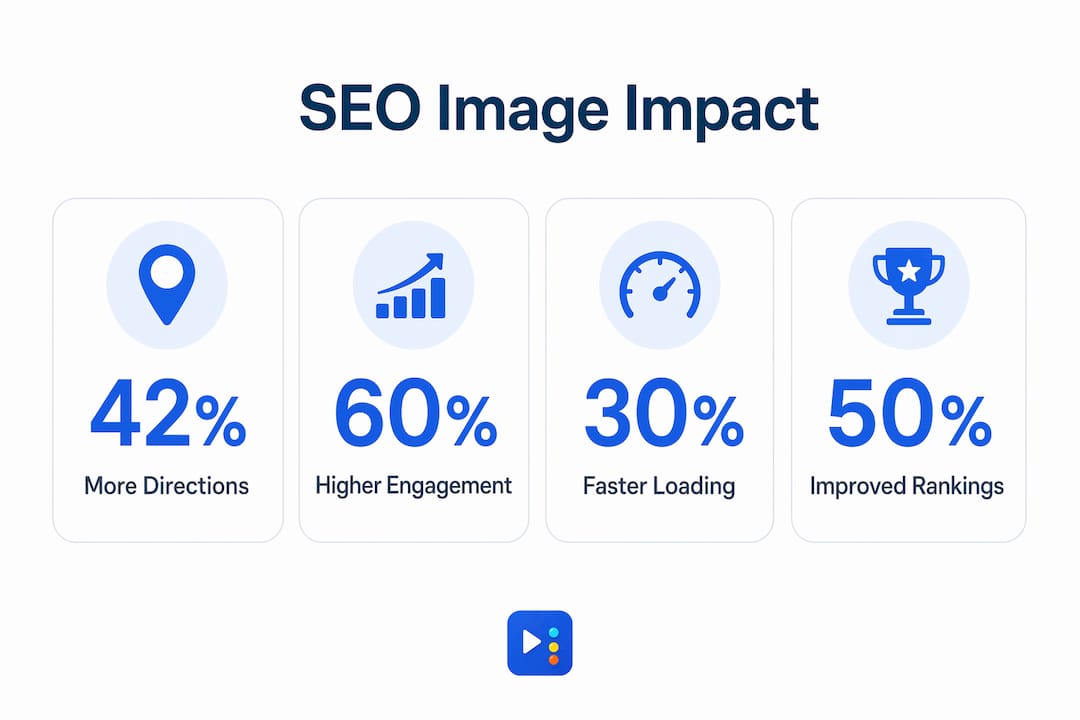
Beyond rankings, photos directly shape user behavior. When someone lands on a page with relevant, high-quality images, they stay longer, scroll further, and click more. Those behavioral signals feed back into Google's ranking model. For local businesses specifically, photos on Google Business Profiles drive measurable action. Businesses with GBP photos receive 42% more direction requests and 35% more website clicks than those without. That gap represents real customers choosing your competitor because their listing looked more credible and complete.

Visual search adds another dimension. Google Lens and similar tools rely on image similarity and entity extraction to surface results, which means a well-photographed product or storefront can appear in visual search results entirely independent of your text-based SEO. This creates a second discovery channel that most small businesses are not using.
Here is what images actually influence in your SEO performance:
- Topical relevance: Images placed near related text reinforce the page's subject matter for Googlebot
- Dwell time: Relevant visuals reduce bounce rates and increase time on page
- Local ranking signals: Photo activity on Google Business Profiles signals listing engagement to Google's local algorithm
- Visual search discovery: Optimized images appear in Google Lens, Google Images, and AI-generated answer panels
- E-E-A-T signals: Original, authentic photos demonstrate real-world experience that stock images cannot replicate
What are the best SEO image optimization practices in 2026?
Modern image SEO requires attention to technical, content, and AI-driven factors simultaneously. The days of writing a quick alt tag and calling it done are over. Here is a numbered checklist of what actually moves the needle:
- Use descriptive filenames. Rename files before uploading. "pflugerville-nail-salon-gel-manicure.webp" tells Google far more than "IMG_4823.jpg." Include your location and service type where natural.
- Write accurate alt text. Alt text is primarily an accessibility tool, but it also helps search engines understand image content. Keep it under 125 characters and describe what is actually in the image.
- Implement ImageObject structured data. Schema.org's ImageObject markup gives AI systems and search engines machine-readable context that alt text alone cannot provide. Include creator, license, and subject fields.
- Place images near relevant text. Semantic proximity matters. Google reads images in relation to surrounding content, so a photo of your team should sit next to your "About Us" paragraph, not buried at the bottom of a contact page.
- Optimize format and compression. WebP and AVIF formats reduce file size without visible quality loss, improving page speed and Core Web Vitals scores. Google uses page speed as a ranking factor, and slow-loading images cost you positions.
- Add visible captions. Captions are read more often than body text. They reinforce the image's context for both users and crawlers.
- Refresh images regularly. Stale photo libraries signal inactivity. On Google Business Profiles especially, consistent new uploads outperform large but static collections.
Pro Tip: Set a recurring calendar reminder every two weeks to upload at least one new photo to your Google Business Profile. This cadence, not volume, is what triggers freshness signals in Google's local ranking algorithm.
How do original photos compare with stock images for SEO?
Original photography and stock images are not equivalent in SEO value. The difference is significant enough to change your ranking outcomes.
| Factor | Original Photos | Stock Images |
|---|---|---|
| Visual uniqueness | High: unique to your business | Low: shared across thousands of sites |
| E-E-A-T contribution | Demonstrates real experience | Provides no proof of experience |
| AI system confidence | Higher: distinctive signals | Lower: may dilute topic relevance |
| Visual search ranking | Strong: unique embeddings | Weak: duplicate embeddings across web |
| User trust | Builds credibility | Can feel generic or impersonal |
Original photos increase brand trust and perform better than stock images, which may dilute topical relevance and lower AI systems' confidence in your content. When Google Lens or an AI answer engine encounters the same stock photo on 500 different websites, it cannot confidently associate that image with your specific business, location, or expertise.
Brands that replace stock photos with authentic images of their team, workspace, and actual work consistently see higher engagement rates and stronger local search performance. A med spa in Round Rock showing real treatment rooms and real staff builds more trust in 30 seconds than a polished stock photo of a woman in a white robe ever could.
Pro Tip: Even smartphone photos of your actual location, team, or completed work outperform professional stock imagery for local SEO purposes. Authenticity beats polish when Google is evaluating topical authority.
Why does image optimization matter for local SEO and Google Business Profiles?
For local businesses, photos on Google Business Profiles are one of the highest-leverage SEO activities available. They are not optional extras. They are active ranking and engagement tools.
Businesses following a consistent two-week upload cadence see 31% higher profile engagement than those who batch-upload photos once and stop. Google's local algorithm treats photo activity as a freshness signal, similar to how it treats new reviews or updated business hours. A listing that shows regular activity looks more relevant and trustworthy than one that has been static for six months.
The types of photos you upload also matter. Here is what works best for local businesses:
- Exterior shots: Help customers recognize your location and confirm they are in the right place
- Interior shots: Set expectations and reduce anxiety for first-time visitors
- Team photos: Build personal connection and reinforce the human element of your business
- Work-in-progress or service photos: Demonstrate expertise and show the quality of your work
- Before-and-after images: Particularly effective for service businesses like salons, contractors, and med spas
Proper file naming and categorization within GBP also improve local relevance. When you upload a photo, select the correct category (interior, exterior, at work, team) so Google can classify it accurately. This small step improves how your listing appears in local map pack results. For a deeper look at how photos fit into your overall GBP strategy, the Google Business Profile optimization guide from Yourlocalseo covers the full picture.
How do AI-powered visual search and structured data change image SEO?
The role of images in SEO has shifted significantly with the rise of AI-generated answer panels and visual search engines. Alt text, once the primary tool for communicating image meaning to search engines, is now a baseline accessibility requirement rather than a primary SEO lever.
Structured data using schema.org ImageObject provides richer machine-readable context for AI systems than alt text alone. When you mark up an image with fields like "name, description, creator, license, and representativeOfPage`, you give AI answer engines the confidence to cite your image in their responses. That citation drives direct traffic and brand visibility in a channel that most businesses have not yet optimized for.
Visual search ranking works through a layered process. Google Lens relies on embedding similarity, entity recognition, OCR text extraction, surrounding content, and schema markup to rank images. Each layer is an opportunity to signal relevance. A restaurant in Georgetown that photographs its menu items with proper schema markup, descriptive filenames, and contextual page placement has a real advantage over a competitor whose photos are unnamed JPEGs with no structured data.
Images with comprehensive ImageObject metadata, including creator and license fields, are more likely to be cited by AI answer engines. This matters because AI citations in tools like Perplexity, ChatGPT, and Google's AI Overviews drive qualified traffic from users who are already in research or buying mode.
Pro Tip: Add "representativeOfPage": true to the ImageObject schema on your most important page images. This signals to AI systems that the image is central to the page's meaning, increasing the likelihood of citation in AI-generated answers.
For local businesses managing multiple landing pages, pairing strong image SEO with local landing page strategy compounds the ranking benefit across every service area you target.
Key takeaways
Photos in SEO work because they simultaneously improve relevance signals, user engagement, local ranking activity, and AI citation potential across every major search channel.
| Point | Details |
|---|---|
| Photos drive local actions | GBP listings with photos get 42% more direction requests and 35% more website clicks. |
| Consistency beats volume | Uploading photos every two weeks generates stronger freshness signals than one-time batch uploads. |
| Structured data outperforms alt text | ImageObject schema gives AI systems the context needed to cite your images in answer panels. |
| Original photos build E-E-A-T | Authentic images signal real experience; stock photos dilute topical relevance for both users and AI. |
| Image placement matters | Photos near semantically related text reinforce topical authority signals for Googlebot. |
What I've learned about photos and SEO after working with local businesses
Most small business owners I work with treat photos as a one-time task. They upload a dozen images when they set up their Google Business Profile, and then they never touch it again. That single habit is costing them rankings every month.
The data is clear: consistent photo uploads are the single highest-impact change for GBP photo strategy. But beyond the data, I have seen this play out with real clients. A nail salon in Pflugerville that started uploading two photos per week, just phone shots of finished sets and the front desk, saw measurable improvement in profile views within 60 days. No new reviews, no website changes. Just photos.
What I find most underestimated is the structured data piece. Most businesses, and honestly most SEO practitioners, are still treating image optimization as a file-naming and alt-text exercise. That was sufficient in 2020. In 2026, AI answer engines are pulling citations from pages with ImageObject schema, and businesses without it are invisible in that channel. It is not complicated to implement, but it requires someone who knows what they are doing.
My honest advice: stop worrying about having perfect professional photos and start worrying about having consistent, authentic, well-labeled photos. A real photo of your team in your actual space, uploaded regularly, with a descriptive filename and proper schema markup, will outperform a polished stock library every time. Authenticity is the signal. Everything else is amplification.
— Tran
How Yourlocalseo helps you get more from every photo
If you are a small business in Pflugerville, Austin, Round Rock, or anywhere in Central Texas, Yourlocalseo builds image SEO into every local strategy we manage. We handle GBP photo optimization, structured data implementation, and the consistent upload cadence that keeps your listing active and ranking.

We also optimize your website images for Core Web Vitals, write accurate alt text, and implement ImageObject schema so your photos show up in AI answer panels and Google Lens results. Every service we offer is built around driving real leads, not vanity metrics. If you are ready to put your photos to work, explore our local SEO services and see exactly how we help businesses like yours get found.
FAQ
Why do photos matter for Google rankings?
Photos provide relevance, freshness, and engagement signals that Google uses as ranking inputs. Businesses with optimized images on their Google Business Profiles receive significantly more direction requests and website clicks than those without.
What is the best image format for SEO in 2026?
WebP and AVIF are the recommended formats because they reduce file size without quality loss, improving page speed and Core Web Vitals scores, both of which influence Google rankings.
How often should I add photos to my Google Business Profile?
Upload new photos on a consistent two-week cadence rather than in large batches. Businesses that follow this schedule see 31% higher profile engagement than batch uploaders, according to Flento's research.
Is alt text still important for image SEO?
Alt text remains important for accessibility and provides a baseline signal for search engines, but structured data using schema.org ImageObject now delivers far more context to AI systems and visual search engines.
Do stock photos hurt my SEO?
Stock photos do not directly penalize your site, but they dilute topical relevance and reduce AI systems' confidence in your content. Original photos of your actual business, team, and work consistently outperform stock imagery for both user trust and search visibility.