

Blogs are the most cost-effective lead generation tool available to local businesses today. The role of blogs for local business goes far beyond publishing tips online. A well-executed blog builds geo-topical authority, feeds Google's local ranking signals, and turns search traffic into paying customers. Businesses with active blogs generate 67% more leads per month than those without. That number reflects a structural advantage, not a content trend. Tools like Google AI and platforms like ChatGPT now pull answers directly from blog content, making your posts a front-line asset in local search.
What is the role of blogs for local business?
Blogging, known in content marketing as owned media, gives local businesses a permanent, searchable record of their expertise. Unlike paid ads that disappear when the budget runs out, a blog post keeps working. The 748% ROI over three years that active blogging programs produce reflects this compounding effect. Every post you publish adds to a growing library that attracts traffic, builds trust, and signals authority to Google.
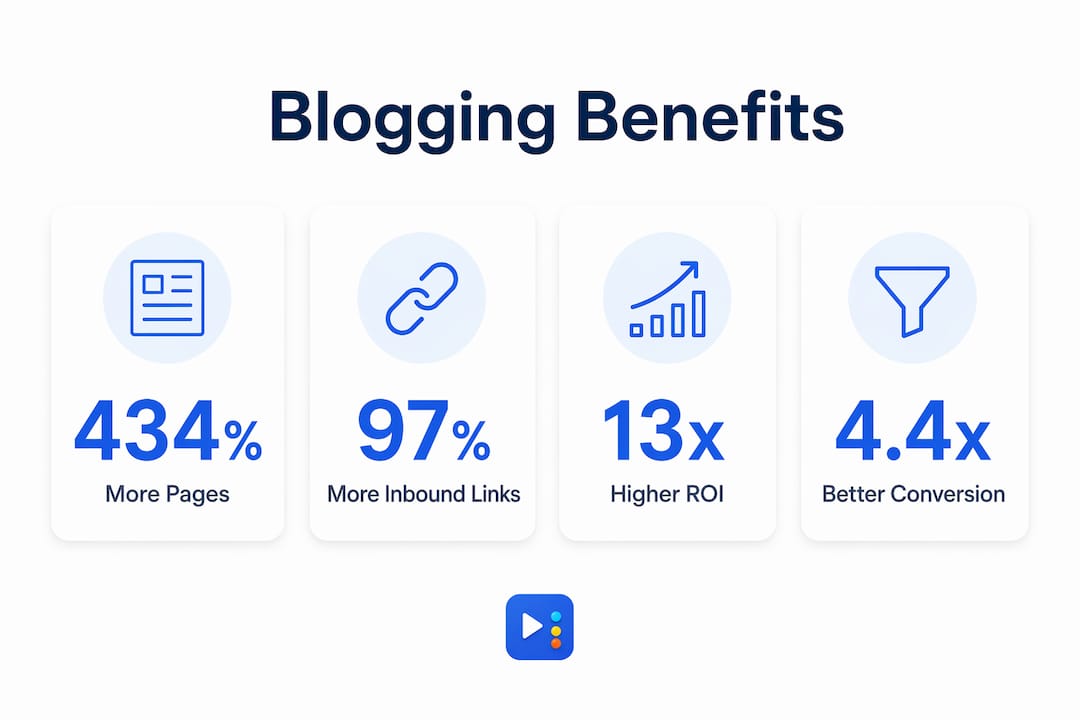
The impact on local SEO is direct and measurable. Active blogs produce 434% more indexed pages and 97% more inbound links than non-blogging competitors. More indexed pages mean more entry points for local customers to find you. More inbound links mean higher domain authority, which lifts your entire website in local search rankings.

Blogs also serve as a content factory. A single post can become a social media caption, an email newsletter, a Google Business Profile update, and a script for a short video. That multiplier effect makes blog content one of the highest-leverage investments in any local business marketing strategy.
How do blogs compare to reviews, social media, and paid ads?
Each marketing channel serves a different purpose. Understanding where blogging fits helps you allocate your time and budget correctly.
| Channel | Strength | Weakness |
|---|---|---|
| Blog posts | Long-term SEO, lead generation, authority | Slow to produce results (6–12 months) |
| Google Business Profile reviews | Immediate trust, local map pack rankings | Cannot be fully controlled |
| Social media | Fast reach, community engagement | Short content lifespan |
| Paid ads (Google, Meta) | Immediate leads | Stops working when budget ends |
Paid ads yield immediate results but carry no residual value. Social media posts have a lifespan measured in hours. Reviews build trust but depend on customer action. Blogs are the only channel where your investment compounds over time.
Traffic from AI-powered search engines converts at 4.4 times higher rates than traditional organic search. That conversion premium exists because AI engines pull from authoritative, well-structured content. A blog post that answers a specific local question is exactly what those engines surface.
Marketers who blog regularly are up to 13x more likely to see positive ROI than those who do not. That gap widens over time as blog archives grow and inbound links accumulate.
How does geo-topical authority boost your local search rankings?
Geo-topical authority is the measure of how relevant and credible Google considers your website for location-specific topics. A plumber in Austin who publishes posts about "water heater repair in Round Rock" and "pipe freezing risks in Cedar Park" signals to Google that they serve those specific communities. That signal directly influences local Map Pack rankings within 6–12 months of consistent publishing.
46% of all Google searches carry local intent. That means nearly half of every search happening right now includes a geographic modifier or implies a nearby result. Businesses that publish hyper-local content capture a disproportionate share of that traffic.
Effective geo-topical blog topics for local businesses include:
- Neighborhood-specific service guides ("Best HVAC Maintenance Tips for Georgetown Homeowners")
- Local event coverage tied to your industry ("How Pflugerville's Growth Is Affecting Home Insurance Rates")
- City-focused comparison posts ("Comparing Nail Salons in Round Rock: What to Look For")
- Seasonal content tied to your location ("Austin Summer Skincare: What Med Spa Clients Need to Know")
- FAQ posts answering questions your local customers actually ask
Pro Tip: Use Google Search Console to identify which geographic queries already send traffic to your site. Build your next three blog posts around those exact locations and service combinations.
Pairing your blog strategy with Google Maps optimization amplifies both channels. A strong blog builds topical authority while a well-optimized Maps listing captures the customer at the moment of decision.
What are best practices for blog content that converts local customers?
Writing for local search intent means answering the exact questions your customers type into Google before they call you. Start every post with the question as the title, answer it in the first paragraph, and then expand with detail. This structure satisfies both human readers and AI engines like Google AI and ChatGPT, which scan for direct answers.
Follow these steps to build a blog post that drives real leads:
- Target a specific local keyword. Use phrases like "emergency electrician in Manor TX" rather than generic terms like "electrician tips."
- Answer the question in the first 100 words. AI engines and featured snippets reward posts that lead with the answer.
- Embed a Google Map of your service area. This reinforces your geographic relevance to both users and search engines.
- Add a click-to-call button above the fold. Mobile users searching locally are ready to act. Remove every barrier between them and your phone number.
- Include a post-specific offer. A unique coupon code or "show this page" deal lets you track exactly how many customers came from that post.
- Link to related service pages. Internal links pass authority to your money pages and keep readers on your site longer.
- Optimize for AI search. Use clear headings, short paragraphs, and direct answers. AI engines favor well-structured blog content that mirrors how people ask questions.
Pro Tip: Publish at least one blog post per month targeting a different neighborhood or city you serve. Over 12 months, you build a geographic content map that covers your entire service area.
Consistency matters more than volume. One well-researched post per month outperforms four thin posts. Google rewards depth, specificity, and relevance over frequency alone.
Is blogging the right strategy for your local business?
Blogging is not the right first move for every local business. The answer depends on your service complexity, your customer's decision process, and your current marketing foundation.
Businesses that benefit most from blogging:
- Law firms and attorneys where clients research extensively before hiring
- Real estate agents who need to demonstrate local market knowledge
- Med spas and cosmetic practices where trust and education drive bookings
- Financial planners and accountants whose services require explanation
- Home service contractors (HVAC, plumbing, roofing) with seasonal demand cycles
Businesses where other channels often deliver faster results:
- Food trucks and quick-service restaurants where social media and Google reviews drive foot traffic
- Bakeries and retail shops where Instagram and Google Business Profile photos convert faster
- Event-based businesses where paid ads and local listings outperform content
Small businesses with immediate service needs see faster returns from Google reviews and social media. Blogs excel when your customer needs education before they buy. A nail salon in Pflugerville gets more value from a strong Google Business Profile than from a blog, at least in the first year.
Most businesses hit a 9-month break-even point before blogs generate meaningful leads. Plan for that timeline. If you need leads in 30 days, start with paid ads. If you want leads in 12 months that cost nothing to maintain, start your blog now.
How do you measure revenue from your local business blog?
Standard web analytics tools like Google Analytics track page views and sessions. They do not capture the customer who read your blog on their phone, walked into your shop, and paid cash. That attribution gap causes most local business owners to undervalue their blog's actual impact.
Practical methods to track offline conversions from blog posts:
- Unique coupon codes per post. "Use code BLOG10 for 10% off" tells you exactly which post drove the visit.
- "Show this page" offers. Ask customers to show the post on their phone at checkout for a discount or free add-on.
- Dedicated phone numbers. Call tracking services like CallRail assign a unique number to each blog post so you can count inbound calls by source.
- Ask at point of sale. Train your front desk or service staff to ask "How did you hear about us?" and log blog as an option.
Embedding offline conversion signals directly into posts addresses the core limitation of web analytics for brick-and-mortar businesses. Without these signals, you are measuring only a fraction of your blog's real contribution.
For monthly reporting, track these four metrics: organic sessions from local keywords, click-to-call events, coupon redemptions, and new customer source attribution. Those four data points give you a clear picture of blog ROI that you can present to any stakeholder.
Key takeaways
Blogs are a long-term lead generation asset that builds local authority, improves search rankings, and converts traffic into customers when paired with offline tracking and consistent publishing.
| Point | Details |
|---|---|
| Blogs outperform paid ads long-term | Active blogs generate 67% more leads monthly and deliver 748% ROI over three years. |
| Geo-topical authority drives map rankings | Publishing neighborhood-focused posts builds local search authority within 6–12 months. |
| AI search rewards structured blog content | Traffic from AI-powered search converts at 4.4x higher rates than traditional organic traffic. |
| Offline attribution requires embedded signals | Use unique coupon codes, call tracking, and "show this page" offers to measure real revenue. |
| Blogging suits complex service businesses most | Law, real estate, and medical practices see the strongest blog ROI due to longer buyer research cycles. |
Why most local blogs fail before they ever get a chance
I have worked with dozens of local businesses across Pflugerville, Austin, and Round Rock, and the pattern is almost always the same. A business owner publishes three or four posts, sees no immediate spike in traffic, and stops. They conclude that blogging does not work. What they actually experienced was the normal timeline for a channel that requires patience.
The 9-month break-even horizon is not a flaw in the strategy. It is the price of building something that lasts. Paid ads stop the moment you stop paying. A blog post you wrote in February 2025 can still be sending you leads in February 2027. That compounding value is what makes blogging worth the early investment.
The other mistake I see constantly is writing for everyone instead of writing for someone specific. A post titled "Tips for Homeowners" competes with millions of results. A post titled "What Georgetown TX Homeowners Should Know Before Replacing Their HVAC" competes with almost nothing. Specificity is the entire game in local content.
Blogs also work best when they are not isolated. The businesses I have seen get the most from their content are the ones who use each post across email, Google Business Profile updates, and social media. A single well-written post can generate touchpoints across five channels. That is the real multiplier. Check out our small business lead generation guide for a broader look at how blogging fits into a full local marketing strategy.
— Tran
Let Yourlocalseo turn your blog into a lead machine
If you are ready to put your blog to work for real local visibility, Yourlocalseo builds content strategies designed specifically for businesses in Pflugerville, Austin, Round Rock, Georgetown, and surrounding Central Texas communities. We handle keyword research, on-page SEO, Google Business Profile integration, and local content planning so every post you publish moves the needle.

We do not write generic content. Every blog strategy we build is tied to your specific service area, your target customers, and the local keywords your competitors are not targeting yet. From local SEO services to full content programs, we connect your blog directly to measurable lead generation. Contact Yourlocalseo today and let us show you exactly what a focused local content strategy can do for your business.
FAQ
How many blog posts does a local business need per month?
One well-researched, location-specific post per month is enough to build geo-topical authority over time. Consistency and quality outperform volume for local search rankings.
How long before a local business blog generates leads?
Most businesses reach a break-even point around 9 months after starting a consistent blogging program. Plan for a 6–12 month timeline before seeing meaningful organic lead volume.
Do blogs help with google map pack rankings?
Yes. Publishing hyper-local content that targets specific neighborhoods and cities signals geographic relevance to Google, which supports local Map Pack rankings within 6–12 months.
What should a local business blog write about?
Write about neighborhood-specific service topics, seasonal issues relevant to your area, and answers to the questions your customers ask most often. City-focused posts and local event coverage also build strong geo-topical signals.
Can a blog replace paid ads for a local business?
A blog cannot replace paid ads in the short term. Paid ads deliver immediate leads while blogs build long-term authority. The strongest local marketing strategies use both channels together, with blogs reducing paid ad dependency over time.