
If you run a nail salon in Pflugerville and a second location in Round Rock, you already know the confusion: one business, two addresses, and a Google presence that feels impossible to manage. Multi-location SEO is the practice of optimizing each physical business location individually so it shows up in local search results for the people nearest to it. Most small business owners skip this and pay for it with invisible locations, lost foot traffic, and phone calls that never come. This guide breaks down exactly what multi-location SEO is, why it works, and how to do it right across Central Texas.
Table of Contents
- Understanding the basics of multi-location SEO
- Core components of a successful multi-location SEO strategy
- Technical best practices and governance for multi-location SEO at scale
- Measuring success and scaling your multi-location SEO efforts
- Why multi-location SEO is local customer service at scale
- How YourLocalSEO helps Central Texas small businesses with multi-location SEO
- Frequently asked questions
Key Takeaways
| Point | Details |
|---|---|
| One profile per location | Each physical business location requires its own Google Business Profile with unique, verified details. |
| Location-specific pages | Create fully developed, unique landing pages for each location with local content and proper SEO markup. |
| NAP consistency | Keep your business name, address, and phone number identical across all listings and directories for better rankings. |
| Governance is key | Use a centralized control system with delegated permissions to manage multi-location SEO efficiently and consistently. |
| Continuous optimization | Regularly track and update SEO efforts per location to maintain and improve search visibility over time. |
Understanding the basics of multi-location SEO
Multi-location SEO means treating every physical location you own as its own separate online entity. Not a copy of your main business listing. Not a footnote. A fully developed, independently optimized presence that competes for local customers in its own market.
Think about how a customer searches. Someone in Cedar Park types "med spa near me" on a Tuesday afternoon. Google is not going to show them your Pflugerville location if you have not told Google that you exist in Cedar Park. That is the core problem multi-location SEO solves.
As Search Engine Land notes, multi-location SEO is "customer service" at scale: improving the experience for prospective customers on and off the web increases reputation, rankings, and revenue. That framing matters because it shifts how you think about the work. You are not just filling out forms. You are making it easier for the right customer to find the right location at the right moment.
Here is why this is so different from single-location SEO:
- A single Google Business Profile cannot represent multiple addresses. Google requires one profile per location.
- Search algorithms evaluate relevance at the local level. A listing in Georgetown will not rank in Austin unless that location is independently optimized.
- Customer reviews, photos, and hours need to be specific to each location. Generic content hurts your credibility.
- Local competitors are optimizing per location. If you are not, you are starting at a disadvantage.
The good news: you do not have to reinvent your brand for every location. You build a consistent foundation using homepage SEO strategies and then layer in location-specific content on top.
Core components of a successful multi-location SEO strategy
Now that we understand why multi-location SEO matters, let us explore the core elements you need to get right.
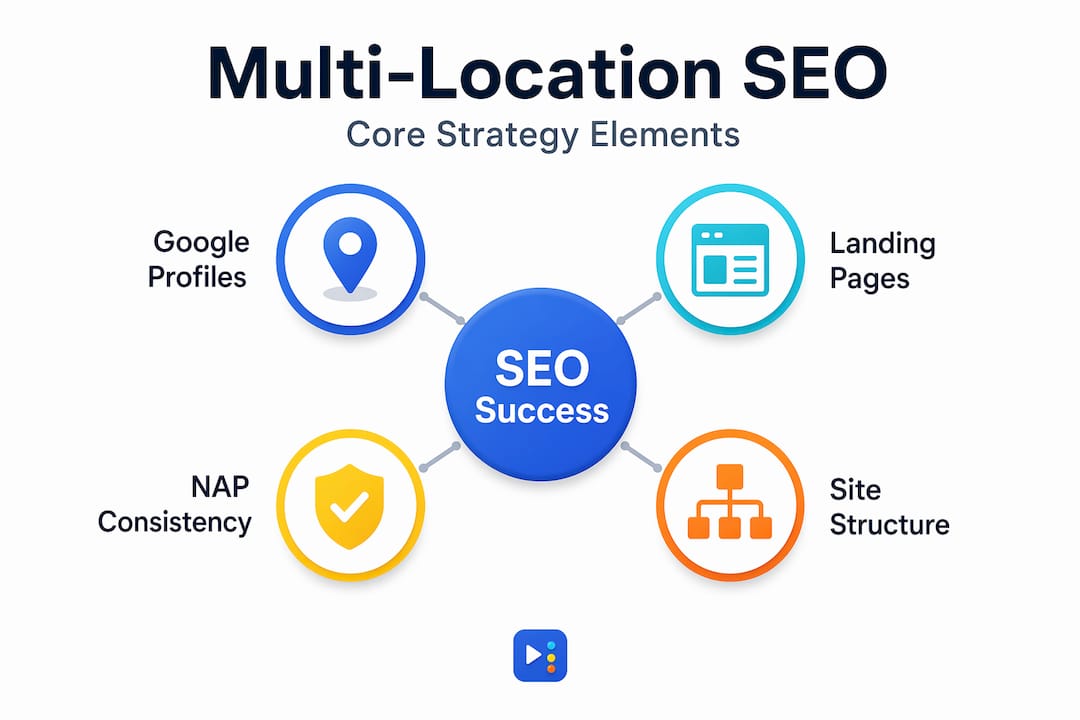
1. A dedicated Google Business Profile for every location
Each physical location must have its own Google Business Profile with unique verification and listing details like hours, photos, and reviews. This is non-negotiable. A single profile with two addresses confuses Google and your customers. Verify each profile separately and keep the information current. For guidance on getting this right, our post on optimizing Google Business Profiles covers the full process.
2. Location-specific landing pages
Each location needs its own page on your website. Not a copy-paste with the city name swapped out. A real page with unique content about that location, staff, services, local landmarks, and customer reviews. Multi-location SEO uses location-specific landing pages, LocalBusiness schema, canonical tags, and a hub-and-spoke website structure to help Google understand each location. Schema markup is the technical code that tells search engines exactly what type of business you are and where you are located.

3. Hub-and-spoke website architecture
Your main website is the hub. Each location page is a spoke. This structure improves how Google crawls your site and makes it easy for customers to find the right location. A visitor landing on your homepage should reach any location page in two clicks or less.
4. Consistent NAP data
NAP stands for Name, Address, and Phone number. Inconsistent NAP data across your website and citation sources is critical to fix. Inconsistency harms local visibility because Google loses confidence in which information is correct.
Here is a quick comparison of what well-managed versus poorly managed multi-location SEO looks like:
| Factor | Well-managed | Poorly managed |
|---|---|---|
| Google Business Profile | One verified profile per location | Single profile for all locations |
| Location landing pages | Unique content, schema markup | Duplicate content, no schema |
| NAP consistency | Identical across all directories | Varies by platform |
| Reviews | Location-specific and actively managed | Mixed together or ignored |
| Citations | Audited and corrected on tier-1 sites | Outdated or missing |
Pro Tip: Run a citation audit before you build anything new. Tools like BrightLocal or Whitespark will show you where your business information is wrong or missing across the web. Fixing bad data first means your new work builds on a clean foundation.
You can use our local SEO checklist to work through these components systematically, and our practical SEO tips post covers how to prioritize each task when you are short on time.
Technical best practices and governance for multi-location SEO at scale
Understanding what to do is critical, but managing technical details and scale ensures long-term success.
Most small business owners stop at Google Business Profiles and landing pages. That is a good start. But if you want to scale to three, five, or ten locations, you need a governance model and technical foundation that can grow with you.
Governance: who owns what
Governance models balance central brand control with delegated location managers to maintain consistency and enable ongoing updates. In practice, this means deciding who has permission to update each Google Business Profile, who approves new photos, and who handles review responses at each location. Without clear ownership, listings go stale and inconsistencies creep in.
For a small business, even a simple spreadsheet that tracks who is responsible for each location's online presence is better than nothing.
Dedicated sitemaps for location pages
Dedicated sitemaps for location pages help Google discover and monitor each location's indexing status effectively. This is especially important when you add new locations. A sitemap tells Google "here are all my pages, please index them." Without it, new location pages can sit unindexed for weeks.
Technical cleanup tasks to prioritize:
- Add self-referencing canonical tags to each location page to prevent duplicate content issues
- Implement LocalBusiness structured data (schema) on every location page
- Build internal links between your hub page and each location spoke
- Check that each location page loads quickly on mobile. Most local searches happen on phones.
- Monitor crawl errors in Google Search Console per location
We also recommend setting up a local SEO workflow that covers these tasks on a monthly schedule so nothing slips.
Pro Tip: Create a simple internal checklist for launching any new location. Include GBP setup, landing page publication, schema markup, sitemap submission, and citation building. Launching with all boxes checked saves weeks of cleanup later.
Measuring success and scaling your multi-location SEO efforts
With a solid foundation and technical governance, you now need to measure and scale your efforts effectively.
The biggest mistake we see Central Texas business owners make is treating all their locations as one bucket of data. If your Round Rock location is thriving but your Georgetown location is flat, you will never know unless you segment the numbers.
Key performance indicators to track per location:
- Search ranking position for location-specific keywords (for example, "nail salon Georgetown TX")
- Google Business Profile actions: calls, direction requests, and website clicks
- Organic website traffic to each location's landing page
- New reviews per month per location
- Conversion rate from location page visits to contact or booking
How to scale your efforts as you grow:
- Use Google Business Profile's bulk management tools once you have more than ten locations.
- Build landing page templates your team can populate quickly without sacrificing uniqueness.
- Automate citation updates through a listing management platform when you change hours or add services.
- Create a review generation process for each location, including follow-up messages after visits.
- Set a monthly reporting cadence to review KPIs per location and catch problems early.
Tracking performance at the location and market level is essential for continuous improvement, especially when scaling to dozens or hundreds of locations.
Pro Tip: Google Search Console lets you filter performance by URL. Set up a folder structure like yourwebsite.com/locations/ so you can quickly compare traffic across all location pages in one report.
Why multi-location SEO is local customer service at scale
Here is where most guides stop: the checklist. Do this, then this, then that. But we want to offer a different way of thinking about it.
Adam Heitzman describes multi-location SEO as "customer service at scale," and that framing has stuck with us. When a customer in Manor searches for a restaurant and finds your location listed with accurate hours, real photos, and 47 recent reviews, they are not thinking about SEO. They are thinking: "This place looks trustworthy." Your online presence did the work your front-of-house team would have done in person.
The businesses we see winning in local search across Pflugerville, Austin, and Round Rock are not just technically optimized. They are locally relevant. Their location pages mention the neighborhoods they serve. Their Google Business Profile photos show the actual interior, not stock images. Their review responses are personal and specific.
Here is the uncomfortable truth: many multi-location businesses treat their second or third location as an afterthought online. The first location gets the attention, the good photos, the active profile. The newer locations get a half-finished landing page and a GBP that was set up once and never touched again. Customers notice. Google notices too.
The businesses that treat every location with the same care they would give a flagship store are the ones that show up in the local map pack consistently. Central control of brand standards combined with local nuance in content and community engagement is the combination that actually drives results. For more on building that foundation, our practical SEO tips post gives you a solid starting point.
How YourLocalSEO helps Central Texas small businesses with multi-location SEO
Running multi-location SEO on top of running your actual business is a real challenge. Most business owners we talk to in Pflugerville, Georgetown, Cedar Park, and Round Rock know they need it but do not have the time or technical background to execute it consistently.

That is where we come in. At ourLocalSEO, we build tailored local SEO services for Central Texas small businesses at every stage of growth, from two-location startups to multi-city service providers. We handle Google Business Profile setup and optimization, citation audits, custom location page development, and the technical SEO work that keeps everything running clean. Our local SEO guide is a free resource if you want to start learning on your own, and if you need a website built to support multiple locations from the ground up, our website design services are built for exactly that. Reach out for a free consultation and we will audit your current presence and show you exactly where your locations stand.
Frequently asked questions
What is multi-location SEO and why is it important for small businesses?
Multi-location SEO is the practice of optimizing each physical business location separately online to improve local search visibility and attract nearby customers. It is essential for small businesses serving multiple areas because it improves reputation, rankings, and revenue by serving local customers effectively at each location.
Do I need a separate Google Business Profile for each location?
Yes, each physical location requires its own verified Google Business Profile with distinct listing details to rank well in local search. Each profile must be verified and have unique hours, photos, and reviews tied to that specific address.
How important is consistent NAP data across my listings?
Consistent Name, Address, and Phone information is critical across all web listings. Inconsistent NAP suppresses local visibility across locations and directly harms your search rankings.
What ongoing tasks are involved in managing multi-location SEO?
Ongoing tasks include tracking search performance per location, updating Google Business Profiles, managing citations, generating reviews, and maintaining your website's technical health. Continuous management and monitoring across all locations is necessary for long-term success, not just an initial setup.